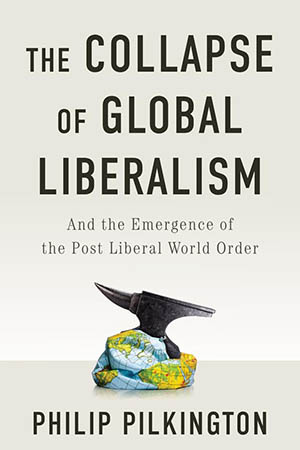
We all want to know comes next, because we sense that it will be very different from what came before. This is a book not so much about our uncertain future, but about why a massive change is inevitable. The author, Philip Pilkington, aims to shake the reader from his slumber, and make him realize that liberalism—“Enlightenment” liberalism, the Left, whatever name you choose—is not only dying, but is already dead. Nor will it reanimate; as always in history, what once seemed forever will, soon enough, be thought of only in the past tense. Our mandate is therefore to cast off the burdensome corpse of liberalism and begin to mold the future, erasing the errors of the past.
This is not a book about post-liberalism, therefore, even though it, accurately enough, treats post-liberalism as inevitable. No doubt this is wise; there have been no good books on the specifics of post-liberalism, probably because, as Yogi Berra supposedly said, “predictions are hard, especially about the future.” Attempts such as Patrick Deneen’s mediocre Regime Change fail either because they pull their punches, afraid of offending those now in power who dictate for their own benefit the limits of acceptable discourse, or because they descend into lurid fantasies, which are mere fiction masquerading as analysis. The only concrete prediction that Pilkington makes is the same one I always make—whatever a post-liberal society looks like, it will be based in reality, rather than in the delusional thinking that has characterized the rulers of the West for more than a century.
You Should Subscribe. It’s Free!
You can subscribe to writings published in The Worthy House. In these days of massive censorship, this is wise, even if you normally consume The Worthy House on some other platform.
If you subscribe will get a notification of all new writings by email. You will get no spam, of course. And we do not and will not solicit you; we neither need nor accept money.
Naturally, to talk about the death of liberalism, you first must precisely define it. This is somewhat of a challenge, because as liberalism’s failings have become ever more evident, those in thrall to the ideology adopt more and more slippery definitions, thereby attempting to evade responsibility for their insanities that have visibly led to catastrophe. They retreat into ever higher levels of abstraction, declaiming that liberalism is merely, for example, the rule of law, freedom of association, freedom of economic action, and personal liberty vis-à-vis the state, ignoring that all those aspirations long pre-date liberalism and are anyway, in practice, almost wholly antithetical to twenty-first-century liberalism, as it becomes completely totalitarian in an effort to maintain power, throwing overboard every principle that supposedly characterizes liberalism. This dishonesty is on full display in the (ugh) Wikipedia definition of liberalism, and is similarly unfortunately present in the new Grokipedia’s definition of liberalism, if you want to suffer through reading them.
Pilkington is having none of this, fortunately. He instead pithily and, I think largely accurately, defines liberalism as that political philosophy which has as its overriding goal the total elimination of all hierarchical relationships in a society. Liberals like to trace their origins to John Locke, who is not much associated with attacks on hierarchy in the popular mind. But as Pilkington notes, of Locke’s Two Treatises, it is often forgotten that while the second is an exposition of “contract theory, property rights, and representative government,” the first was an extended attack on Robert Filmer, author of Patriarcha, or the Natural Power of Kings, an excoriation of the leveling demands of Oliver Cromwell and the Parliamentarians in the Wars of the Three Kingdoms. That is, the original liberal’s prime concern was destroying hierarchy, and nothing has changed in four hundred years.
Liberalism views hierarchy as arbitrary and irrational, the root of all society’s ills, and in its own self-conception, believes that it is going about rationalizing the world by removing this unpleasant obstacle to the happiness of mankind. And the chief aim of liberalism, therefore, is to expand the dominance of liberalism, both within a society and in societies which are not yet wholly liberal. In its nature liberalism, based on false a priori conceptions of reality, contains no limiting factor, because some supposed irrationality can always be detected in any human institution. It is helpful to such an ideology, however, to have a yardstick, and the prime one used by the Left is perceived progress, both towards the destruction of hierarchy, as well as towards economic growth, meaning maximizing output and consumption through measurable efficiency, always driven by attempted rationalization while ignoring the actual net effects on society.
In the early years of liberalism, when as with all ideologies utopia was foreseen as possible and the costs were not only ignored, but cast as benefits, it was Locke, not Filmer, who won the day. To be sure, Cromwell’s liberal tendencies were extremely mild compared to those which proceeded to take hold in England and the West, but he cut with an axe, literally, at the primacy of hierarchy. Soon enough, the French Revolution took liberalism to its next logical stopping place, and after some retrenchment, it proceeded to the slower but more systematic destruction of all traditional hierarchy in Europe. Karl Marx and Communism were merely a further extension of this process, an attempt to destroy “the hierarchical relations established by liberal capitalism between the worker and the capitalist.” In the twentieth century liberalism’s pernicious program was expanded “to questions of a more personal nature,” by thoroughly destroying hierarchical relations in religion, the family, the sexes, and within the individual himself.
Liberalism has had a good run, to be sure, in part because the fruits of the pre-Enlightenment Scientific Revolution, combined with the high-achieving culture of Christendom, emerged when liberalism was spreading throughout the West. The fly in the ointment for liberalism, however, is that reality has a disconcerting way of reasserting itself and falsifying ideologies. Liberalism is unnatural and exists in defiance of human nature and all of human history, which always reverts to the mean. As the demands of liberalism expand, a countervailing force, reality, inevitably emerges from within every society. Thus, while Communism is in theory merely a particularly aggressive branch of liberalism, in practice (what Pilkington calls “Actually Existing Communism”) it apparently paradoxically, but entirely logically, creates societies that are more hierarchical than societies which see themselves as less liberal. Russian Communism, for example, replicated many of the elements of Tsarism, and North Korea has implemented a form of bloodline monarchy.
Contrary to liberal myth, the mirror image of liberalism is not fascism, the boogeyman liberals trot out whenever the cracks in liberalism become too obvious to ignore. It is neither, however, that fascism is a species of liberalism. Rather, fascism is a largely-artificial reaction against liberalism, “the violent reassertion of hierarchy.” Where Communism “quietly retreats to new forms of old hierarchy, the fascist state simply announces its newly fashioned hierarchies and imposes them from the top down.” Neither of these political philosophies are based in reality; fascism is a mere shadow emanation of liberalism. “The liberal history of the twentieth century, in which liberals fought against the dark forces of communism and fascism, is really nothing but an intra-liberal psychodrama.” A truly non-liberal society, which includes almost all societies in human history, is one of natural hierarchies, not new ones pulled from the ether.
All this, of course, parallels my own contentions about the Left, about which I have written many times. In my frame, its prime goals, what makes the Left what it is, are first to tear down all bonds not continuously chosen, that is, to emancipate every individual fully from any obligation, and second to impose total equality upon all members of every society. The elimination of hierarchies achieves both, because any hierarchy can be viewed as a species of oppression, limiting both a man’s choices and his supposed equality with his fellow men. The ultimate goal, as aptly phrased by the Satanist Aleister Crowley, is “do what thou wilt shall be the whole of the law.”
As with most ideologies, a key plank of liberalism is that its triumph is historically ordained. Progress can therefore also be measured by liberalism’s expansion, both inside a society and inside other societies where liberalism is imposed, by any means necessary. To be sure, that liberalism is inevitable is completely ahistorical and thus easily proven false, but because liberals are ideologues divorced from reality, that is no matter. Nor is there any difference among different brands of liberalism, packaged to appeal to different peoples at different times. “Soft liberalism,” often cast as different from other forms of liberalism, is merely incomplete liberalism, practiced by those who shy away from the immediate imposition of the logically consistent internal demands of liberalism, which always necessarily proceeds, if by fits and starts, to “hyperliberalism.”
Pilkington, a financier by profession and therefore most interested in economics, identifies the peak of hyperliberalism as the Western way of life in the 1990s. Liberalism, cast as mere “freedom” to which no person could rationally object, was everywhere ascendant, and managed to produce the “illusion of stability,” resulting in such epiphenomena as Francis Fukuyama’s infamous declaration of the end of history, meaning the total triumph of liberalism. But liberalism’s reach always exceeds its grasp, and it very soon became apparent that Fukuyama was a moron. This was evident to careful, objective observers even then, as illiberal societies, notably China, from the first rejected liberalism in its entirety while modernizing their economies on a rational, rather than ideological basis. At the time (and I remember this), we were all told that the inevitable future of China was liberalism, because economic success meant liberalism, which supposedly was the origin of all economic success, would overthrow all non-liberal tendencies. This was proven wholly false, and we no longer hear this claim—not because liberals admit it was wrong, but because as with any inconvenient fact, it is ignored by them (or thinking is contorted to prevent contradiction of the ideology). Instead China followed the path of Wan Huning, who famously and completely excoriated America’s liberalism as self-destructive (and is now one of the most powerful men in China).
Similarly, after Western attempts to impose liberalism by force on Russia in the 1990s, while simultaneously looting the country for the benefit of Western interests and their lackeys inside Russia, Russia vomited liberalism out of its mouth. Pilkington says, correctly, that asking whether Russia is “naturally a non-liberal country” is “a meaningless question since all countries are naturally non-liberal. Liberalism is an ideology that is imposed from the outside with the goal of flattening natural heterogeneous hierarchies within a given social structure.” However, “some countries can accommodate liberalism better than others,” and Russia is definitely not one of those. America, or rather American’s elites, are currently at war with Russia because of geopolitical competition—but the sole source of that competition is the desperate desire of our elites to impose liberalism everywhere. (Pilkington could also have correctly ascribed our misadventures, and ultimate defeats, in Iraq and Afghanistan to the same impulse.)
So far, so analytical. The point of the book, however, is that liberalism is dead, and its hollow works are collapsing. “When historians look back on this collapse, the key event they identify will almost certainly be the Russo-Ukraine War.” In 2022, all informed opinion in the West thought that Russia would not invade; and when it did invade, that it would rapidly fail and its government collapse, as America wielded the terrible swift sword of liberalism. These opinions were not based on any facts or analysis, but on wishful ideological thinking, in opposition to actual facts and logic. In reality, Russia suffered little on the world stage, and what it lost in Western goodwill and trade, it gained in goodwill and trade from China and other nations opposed to Western liberalism. Freezing Russian foreign assets was the most grievous own goal, resulting in the inevitable end of Western financial hegemony. The failure of liberalism’s response exposed the frailty of liberalism to the entire globe; Pilkington believes this process will continue and result in the total restoration of a multipolar world; the United States cannot even keep the Red Sea shipping lanes open from attacks by low-tech Houthis, and will have no luck whatsoever against any enemy more capable. Such incapacity is the future of all liberal regimes, individually and collectively; the apogee of liberalism is rapidly receding in the rear view mirror.
The second half of the book examines the axes on which liberalism is collapsing. The liberal belief in progress, leading to an unwise reliance on fragile technology, has resulted in unworkable militaries and military doctrines, dependent on complex, unreliable, and extremely expensive weapons systems, while at the same time we have destroyed the factories and skilled workers necessary to conduct actual wars. The post-liberal battlefield will be like that of the Russo-Ukraine War, and we will not do well in such a war, which is any future war against a Great Power. (In the past few weeks, I note, it has come to light that the hyped Anduril drone systems have been a total failure in the Russo-Ukraine War, reinforcing Pilkington’s claims.)
But it is not just war. GDP, that idol of liberalism, is fake and gay (something about which I wrote myself). Liberalism, chasing the false idol of progress as exemplified by supposed competitive efficiency, deindustrialized the West, shattering the foundations of real security and prosperity for the common man and the society he collectively composes, and distorted the entire world economy with fake money, resulting in permanent trade imbalances and inevitable collapse due to massive deficit spending.
Worse, liberalism, demanding individual autonomy and that all relations be reduced to breakable contracts, has completely atomized the social fabric of the West, and of much of the world, resulting in a cratering birth rate and horrible relations among the sexes. The future of the entire West is that of superbly-liberal South Korea, where I read the other day that for every one hundred Koreans alive today, they will have a total of four great-grandchildren, if they even manage to maintain their current fertility rate. There is a direct relationship between how not-liberal a society, or any subset of a society is, and how many children are produced, and this equation dictates much of the future. Post-liberalism is pro-natalism. All liberal societies will become, quite literally, unsustainable, as the unproductive but extremely demanding old become an ever-larger percentage of the population. Pilkington predicts this will lead, through encouraged euthanasia or harsher measures, to the killing of the old; one recurrent theme of his book is that barbarism in many areas of life is the certain end state of dying liberal societies, and he is probably correct.
True, even societies that courageously resist liberalism, most notably Hungary, have not had much success raising the birth rate. But they will in the long term—the author notes that Hungary has doubled the marriage rate, a completely unprecedented achievement, and one which will bear fruit in due time, because it heralds an attitudinal change, which is what matters for the goal of a society’s future. When mothers and children are honored, rather than despised, it is inevitable the birth rate will rise.
Other social ills, from drugs to mental illness to the migrant invasions to the insane “Gaia hypothesis,” also follow in the train of dying liberalism. What links these together is that they are the result of fantasy thinking that rejects reality. And when nobody can deny anymore that liberalism is dead, we will have instead post-liberal societies. As I say, Pilkington is not interested in predicting what these will look like with any great specificity, except to say that each country will be different, and all will reflect reality and contain definite hierarchies. Those which succeed will prioritize the family and its continuation and expansion above all; and will fight wars, conduct diplomacy, and organize their economies in rational, not ideological, ways.
“We cannot predict what is to come, [but] a key message of this book is that the longer we pretend global liberalism remains a robust mode of governance, the worse the outcome is likely to be.” A key specific difference between liberal and post-liberal regimes, Pilkington says, will be that the latter will not be universalist. Each will be different, and its form and actions will depend on the nature of the state and people in which the regime exists. At the same time, he optimistically sees the possibility of reworked cooperation among those societies. He spends quite a bit of time on the “bancor” proposal made by John Maynard Keynes in the 1940s, a supranational system of settling accounts that was designed to right trade imbalances in a rational fashion. In fact, he recommends it as a future system for a multipolar world, though it seems to me that world is likely to have more conflict than would make such a system possible. But perhaps removing the poison of liberalism will restore rationality, and therefore calmer relations, to the Earth.
This is, in fact, my only reservation about this book. It elides, no doubt because the author wants to avoid melodrama, that no group of people in power ever gives up that power without a fight, and thus any transition to a post-liberal society will not involve a peaceful transfer of power after an election. You can see this in the vicious tack taken by the present UK regime against any citizens who dare to question liberalism, and you can see it similarly in the present German and French regimes’ use of force to prevent the election of any who will not burn incense at the altar of liberalism—the denial of “equal chance” that a hundred years ago Carl Schmitt predicted would be the Achilles heel of liberalism. Ultimately liberalism will retreat to open war through Bertrand de Jouvenel’s high-low coalition, weaponizing swarms of alien parasitical migrants to first expropriate and then slay the natives, a process that has already begun. In the end, no doubt all societies will once again become post-liberal, or disappear entirely, but that process will involve fire and sword, not an endless conversation leading to a peaceful change. There is no political solution. Sorry, that’s just the way it is.
My daughter asked me, while I was reading this book, why I was reviewing it, because I usually only review books on which I feel I have something new to say, and I have been banging the same drum as Pilkington for years, though from a slightly different perspective (more social and less economic, I think). Nearly four years ago I wrote a long piece on the inevitable end of what I call Late Stage Leftism, and every word I wrote has so far proven accurate. I suppose the answer to my daughter is that I think the topic is important, the most important topic for the actual lives of every American citizen, and every day the headlines show the accuracy of Pilkington’s, and my, analysis. It is best to know what one is getting into, after all, and to take action on that basis, even if the details remain to be revealed.
You Should Subscribe. It’s Free!
You can subscribe to writings published in The Worthy House. In these days of massive censorship, this is wise, even if you normally consume The Worthy House on some other platform.
If you subscribe will get a notification of all new writings by email. You will get no spam, of course. And we do not and will not solicit you; we neither need nor accept money.