
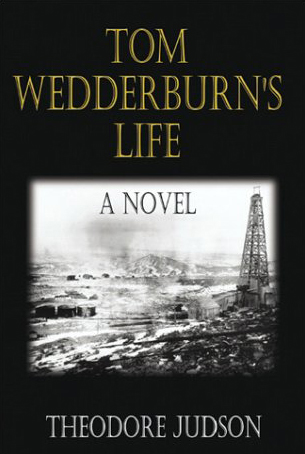
In the perhaps-unfortunate words of the Declaration of Independence, men “are endowed by their Creator with certain unalienable Rights, [and] among these are Life, Liberty and the pursuit of Happiness.” The words are unfortunate, 250 years later, because modernity has assigned to “liberty” and “happiness” much different meanings than those intended by Thomas Jefferson. The latter is not amusement or pleasure, but pursuit of a whole life filled with meaning, found most of all in fulfilment of the purposes of being a man or woman. Theodore Judson’s Tom Wedderburn’s Life, an autobiographical fiction, is an exploration of one man’s flawed, yet unwaveringly honorable, search for such happiness.
Judson is, as I tell anyone who will listen, soon to include random strangers on the street, the author of my favorite work of fiction: 2004’s Fitzpatrick’s War, a future history of the twenty-fifth century. He also wrote, a little later, the fantastic The Martian General’s Daughter. Both books have for years been nearly impossible to find at any reasonable price, but I am pleased to report that this August Ark Press is republishing the first, along with a newly-published sequel, The Timerman. But Tom Wedderburn’s Life, Judson’s first book, published in a short run in 2002, is even more difficult to find; it took me years to find any physical copy at all. I am glad I did, for it was worth the wait. And, while hopefully at some point in the future Tom Wedderburn’s Life will also be republished, here with Judson’s permission is a link to a PDF of his book.
You Should Subscribe. It’s Free!
You can subscribe to writings published in The Worthy House. In these days of massive censorship, this is wise, even if you normally consume The Worthy House on some other platform.
If you subscribe will get a notification of all new writings by email. You will get no spam, of course. And we do not and will not solicit you; we neither need nor accept money.
All three of Judson’s books revolve around men of high and tough moral fiber caught up in currents larger than themselves—men, perhaps, like Minniver Cheevy, misplaced in time. This book, however, unlike the others, is not a book about great happenings; there are no Martian generals here. Wedderburn is born, lives, and dies in rural and small-town Wyoming, only twice leaving the state. Nothing that happens specifically to Wedderburn has any relevance or importance to the larger world. He is writing as he nears death, which he does not fear; it is only that he will “miss the moments of happiness when I am gone from the earth, and I hope God grants me more of them in the place I’m going.” He has no children and few will mourn him. He writes because “if I die before I finish this book nobody other than God will know I walked the earth like other men and I will be forgotten.” Wedderburn admits this is a form of vanity; after all, it is truism that every man’s grave will some day no longer receive any visitors. But it is a pardonable form of vanity, common among men (more so than women, I think).
I do not know to what degree, if any, Judson meant the book to reflect his own life. Just like Wedderburn, Judson (now in his seventies) was born in and has spent much or all of his life in Wyoming. His self-written authorial description on the rear cover is “Thedore Judson has worked as a teacher, construction laborer, and security guard. He continues to live in Wyoming, where he was born and grew up. This is his first published book.” In 2007, at his publishing agent’s behest, he briefly wrote a blog, which is still extant, in which he describes a little more about his life, in the same vein. The main feeling one gets from reading his blog is a resigned sadness that his books did not gain greater traction. We can hope this injustice is now being rectified; I am doing my part to make it so.
What is the measure of a man’s life? We, and I, tend to focus on great men, or if we are in an introspective mood, on the lives of average men whose moral failings, or bad choices, lead to tragedy. Yet the vast majority of men lead lives, not of quiet desperation as some moderns claim in order to justify deviating from the path of duty, but of quietly trying to live up to what it means to be a man. Not so long ago, in America it was understood by all what a man should be. Yes, in different subcultures, the answer might vary a little in its details, but in all places a man was expected to be brave, honest, hard-working, emotionally controlled, and to defend and provide for his family at all costs. A man who failed in any of these obligations was, entirely correctly, and beneficially for society, stigmatized as less than a man. Today, however, masculinity has been deliberately and forcibly fractalized into unrecognizability. The tools for this have been imposed hyperfeminization, combined with denigration of masculinity, exacerbated by the decay inherent in Left-dominated modernity, which seeks emancipation from all unchosen duties, a demand utterly incompatible with masculinity as understood in any earlier time.
Judson ably and evocatively sketches the life of the early-twentieth-century American West. Wedderburn’s life begins in 1917, with a sheepherder father, long-suffering mother, and several siblings, all living in a herder’s wagon in the harsh-but-beautiful Wyoming landscape, where a child’s lunch is salted potato chunks. This type of existence, though common in all agrarian societies in history, is inconceivable to a citizen of 2026 America, where real poverty in the historical sense does not exist. Today, the “poor,” including every migrant who just arrived on a free airplane ride from whatever cretinous place he was born in, have free medical care, free smartphones, subsidized rent, and enough food to be enormously obese. Those who actually need and deserve help, the working poor with families, are instead abused by corporations and private equity, careful to not offer them jobs with predictable hours or enough weekly hours to qualify for corporate benefits, and ignored by our corrupt governments in favor of showering unearned handouts on the lazy and grifters.
Thus, at our church food pantry where I sometimes volunteer, more than half the recipients every week are Burmese migrants who live far from the church—who may actually be poor, though there is little evidence of that. More likely they are not very poor at all, rather just indifferent to the stigma that normally effectively reserves food pantries to the actually poor, and have discovered a way to get free food, no questions asked. They are, to be sure, polite and grateful, nice people, and they are Christian, but America needs no Burmese, so they should not be here at all. True, Saint John Chrysostom, and my priest, instruct us to not inquire too closely into why a man asks for charity, even if in Chrysostom’s time a normal way to alleviate poverty was selling one’s children into slavery, and it was extremely clear who was truly poor and who was not. And when you see a woman at the food pantry one day, and the next day see her filling a cart at Costco with eight 1.75 liter bottles of Maker’s Mark, as I have, you cannot but feel something is at least somewhat wrong with our approach to charity.
In any case, poverty is incidental to Wedderburn’s life, and in later years he becomes moderately well-to-do, the result of investment in oil stocks. The central, defining event of Wedderburn’s life is his unrequited love for one woman, which causes him to never marry, or even have any romantic relationship. He is the type of man, and I have known more than one, who hobbles his entire life by failing to cut his losses and take his lumps when his love is rejected. Now, it is true, and I instruct my children, that a man should always fight until the last dog dies—but that obligation is for himself, for his honor, and even more for those to whom he owes loyalty, for whom he is obligated to lay down his life, if necessary. A man owes nothing to, and does not dishonor himself by cutting all contact with, a woman who does not return his love. Confusing desire with obligation is ruinous.
But that is the type of man Wedderburn is. He grows up near the fictional town of Sterton (perhaps modeled on the actual Riverton), in western Wyoming, outside the very large Wind River Reservation. His family is not at the bottom of the social heap—that distinction is borne by the extended Aldpack family, largely Indian half-breeds and functionally an American type of Gypsy, existing on the fringes of civilized life. (His older brother, born or perhaps only raised half wild, marries into the Aldpacks, and disappears from his own family’s life forever.) At the other end is the grand patriarch of Elder County, Frank Elder, one of the men who tamed the land in the second half of the nineteenth century, respected and deferred to by one and all. But, in the American way and in the way of frontier societies, social stratification is compressed, and class conflict is minimal.
The family’s life is not easy, even aside from poverty. When Wedderburn is eleven, his shiftless father abandons the family, and Wedderburn is sent to live on a neighbor’s farm. The man, Alexander Muir, a carpenter, becomes his substitute father, and the biggest male influence in his life. From him and his personal library Wedderburn becomes a modest autodidact, versed in the classics of history and literature, while also attending the local grammar school. When he is fourteen, a friend of his introduces him to his cousin, Julia Bartholemew, the aforementioned unrequited love, with whom he spends nearly every day of a summer, not as boyfriend, but as the hanger-on of her relative, though she is perfectly aware Wedderburn is enamored of her. Julia is also poor and fatherless, a refugee from the Aldpacks, but is, to Wedderburn’s loss, and as Judson says in the blurb he wrote for the book, “a modern woman.” Wedderburn is anything but modern, and he resolutely refuses to adopt to modern modes and orders. He has nothing to offer a woman burning to rise in the world by using her sex, and in no universe would a love match between them ever succeed. Perhaps, probably, Wedderburn knows this even at the very beginning, but he will not change his chosen path.
Julia is one of those women who always has a man and has no close female friends. More than three decades ago, around when I was twenty, I wrote down what I called “Charles’s Seven or So Great Rules,” for my own use and, perhaps more importantly, for the use of others who sought advice. (I have never been shy about directing and manipulating the lives of others, whether asked or not; mostly this has been to their benefit. And because I have an iron will, I have never violated my own rules.) One of those rules was “Never fall in love with a woman who has no close female friends.” Such a woman is invariably bad news, but if she is beautiful, as such women often are, she has a magnetic attraction for men, the more so as she is aware both that she is beautiful and that her path to ease and comfort in life is by attracting a successful man (though some such women also have a self-destructive streak which derails that opportunity, because they choose unreliable men or throw over a good catch for a man who is more exciting).
Julia does not break the mold. She immediately starts dating the “swells” at the high school, and Wedderburn becomes an itinerant fiddle player in the towns around Sterton, playing and singing songs such as “The Golden Vanity,” an old tune about a cabin boy who volunteers to sink a corsair threatening a merchant ship by drilling a hole in it underwater, on the promise by the captain to give him his daughter in marriage, only to be abandoned by the captain to drown. Julia is still around, attaching herself to whichever man seems to promise her a way out of town. Soon enough, however, fiddle music is no longer fashionable, rather odious jazz, and Wedderburn, for no reason very clear even to himself, or perhaps because he is told it is the “most dangerous thing a man could do in this war,” joins the Marines.
A third of the book is taken up with detailed accounts of his fighting in the Pacific, in the First Raider Battalion, on Guadalcanal and Iwo Jima, under the command of Merritt A. Edson, “Red Mike,” a commander of the old school, who in 1955 would kill himself in his garage. “I today think of the morning after the battle, of myself: tired and dirty, my right hand bleeding from the heat of my rifle barrel, of the many dead, theirs and ours, including Jack Kildeer and Sammy Lee, rotting in the sun; and I understand why the post-war world is no damn good. For I was there when the beast was born, and anything so hideous as a newborn will not become beautiful as it grows older and stronger.” He and his surviving friends become changed men, harsher men; he says of his closest friend, “The boy who used to ask me endless questions about the world had decided that destroying everything in the world was the answer to every possible question.”
Wounded on Iwo Jima, and recovering back in the States, he conducts a clumsy proto-romance with a nurse, who is more than willing to become his lover, but at the moment of decision, when by arrangement he goes to visit her at her apartment after being released from the hospital, he instead returns home. He does not say why, perhaps expecting the reader will simply understand that he cannot betray, in his view, his love for Julia; this is the typical behavior of such men, caught in a trap forged by their own minds. A few years later, when Wedderburn has returned to sheepherding himself, Julia reappears in Sterton, asking him to go on a Caribbean cruise with her, which she won in a radio jingle contest. He foolishly agrees, not realizing that with such women nothing ever changes, and on the cruise, the last time he leaves Wyoming, gradually realizes something is wrong, as Julia largely disappears to “play bridge” and never goes ashore. When he realizes that Julia lied to him, that she came on the cruise to be with the man with whom she is having an affair (whose wife is also on the cruise), he beats the man nearly to death, although he is not the one who really deserves punishment, and again returns to Sterton.
And that is the sum of his life, or of his life that is of any real interest to a third party. To be sure, he is writing forty years later, in the late 1980s, having spent the decades farming, becoming in the 1970s a type of surrogate quasi-father to a neighbor’s son, and, finally, giving all his money to Julia when she comes to beg for financial assistance to fend off ruin in a bad real estate investment. He refuses to see her face, and she loses everything, as he expects she will, and as he also expects, she never comes to see him again, dying in 1986. “I should have predicted that Julia would not live long once she was both old and poor.” The book ends with him singing and dancing to “The Golden Vanity” with an old friend who went insane in the war, after killing scores of Japanese in a cave on Okinawa. The friend has wandered desolate areas of Wyoming for years, looking for a uranium deposit, yellow rock, that he saw by chance in the 1930s. He ultimately finds it and receives tens of millions of dollars. They agree the singing is a “good thing, good enough to end this story.” The real end of the story is not written, but foreseen. “It may seem a ridiculous boast, but the love I bore for her was as worthy as any man, even the great, ever had for a woman, and I want that love to live on in this book long after I am taken to Sterton and, as provided in my will, buried in the small cemetery at the base of Griffen’s Hill in the grave next to hers.”
Was his love worthy? Who can say? It was foolish, but it was honorable. More importantly, perhaps, Wedderburn’s whole life was honorable, and while he never achieved the conventional role of protector and provider, nor did he even once betray anyone to whom he owed a duty. It is not wrong, only perhaps unwise, to add duties by choice, as Wedderburn did in his lifelong interactions with Julia. He did not seek to throw off unchosen bonds, but added additional bonds. Reciprocal unbreakable sworn bonds used to be common in the West; a marriage was such a chosen bond, before the advent of insane no-fault divorce. True, Wedderburn was never granted a reciprocal vow, but he was true to the path he chose, and that gave him happiness, in its original meaning, for one of the purposes of a man is to keep his word, come what may.
Tom Wedderburn’s Life forms a sort of parallel to John Williams’s Stoner, another book about a man whose life does not turn out the way he wanted. But Stoner was a loser by choice, who could have taken action to improve his life, but flinched from the conflict that would result, levying costs on not only himself but on those around him. Wedderburn, by contrast, owes no unfulfilled duty to anyone, and unlike Stoner, could not take any obvious action to correct the course of the life he chose. Perhaps this is solipsism. Perhaps it is stoicism; more than once he quotes Marcus Aurelius, suggesting he views it as the latter. Wedderburn is not real, of course, but you will find your own life enriched, or perhaps guided, especially if you are young, if you read this book.
You Should Subscribe. It’s Free!
You can subscribe to writings published in The Worthy House. In these days of massive censorship, this is wise, even if you normally consume The Worthy House on some other platform.
If you subscribe will get a notification of all new writings by email. You will get no spam, of course. And we do not and will not solicit you; we neither need nor accept money.