
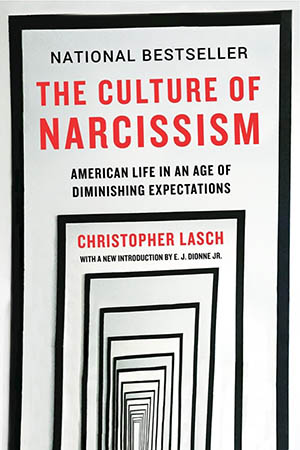
This is a strange book. Christopher Lasch, who published The Culture of Narcissism in 1979, wrote this sociological study at what seemed like the nadir of American vitality. His book freezes in time the moment Lasch, a prominent left-oriented social analyst who moved rightwards before he died in 1994, was turning fully against leftism, but could not admit that, probably not even to himself. Stripped to its core and with the benefit of hindsight, this book is a full-bore attack on the Left and what it had done to America. But Lasch’s internal conflict gives the book a tension-filled feel, exacerbated by many pages of insane Freudian word salad meant to, but failing to, buttress his analysis. Still, within, as always with Lasch, are many valuable insights.
I have previously discussed two of Lasch’s works: The True and Only Heaven (published in 1991), and The Revolt of the Elites and the Betrayal of Democracy (published posthumously in 1995). Those books are fully reality-based Right, the Effective Right, filled with the nuance and deep understanding of American history that always characterized Lasch. It is crucial to note that Lasch always rejected what passed for the Right in his own day, the “conservative” pseudo-Right, exemplified by Ronald Reagan and William F. Buckley, a destructive combination of atomized, devil take the hindmost economics and weak sauce attempts to slow down the decades-long march to power of the Left, while still wholly embracing in practice the twin goals of the Left, total emancipation and forced egalitarianism. Lasch, no fool in an age of fools, recognized that we had lost the organic reality-based community that made America great, and that both the so-called Right of his day and the Left were responsible for its destruction. All this comes through very clearly in his later books—but only through a glass darkly here, where he was still working out his own thoughts, and tried to pay lip service to elements of Left thought that he had functionally abandoned.
You Should Subscribe. It’s Free!
You can subscribe to writings published in The Worthy House. In these days of massive censorship, this is wise, even if you normally consume The Worthy House on some other platform.
If you subscribe will get a notification of all new writings by email. You will get no spam, of course. And we do not and will not solicit you; we neither need nor accept money.
Despite the crystal clarity of this, I am given to understand that today, elements on the Left cite cherry pickings from Lasch to support their crumbling political agenda. This is very strange, except to the extent that there is some connection between the Effective Right and elements of the Left on certain populist issues. Yet it must be true, because this edition, issued in 2018, contains a bizarre and vomitous, incoherent and preening, twenty-page Introduction by one E. J. Dionne, a decrepit Boomer Left propagandist of no accomplishment at all. His Introduction is meant to serve two purposes, First, to spew an unhinged attack on Donald Trump for his supposed narcissism, completely ignoring that, as we will see, what Lasch means by narcissism is not the colloquial understanding of that word. Second, and more importantly, to desperately try to persuade the reader that Lasch was not attacking the core doctrines of the Left at all. Certainly the Introduction is not worth reading, but it confirms my thesis about what this book represents. However, it is also true that at no point does Lasch directly address actual Effective Right thought; his specific views on that, at least in this book, are inchoate. This is not surprising, because in 1979 there was no such Right thought in any prominence in America, or for that matter anywhere in the world.
Lasch begins, in his Preface, with the simple observation that “American confidence has fallen to a low ebb.” Our elites hold a justifiably “despairing view of the future.” The study of history and literature has been corrupted (one wonders what Lasch would think of those disciplines today); philosophers “no longer explain the nature of things or pretend to tell us how to live.” All the supposedly authoritarian structures of our society, against which radicals (i.e., the Left) railed and still rail are long gone, replaced by “competitive individualism,” which has “carried the pursuit of happiness to the dead end of a narcissistic preoccupation with the self.” That transitory stage of “economic man” has now given way to “the psychological man—the final product of bourgeois individualism,” who is “haunted not by guilt but by anxiety.” Freed from all the old limitations placed on men and women by society, he “demands immediate gratification and lives in a state of restless, perpetually unsatisfied desire.” He rejects any wisdom from, or even reference to, the past, though the past is crucial to any society, “a political and psychological treasury from which we draw the reserves that we need to cope with the future,” the rejection of which “proves on closer analysis to embody the despair of a society that cannot face the future.” The only hope for a solution is “local action, the revival and extension of which holds out the only hope that a decent society will emerge from the wreckage of capitalism.”
The reader notes that Lasch sees little difference between “radicalism,” his term for the Left; “liberalism,” meaning bourgeois liberalism (“politically and intellectually bankrupt”); and “capitalism,” the deracinated bastard son of bourgeois liberalism. (He would lump the catamite Right of his day into a combination of the latter two.) All have collapsed into the “therapeutic society”; even supposedly radical politics of the 1960s and 1970s merely “filled empty lives, providing a sense of meaning and purpose.” Having forgotten “historical time,” the American seeks above all “the feeling, the momentary illusion, of personal well-being, health, and psychic security.” Robust American individualism, rooted in thick community, has disappeared. “The atrophy of older traditions of self-help has eroded everyday competence, in one area after another, and has made the individual dependent on the state, the corporation, and other bureaucracies. Narcissism represents the psychological dimension of this dependency. Notwithstanding his occasional illusions of omnipotence, the narcissist depends on others to validate his self-esteem. He cannot live without an admiring audience.”
The modern man thus seeks peace of mind, but cannot find it, because everything is organized around him, toward his liberation, toward fulfilment of his emotional requirements. “ ‘Love’ as self-sacrifice or self-abasement, ‘meaning’ as submission to a higher loyalty—these sublimations strike the therapeutic sensibility as intolerably oppressive.” This is also true in politics; Lasch scathingly attacks Jerry Rubin, the “Yippie” leader and a stand-in for all Left political agitators of the 1960s, for his 1970s turn to navel gazing. “He has succeeded only in exchanging current therapeutic slogans for the political slogans he used to mouth with equal disregard of their content.” What is triumphant is the cult of self, focused on a collapse in personal relations and an overwhelming fear resulting from “the warlike conditions of American society.” Those conditions are not the cause of the problem, however, they are its result. The “crisis of personal relations” results from the demand that we “not make too large an investment in love and friendship, [that we] avoid excessive dependence on other, and [that we should] live for the moment.”
The bulk of this book is a series of chapters analyzing various specific aspects of American society through this lens. But first, Lasch examines “The Narcissistic Personality of Our Time” as a concept. “Theoretical precision about narcissism is important not only because the idea is so readily susceptible to moralistic inflation but because the practice of equating narcissism with everything selfish and disagreeable militates against historical specificity.” Narcissism is not “simply the antithesis of [a] watery love for humanity,” or a form of vanity or self-glorification. Lasch then veers into extensive Freudian “clinical” analysis, including such gems as a discussion of “feelings of oral deprivation that originate in the pre-Oedipal stage of psychic development.” But when you cut through that, his basic claim is that the modern narcissist is someone ridden endlessly by fear—fear of being viewed as a “loser” by others, and fear of floating free of all connection, at the same time he seeks, because he is told he must in an era of rising Left dominance, total emancipation from all unchosen bonds. This contradiction makes him desperately unhappy, exacerbated by his removal from the concrete as a result of his life being “mediated by electronic images” which “undermines our sense of reality.” He cannot develop, cannot advance; he is caught in the eternal unsatisfied now, fearful of aging most of all. “Narcissism emerges as the typical form of character structure in a society that has lost interest in the future.” His is the “ ‘liberated’ personality of our time,” unwilling to invest in the future, including in his own progeny, and he thereby conveys his disastrous personality traits to his own children. (The reader recognizes an early grasp of the pernicious Boomer mentality.) The result is a profoundly antisocial attitude, full of “emptiness and isolation.” “The ideology of personal growth, superficially optimistic, radiates a profound despair and resignation. It is the faith of those without faith.” This is Lasch’s narcissism in a nutshell.
The central element of narcissism is living in the eternal present. Again and again Lasch returns to our loss of the grasp of historical time. “The real value of the accumulated wisdom of a lifetime is that it can be handed down to future generations,” and this is in danger of being entirely lost. “Because the older generation no longer thinks of itself as living on in the next, of achieving a vicarious immortality in posterity, it does not give way gracefully to the young.” A better description of our current aged generation does not exist.
We then dive into how this manifests in American society of the late 1970s. First, “Changing Modes of Making It: From Horatio Alger to the Happy Hooker.” You have probably never heard of the latter, but the Happy Hooker, a term from the title of a 1971 book by a New York brothel owner, propaganda designed to celebrate sexual promiscuity as liberation, was once extremely famous. Lasch’s point is only in part to criticize the Sexual Revolution, it is more broadly to point out that “self-preservation has replaced self-improvement as the goal of earthly existence.” And in a sense this is necessary, because American society has destroyed the ability of self-improvement to bring security. He traces this devolution from the Puritans, through P. T. Barnum, the Gilded Age, and Dale Carnegie, the successive tearing down of “industry and thrift” to instead focus on “winning friends and influencing people.” Men now want to be admired not for their accomplishments, but for their personal attributes; they want envy rather than respect. This attitude has wholly infected America through the twin vehicles of bureaucracy and managerialism, including the factory system (which Lasch castigated in The True and Only Heaven). We therefore celebrate a prostitute; even though “she remains a loner, dependent on others only as a hawk depends on chickens.” We live in the ideal society of the Marquis de Sade, he who “defended unlimited self-indulgence as the logical culmination of the revolution in property relations.”
Lasch then excoriates the related cult of consumerism, propagated with enormous amounts of sophisticated propaganda masquerading as mere “information,” pushed as a remedy to “fill the aching void.” Our elite “upholds consumption as an alternative to protest or rebellion” while it “turns alienation itself into a commodity” with lying promises of imminent happiness from the next purchase, the “banality of pseudo-self-awareness.” Women are affected even more than men. “The logic of demand creation requires that women smoke and drink in public, move about freely, and assert their right to happiness instead of living for others.” “The ‘education’ of the masses has altered the balance of forces within the family, weakening the authority of the husband in relation to the wife and parents in relation to their children.” It is sentences such as these which give away Lasch’s actual internal frame, that of a Right traditionalist at heart, and Lasch follows this with another vicious attack on the 1960s and 1970s Left, who “embraced radical politics in the first place not because it promised results but because it served as a new mode of self-dramatization.”
In other chapters, Lasch derides the “degradation of sport”—not that it is too much spectacle or distraction, but that it is trivialized, mere commercialized entertainment, with spectators now passive rather than participating in a group ritual. He thumps the education system for providing “stupefaction” rather than uplift, refusing to demand excellence, in part because of a fear that would feed elitism. Instead, progressive education “reformers” have given us endless bureaucracy and a focus on filling time combined with “life adjustment.” Again, one wonders with what horror Lasch would regard today’s education system, with ten times the bureaucracy, along with “social emotional learning” and other abominations. Interestingly, in a footnote he specifically attacks Evergreen State College for becoming “a playpen of self-exploration.” That college was more recently famous forty years later, in 2017, for its wholesale descent into violent jealousy, and consequent hatred, of White students and faculty, something at which even Lasch might be surprised.
He stigmatizes “the socialization of reproduction,” the “assumption of childrearing functions by surrogate parents responsible not to the family but the state, to private industry, or to their own codes of professional ethics.” (Lasch has a very low opinion throughout the book of the self-governing mechanisms of professional associations, another early glimpse of something that has borne extremely rotten fruit in the modern era, from lawyers advancing a Left agenda by disbarring anyone prominent on the Right to doctors pushing the genital mutilation of children.) Destroying the family is the goal. “Almost everyone agreed that the family promoted a narrow, parochial, selfish, and individualistic mentality and thus impeded the development of sociability and cooperation.” The “rights of the child” were exalted, meaning the child should be indoctrinated by anyone other than his parents, as long as the indoctrination was approved by those au courant with the latest Left doctrines. He calls this the “transfer of functions,” an attack on the “patriarchal family,” which Lasch very obviously prefers, since he sees that children are best served by a mother and a father, with each performing time-honored sex roles. Though, oddly, to this he ascribes, among other maladies resulting, an increase in schizophrenia—and, again, he throws in constant Freudian analysis, resulting in a jarring combination for today’s reader.
In all these chapters, Lasch’s targets are the core programs of the Left, although he mostly either does not want to admit or cannot see it, given the time, when the Left seemed permanently on the ascendant, the water in which the entire West swam. His aim is most clear in two chapters, on the “Sociopsychology of the Sex War” and “Paternalism Without Father.” It may seem, Lasch says, that “the growing determination to live for the moment . . . appears to have established the preconditions of a new intimacy between men and women.” But “this appearance is an illusion,” because “the same developments that have weakened the tie between parents and children have also undermined relations between men and women.” He attacks resultant divorce as disastrous for both family life and children, sneering at “enlightened opinion” that divorce is often the preferable option. At the same time, though, he pays lip service to supposed historical “oppression of women,” even bizarrely, for a man so historically oriented, claiming the total historical fantasy of droit du seigneur actually existed (although it is possible he is actually inserting a coded statement, a type of reductio ad absurdum, to suggest that women were not in fact oppressed as claimed). Yet what has been done to tear down this supposed oppression is worse than the disease, for men are no longer rigidly constrained by social strictures from ill treatment of women, as they were in the past. The Sexual Revolution has contributed to narcissism on both sides; “sexual warfare” is both intensified and shorn of traditional, reality-based limitations. Living for the moment leads to dissatisfaction and escape into drugs and promiscuity. In short, the destruction of the old system, whatever its faults, has not been an improvement.
As to paternalism, we still have it, in the form of bureaucracy and “welfare liberalism,” and neither is this an improvement. “American capitalism has rejected priestly and monarchical hegemony only to replace it with the hegemony of the business corporation, the managerial and professional classes who operate the corporate system, and the corporate state.” To be sure, this problem got a lot worse; Lasch wrote before the destructive consequences of so-called civil rights law moved the locus of power from corporations to the Left omnicomplex, dominating all employment relations. In the family, instead of the old, desirable system where fathers built up their children in the way they should live, ensuring a “sense of continuity,” we have a bogus paternalism, led by the “helping professions,” which do not help at all. This is the fruit of early twentieth century Progressivism, which attacked the social power of those in the productive middle classes which made America, “the artisan, the small farmer, and the independent entrepreneur.” What should be done is restore the power of parents, who now “occupy a position closer to proletarians than executives,” and extinguish the power of bureaucrats who claim they should be in charge because they know better. Although he does not go into detail here (apparently he does in his relatively obscure 1977 Haven in a Heartless World, where he complains that feminism has made “women more shrewish than ever in their daily encounters with men”), it is apparent that he far prefers the pre-nineteenth-century household economy discussed by Mary Harrington in Feminism Against Progress, where women were not forced into the workforce, a disaster which was a major building block of the desired Left goal of destroying the family.
This book was an unexpected bestseller; Jimmy Carter even invited Lasch to meet with him to discuss it. It was also controversial, because Lasch’s old comrades in arms were enraged by what they saw as his betrayal. Therefore, in a short Afterword written in 1990, Lasch addresses critics of his book (perhaps tied to what he wrote in The Minimal Self, in 1984, a type of sequel, which I have not read, but which is apparently even more psychoanalytical than this book). He attacks both “New Age spirituality” and “technological utopianism,” arising since 1979, as both rooted in narcissism. His aim, he says, was “to explore the psychological dimension of long-term shifts in the structure of cultural authority.” We must recognize our dependence on others and the reality of our limitations. “The best defenses against the terrors of our existence are the homely comforts of love, work, and family life, which connect us to a world that is independent of our wishes yet responsive to our needs.” And that was his last word on the topic.
One complication found in The Culture of Narcissism, though it is not really the author’s fault, is that throughout the book, Lasch refers to once wildly popular authors with the confidence that his readers will recognize them and already know their work in detail. A few remain vaguely in our memory—Philip Roth, for example. But who is Paul Zweig? Frederick Exley? Donald Barthelme? Lasch uses their writings to illustrate his points, but not having any background, the reader is sometimes largely at sea, although he certainly grasps that Lasch has almost total contempt for the solipsism and foolishness these men and women wrote.
Of course, America seemed to recover somewhat after 1979. By 1984, Reagan was winning elections with the slogan “It’s Morning in America,” and despite huge challenges, few would describe America as less vital today than in 1979. This is a complex question, to be sure, because America is very different today, both in composition, the result of importation of tens of millions of inferior foreigners to replace the heritage American population, and in political division, as the poison of the Left has totally dominated society, a process only halfway complete in 1979. Moreover, Americans are certainly more pessimistic about the future than they were in the 1980s and 1990s; it has been a long time since creative optimism, rather than decadence, the inability to create anything new, characterized American culture. And let’s not forget that the reason there is not more overt, expressed unhappiness is in large part the fake nature of our economy, fueled by unsustainable debt and the dubiously-secure global status of the dollar. But vitality is merely the backdrop of Lasch’s analysis; his real objection is not merely that we lack vitality, but that our psychology is defective, degraded, and that has destroyed our society.
So are Americans less atomized, less fearful, less narcissistic, than they were in 1979? Have they recovered a sense of historical time and started to live for their children’s futures? Are they less consumeristic? Are they less dependent on and less governed against their will by professional “experts” and bureaucrats? Has the family been repaired by the restoration of the traditional roles of men and women? Have we regained “peace of mind”? Of course not—wildly the contrary. To take only one data point, but a telling one, something like one-third of adult women take prescription psychoactive drugs in order to combat the symptoms of precisely the conditions Lasch identifies. The internet, economic instability for anyone outside the professional-managerial elite, and the quest for endless emancipation, so-called liberation, along with the consequent rejection of any sense of duty, have instead merely exacerbated every pathology Lasch identified.
Not that there’s anything that obviously can be done about it. All of these pathologies are, at their root, the result of Left cultural dominance (and political dominance, for contrary to myth, culture is nearly one hundred percent downstream of politics, at least in modern pseudo-democratic systems). Certainly, the total destruction of the Left, and its handmaiden the catamite Right, followed by replacement with a new system (hopefully a Foundationalist system) would renew American vitality. But that would require massive dislocation, some kind of collapse or fracture, followed by rebuilding. There is no path from here to there through normal channels. No doubt Lasch would be very disappointed by the world of 2026. But he would almost certainly not be surprised in the least.
You Should Subscribe. It’s Free!
You can subscribe to writings published in The Worthy House. In these days of massive censorship, this is wise, even if you normally consume The Worthy House on some other platform.
If you subscribe will get a notification of all new writings by email. You will get no spam, of course. And we do not and will not solicit you; we neither need nor accept money.