
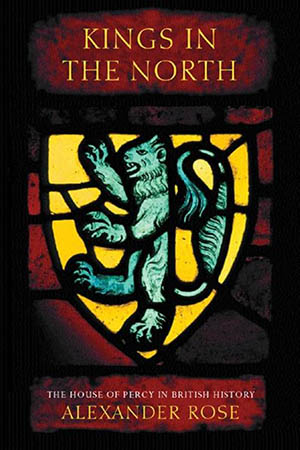
Cicero described Julius Caesar as a man “of supreme daring, hardened to every risk.” In our hyper-feminized age, such men seem nonexistent, though more likely they are quietly biding their time, and will emerge when the time is right. Such rarity, however, is anomalous in the West, as this book shows. Kings in the North is a voluminous history of the Percy family, holders of estates in northern England for a thousand years, and within these pages are scores of such men. Aware that death was always near, they fiercely pursued profit and glory, seeing no difference between the two, with a naked openness which astonishes the modern mind. And it was this spirit which laid the foundations of the now-vanished glory of Great Britain.
The English homeland of the Percys has always been more-or-less what was once, in Anglo-Saxon times, the Kingdom of Northumbria, lands north of the River Humber. Thus, the Percys were quintessential Northerners, and the title borne to this day by the Percys, though they gained and lost it more than once, was the Duke (sometimes Earl) of Northumberland, a portion of that kingdom. Crucially, you cannot understand the history narrated by this book if you do not grasp that Northern culture and interests have, for all the history of England, often diverged very strongly from Southern culture and interests. The North was always poorer, rougher, and less stratified than the South. Most notably, although all medieval culture revolved around honor, something moderns often completely fail to grasp, this was an extreme honor culture. The same types of men, when they came to America, imported their culture, now denoted “Scots-Irish,” to the areas they settled, and ever since they have maintained, at least more than other Americans, that culture, if today in desiccated form.
You Should Subscribe. It’s Free!
You can subscribe to writings published in The Worthy House. In these days of massive censorship, this is wise, even if you normally consume The Worthy House on some other platform.
If you subscribe will get a notification of all new writings by email. You will get no spam, of course. And we do not and will not solicit you; we neither need nor accept money.
The kings of England, with their main sources of power and income in the South, cared little for Northern interests. Rather, they tried very hard over the centuries to establish permanent dominance over the English in the North, and to at least corral the fractious Scots even further north. Sometimes they failed, sometimes they succeeded, but over the years more the latter than the former. Thus, eventually the Percys faded from importance as quasi-independent historical figures, which is no doubt why this book only covers the family’s history through the end of the Wars of the Roses, in 1487.
How different the English North is from the South today, I cannot say. The author, Alexander Rose (who also wrote the excellent, more recent Empires of the Sky), published this book twenty-five years ago, and he thought that the North was still very different. But that was before the invasion of England by tens of millions of swarthy alien foreigners, an invasion organized and abetted by the ruling classes of England (many of whom should be hanging from lampposts), with the goal of replacing the native English. Yorkshire, for example, is part of the North, and it is there that the infamous Paki rape gangs, found throughout England, have been most active. But none of these problems of the twenty-first century appear in this book.
The problem with Kings in the North is that, even for someone well-versed in English history, it is nearly impossible to keep straight everything that happens. Hundreds of names, often identical to each other, pass by the reader, forming a spider’s web of blood relations, intermarriage, and shifting alliances, with each man profiled very often ending dead on one battlefield or another—including, toward the end of the book, at the Battle of Towton in 1461, the deadliest battle ever fought on English soil. This opacity is not really the author’s fault; Rose delineates every person and event clearly. It is simply the nature of a highly granular longitudinal history, which focuses on people and events rather than, as is more common nowadays, some overriding abstract theme of which the author is fond, as with the Marxist historians of the second half of the twentieth century. Nonetheless, you really have to be interested in the history to keep with it, or you have to reconcile yourself to absorbing impressions and broad strokes, combined with memorable anecdotes, rather than trying to remember it all. Alternatively, one could view this as a colorful reference work; if you want to know the details of any English dynastic struggle of the first five hundred years of England, you will find it here.
The Percys were, no surprise, originally French. William de Percy, the first English Percy, did not accompany William the Conqueror in 1066, despite what some Percys like to claim, given that “Companion” was once a celebrated title; he came to England in 1067, after the Conqueror returned for a time to Normandy to celebrate his conquest. From the first, the Percys were associated with the North—initially with the Conqueror’s brutal suppression of opposition in the North as he consolidated power, after which William de Percy was given land in Yorkshire as a reward. He was not a major landowner; according to Rose, his lands supplied income of fifty-four pounds, when all the rural land in England generated income of around 73,000 pounds, making Percy a very modest baron, nothing more. De Percy built a small castle at Topcliffe, north of York, which was the central Percy residence for three hundred years (when they built a giant castle at Alnwick, still the home of the Percys, and commonly seen in movies as the backdrop, including as Hogwarts in the Harry Potter movies).
The first Percy died at the siege of Jerusalem, in 1099 (belying the old fable that the glorious Crusades were fought by landless second sons). His children married well, but when Henry I died in 1135, the twenty-year period of civil war known as the Anarchy began, and his son and heir, Alan, had to navigate ever-shifting power dynamics—something that characterized the entire history of the Percys for five hundred years. The family managed to stay afloat, and gradually, by fits and starts, increased their holdings, the primary goal of every medieval English noble, whether by royal grant, conquest, or marriage.
Alan’s heir, also William, died in 1175 and had no legitimate sons, but one of his daughters married a Frenchman whose half-sister was the second wife of Henry I, and their sons took the name Percy, perpetuating the line. Still, much of the property accumulated by the father and grandfather was dispersed. In part, this dispersal was due to a complicated legal question relating to inheritance when an elder son pre-deceased his father, and the father had younger sons but the elder son had left a male heir. This question was called the casus regis, and it was a very important issue at the time because King John faced the same problem—his elder, dead brother, never king, had left a son, who might have inherited instead of John after another elder brother, Richard I, the Lionheart, died without an heir. John solved this by murdering his competing nephew, Arthur of Brittany; ultimately the legal question was resolved to deny inheritance to the elder son’s issue. John paid a price, however, for this was seen as supremely dishonorable, and it is no surprise no later king of England has been named John. I find all this fascinating, but you see what I mean about complicated.
The remaining five hundred pages of the book are more of the same. The Percys rose and fell, usually in tandem with how their patrons and allies, royal or one or more of the great Southern houses, fared. Sometimes they fell very low, with more than one of the Percys being attainted and losing both his life and all his property, but somehow the family always reemerged. Kings come and go in these pages, each incisively drawn with both his virtues and his vices. The Percys, most of the time, either totally dominated the North, or competed to dominate it with the Neville family (the feud between the two families was a key cause of the Wars of the Roses). Regardless, they usually had great freedom of action, administering affairs as they saw fit, and the king usually did not presume to directly order the affairs of the North, leaving that to the Northerners.
The Scots make continual appearances, raiding into Percy territory and further south, while the English kings often ventured under arms into Scottish territory, usually finding only frustration, as the Scots melted into the landscape and the expensive English armies could not stay in the field for long—in part because, unlike in England, there was little portable treasure to seize to make long campaigns worthwhile. To be sure, Braveheart is a fantasy, and both William Wallace and Robert the Bruce were brutal, nasty men, but it is true that the Scots always loved freedom, and would go to almost any length to avoid subjection to the English. Showing once again how the North was different, the Percys very often maintained quasi-traitorous contacts with the Scots lords, contacts Southerners would never have dared, though the Percys saw this as the natural way of the North, to the frequent discomfiture and rage of the English kings.
An interesting part of the book concerns how the English nobility funded themselves. They received income from land, and later from wool, but most of them were chronically short of money, especially because they were often called upon to fight, yet were expected to fund their knights and footmen out of their own pocket, only occasionally being reimbursed, even if their side won. (Rose quotes what Henry IV told one Percy when he demanded to be paid back: “Aurum non habeo, aurum non habebis”—“I do not have any money, so you won’t get any money.”) The standard way to obtain quick cash was by borrowing from Jewish moneylenders. This was a risky proposition for those Jews who had liquid cash (probably quite a few or most of them, given there were only several thousand Jews in England, and they were a tight-knit, exclusively urban community), because while the king often protected the Jews, seeing them as necessary for operations, at the same time he frequently changed terms on loans, ordered that loans be marked down, or simply stole from the Jews.
King John, for example, infamous for his rapacity, in 1210 “imposed [on the Jewish moneylenders] a one-off penalty of 66,000 marks (almost 44,000 pounds) for ‘administrative reasons,’ ” and tortured Jews who would not pay up. (He got another 60,000 pounds by imposing a tax of one-thirteenth on all property and income in the kingdom, which comparison shows how much money the Jews had.) Rose does not discuss why the Jews had access to such massive sums; in part it was no doubt due to the Christian prohibition on usury, which meant that the Jews could charge very high interest and profited even if they collected only part of it, and the ability of Jews (as well as of Italian bankers, who avoided accusations of usury by devising creative structures such as fake agreed-upon damages) with cross-border co-ethnic networks to profit from exchange-rate differences. Rose only mentions the latter in passing, and it sounds like it would make an fascinating economic study, given that exchange rates seem like they would be pegged to gold and silver, which would not appear to vary that much from nation to nation, but apparently did.
This funding mechanism did not last forever. Edward I, in 1290, expelled the Jews, who were unpopular with both the lower and upper classes, from England (though as in Spain, this was in large part a device to force conversions by the devout Edward), so presumably medieval Jewish moneylending in England ended then (until Oliver Cromwell re-admitted the Jews in 1656). Usually this expulsion is ascribed to unjustified anti-Semitism, which may be true, or it may not be true; it is hard to get a disinterested answer to such questions today. Whatever the level of unjustified anti-Semitism, apparently over time the Jews had lost much of their liquid cash, which from the royal perspective was probably more important than either dislike of the Jews or converting them to Christianity.
Another interesting thread is the persistent importance of Magna Carta, originally signed between King John and rebellious nobles in 1215. It is fashionable nowadays to deprecate the importance of Magna Carta, and more broadly to denigrate as a Victorian fantasy the claim that Englishmen early successfully asserted their rights against the king, that is, against the central government. However, this book makes clear that Magna Carta was always considered a live matter after its signing—in 1354, under Edward III, for example, Rose notes that Parliament clarified it “to read that ‘no Man, of what Estate or Condition that he be’ shall be subject to arbitrary diktat by his governors.” The deposition of Richard II, last of the Plantagenets, in 1399, was argued to be legitimate under Magna Carta (though not so much his murder in 1400). The rule of law, that is to say, one part of which is limits on arbitrary authority, emerged very early in England. Thus, Magna Carta cropped up regularly for eight hundred years, sometimes with effect, sometimes not, but it was undoubtedly a living part of English politics. To be sure, the rule of law is today vanished in England, with its two-tier system of justice weaponized against white Englishmen, and Magna Carta a dead letter, but once the current regime is crushed, perhaps England can return to the principles which formed the backbone of what it once was.
Finally, we should note that despite the seemingly endless battles in these pages, life for most Englishmen and Englishwomen was not bad at all (except, perhaps, during the Black Death). True, in these northern regions burning the crops and villages of your opponents was a common tactic, but as Rose points out, during the entire thirty-five years of the Wars of the Roses, regarded as the most destructive period of medieval British history, the total time spent in campaigning was less than a year, and most battles lasted less than eight hours. Even during those wars, in other words, “about 97 percent of the time 95 percent of the English population lived peacefully.” Being a great lord was dangerous; being a peasant, really not at all. It is common now to assert that modern life is vastly superior on every axis to the past. There is some truth to this—I like antibiotics and immunotherapy for cancer, and reductions in infant mortality, even if Victorian life expectancy was not much different than ours, and improved sanitation in filthy cities had a much greater impact on preventing premature death than has all of modern medicine. But the reality is that the life of the average person in Britain in the five hundred years covered by this book was pretty good, and in many ways better than the lives of moderns. At least they never risked African savages stabbing their children.
And what of the Percys today? They would seem to be a quintessential Great House, of the type Johann Kurtz advocates creating in his Leaving a Legacy, which should still be influential in the land. But they apparently play no significant role of any type, perhaps inevitable in today’s degenerate Britain. True, the Percys still live in Alnwick Castle; the 12th Duke of Northumberland, Ralph Percy, lives quietly as a rural and urban landowner. He seems to be uninvolved in politics; the decayed and feeble English eliminated hereditary seats in the House of Lords twenty-five years ago. At least, unlike so many other English nobility, the Percys have maintained their family home and lands, even with confiscatory inheritance taxes designed to destroy the fabric of English society. But the story of the Percys is over.
It is a pleasant fantasy to imagine that the future of England will be a rebirth of the internal fire which drove the early Percys, but fantasy it is. The possible, even desirable, future wars of England, wholly necessary for any rebirth, will be driven and led by entirely new men, who may yet establish a new civilization, if indeed England does not simply sink beneath the waves of history. It will be new, however, not any kind of return, even if some elements refract the life and deeds of these early Percys, in all their vices and virtues. None of us are likely to live to see any such stable future for England, however.
You Should Subscribe. It’s Free!
You can subscribe to writings published in The Worthy House. In these days of massive censorship, this is wise, even if you normally consume The Worthy House on some other platform.
If you subscribe will get a notification of all new writings by email. You will get no spam, of course. And we do not and will not solicit you; we neither need nor accept money.