
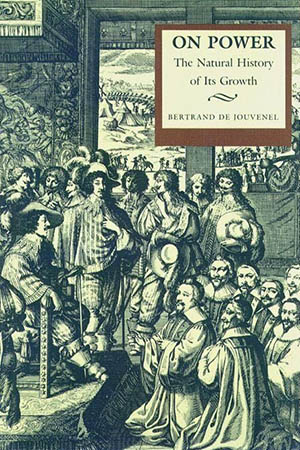
For years, I put off reading On Power, despite seeing frequent references to it. The book seemed, as filtered through online discourse (my first mistake), to be merely another tedious libertarian manifesto. Moreover, dimwits on the internet often falsely cite this book for the supposed irrelevance of popular discontent to regime change, a very stupid claim, so that also colored my view of On Power. I did myself no favors by delaying, however, because this book is among the top ten, maybe top five, books on political theory I have read, and I have read quite a few. Bertrand de Jouvenel’s thought even rivals Carl Schmitt. So today we will finally dive in, and a deep dive it is.
On Power is immensely erudite, and parses much of the history of mankind with a surgeon’s scalpel, offering innumerable insights along the way. It is, if anything, the opposite of a libertarian screed, nor does it offer any support for libertarianism’s dubious cousin, “classical liberalism.” Its essence is one long cry that only one type of political system can reliably offer freedom from tyranny—namely, an aristocracy risen from a largely homogenous population, which aristocracy is governed by rigid religious precepts universally recognized. Such a system naturally tends to produce ordered liberty for all. Only such a system has any chance of resisting the eternal pull of centralized power and consequent loss of liberty, meaning freedom from arbitrary, unconstrained power. Many of the systems of medieval Europe were like this, but those are long gone, and we, their descendants who have far less liberty than anyone in those societies, are headed rapidly into “democratic totalitarianism.”
You Should Subscribe. It’s Free!
You can subscribe to writings published in The Worthy House. In these days of massive censorship, this is wise, even if you normally consume The Worthy House on some other platform.
If you subscribe will get a notification of all new writings by email. You will get no spam, of course. And we do not and will not solicit you; we neither need nor accept money.
It is not that Jouvenel, a French journalist and political theorist who published this book in 1948, sees any realistic way back to a desirable, balanced, system. Rather, he aspires to chronicle and explain our inevitable descent to tyranny. Every political current over the past thousand years, most of all so-called democracy, has inexorably trended towards the increase of despotic power. We have marched ourselves into a box canyon, loading ourselves with more chains at every step, while we are lied to, and lie to ourselves, that we are more free than any peoples in history. On Power is analysis, not a call to action, because Jouvenel sees no practical path that will reverse this process within the societies of the West. But at least you will know where you are, and why.
Among this book’s stellar characteristics is that, unlike other contemporaneous books still read today, such as James Burnham’s The Managerial Society, it could have been written yesterday. To take only one startling example, towards the end of the book, as he describes the oppression under which we are all laboring in the West (an oppression in his day vastly less than that of 2025), Jouvenel says “The business is one of setting up an immense patriarchy, or, if anyone prefers the word, a matriarchy, since we are now told that collective authority should be animated by maternal instincts.” That is to say, nearly eighty years ago, long before the massive destruction wrought by odious feminism, when nobody at all was complaining about hyper-feminization of political and social life, he identified the Longhouse, often thought of as an insight of the past decade.
Where to begin? I suppose with the word Power, by which the author means central government authority. And with his word Minotaur, by which he means the modern manifestation of Power, an enormous devouring beast which savagely consumes entire societies of men and women to feed its growth, breaking all the shields and weapons citizens had in the past created to defend themselves from Power. World War II “presented the Minotaur,” through the unprecedented militarization of whole societies, seizing control of all the resources, men and treasure, of our societies to feed the war machine. Such events would have been incomprehensible to a man of 1700; the supposedly absolute monarchs of the early modern period were completely unable to field giant armies, because any attempt to extend their power was fiercely opposed by other organized groups who had no, and wanted no, path to a share of the monarchy, who were content with their intermediate position in society. But in the modern age, when every man falsely believes he may obtain a share of Power, each of us has abandoned our opposition, and thereby submitted himself to extraordinary exactions, while telling himself, falsely, that he is more free than a medieval, peasant or lord.
Jouvenel then steps back from this presentation, or summation, and spends the next four hundred pages demonstrating every aspect of how this came about. His goal is not to discuss “what is the best form of Power,” but rather “what is the essence of Power,” to “construct a political metaphysic.” He wants to answer two questions, in all times and in all places. Why do men obey Power, whatever precise form that Power may take in their societies? And why has the percentage of every society’s resources disposed of by Power increased from almost nothing to almost everything? All societies have always had some form of Power, so it must be in some way natural to man, but too often we focus on bogus distractions, such as supposed legitimacy, alleged beneficence, and apparent inherent strength, or force. We must look deeper.
The author begins by dissecting various theories of sovereignty, attempts to explain from first principles how Power arises. One core theory is that sovereignty is “an emanation of [a] supreme sovereign,” “either the ‘Divine Will’ or the ‘general will.’ ” As to divine sovereignty, Jouvenel heaps contempt on facile modern conceptions of how this view manifested in the past. “The idea that Power is of God buttressed, so it is said, a monarchy that was both arbitrary and unlimited right through the Dark Ages. This grossly inaccurate conception of the Middle Ages is deeply embedded in the unlettered, whom it serves as a convenient starting-point from which to unroll the history of a political evolution to the winning-post, which is liberty. There is not a word of truth in all this.” Rather, divine sovereignty was an extreme limitation on all medieval monarchy, which was further limited by the immutable, or treated as immutable, customs of each nation. Men “repeated St. Paul’s formula, ‘all Power is of God,’ but less with a view to inducing subjects to obey Power than to inducing Power to obey—God. . . . The consecrated king of the Middle Ages was a Power as tied down and as little arbitrary as we can conceive.”
What eroded this first conception, of divine sovereignty being the fount and limit of temporal sovereignty, was political theorists, from Marsilius of Padua to Thomas Hobbes to John Locke, who instead substituted the idea of popular sovereignty. When this is accepted, that sovereignty comes, by some path, from the people as a whole, rather than from God, it opens a broad road to despotism, because whoever receives that sovereignty is now exempted from limits, due to that all men have been deemed to surrender all their rights to a sovereign, and there is no objective, permanent limit outside that sovereign. Power, when it recognized God as its superior, could not contradict God, or even, short of divine law, go against “a community’s laws [which] admit of no modification whatsoever,” the type of laws the early Romans recognized. But when those barriers fail, there are no fallback barriers to any action of Power whatsoever.
To be sure, the process was not immediate, but it had been set in motion, and soon enough men such as Jean-Jacques Rousseau were removing all earlier self-imposed limitations and demanding total submission to the General Will—as embodied in an all-powerful, unquestionable legislature. This process was reified in the French Revolution, and ever since, in practice, either an all-powerful executive or all-powerful legislature, the supposed embodiment of the nation but not checked by any intermediate bodies representing the actual interests of different actual groups in the nation, has been deemed to embody sovereignty. And while Power is said to be subordinate to the “real” sovereignty, of the people, this proves over time to be an illusion, as Power seeks to destroy any and all checks created to limit it, making this subordination wholly illusory. The result is that Power becomes absolute, and absolutely arbitrary, tyrannical, and works tirelessly to accrete and centralize itself.
But which individuals actually control this Power? Jouvenel again steps back, very far back, for a historical survey, from the earliest societies to the present. Not for him the idea that all primitive societies are alike; rather, each is very different and the form of those differences determines its ultimate success. A patriarchal, warlike society creates a strong, expanding society. In every early society, however, law, and therefore authority, comes from religious belief, which is why (shades of Fustel de Coulanges in The Ancient City, which Jouvenel cites) the earliest kings were priests, who either then took power beyond that of intermediating with the gods, or had their power sharply confined by a warrior aristocracy. This conflict between a single central Power and groups of prominent men limiting that Power is the entire political history of the West, with different results at different times and places—but always with a balance that resulted in some distribution of power among many groups, where the assent of all those who mattered was necessary for any important action, most of all war, and the central state lacked any significant apparatus of coercion, because “imposing the public will on all the citizens” was an impossibility, a contradiction in terms. Taxation, war, all the actions we associate with Power, were fundamentally voluntary, in the sense that intermediary groups were required, at their option, to agree with and participate with the central Power, and thus a successful state required “moral cohesion and the inter-availability of private citizens for public office.” Yet in some societies, the most monarchical societies, the skeleton had been created for further accretion of Power in the hands of one or a very few.
In practice, however, monarchs very soon bump up against other inherent limits to power accretion and centralization. If a monarch accedes to apparently near-absolute power, it is for his own ends, but soon enough all monarchs come to care for the common good. “Those same tyrants who left behind them in the shape of the Pyramids the proof of a horrifying egoism, also regulated the course of the Nile and fertilized the fellah’s fields.” Naturally, much of this is self-interest, but “the need to establish his authority, to maintain it and keep it supplied, binds him to a course of conduct which profits the vast majority of his subjects. . . . The king, who is but one solitary individual, stands far more in need of the general support of society than any other form of government. . . . Power has, by a wholly natural transition, moved from parasitism to symbiosis.” However, this symbiosis is always unstable; the nature of command means it must be exercised through delegates, who soon enough form a new self-interested class which begins to desire to protect their own interests through the exercise of power, for such is the nature of man. The result is that a monarchical Power always falls far short of absolutism.
As long as Power is concentrated in a central single ego, it therefore paradoxically tends to the common good. True, Power can destructively adopt a false conception of the common good, drawn from outside the ego, such that the nation suffers. This happened with Louis XIV, when under religious pressure, he revoked the Edict of Nantes (which had protected Protestants in France). Or, for a more modern example, Adolf Hitler. “A healthy egoism would, in the absence of other motives, have dissuaded an ambitious Power from racial persecutions which were bound, as it knew, to excite universal indignation, and which, as it admitted itself, helped to throw into the scale of its enemies the immense weight of a nation which disposed of unlimited resources.”
Nonetheless, even with this symbiotic semi-equilibrium, an egoistic, monarchical Power is always desirous of more power, as is demonstrated in the ever-increasing strength over the centuries of Western monarchies. Phillip Augustus, in the thirteenth century, was dependent on voluntary donations from the lords and could raise only small numbers of troops who would only serve for a short time; Louis XIV, four hundred years later, could maintain at his own expense a standing army of two hundred thousand men. The primary immediate mechanism for this expansion of Power is claims on the nation by the monarch that he is advancing the public interest, mostly meaning defending it against danger from other nations, for “war is the midwife of absolute monarchy” (though today Jouvenel would no doubt adduce the Wuhan Plague to the same point).
But just as important, if not more important, and what ultimately causes the singularity of Power that we see today, is that the very many other groups with smaller shares of power turn to the king in order to escape “various petty tyrannies to which they have been subjected.” They fail to see that in doing so, Power increases inexorably, and they merely trade one tyranny for another. “Here is the main reason for the endless complicity of subjects in the designs of Power.” And for good measure, Jouvenel bitch slaps philosophers, from Plato to Thomas More to Tomaso Campanella (author of The City of the Sun), who look to the king to impose their abstract designs, all of which tend towards tyranny as a result. “Authority can never be too despotic for the speculative man, so long as he deludes himself that its arbitrary force will further his plans.”
Thus we have been brought to our modern pass, Power complete, exemplified most by Jouvenel’s favorite example, entire nations in arms, a phenomenon first seen in revolutionary France. To achieve this completion, Power destroys the most important intermediary powers, by which Jouvenel primarily means the militarized high aristocracy. When Power can identify itself as, and is identified by the people as, the nation itself, without limitation, rather than merely one power among many, “the people are left in consequence without a champion,” and so are fed into the fire, most obviously in war but also in every other aspect of their lives, such as taxation and regulation.
Power cannot abide the aristocracy, and seeks always and everywhere a type of levelling. “By ‘aristocrat’ I mean a man who is in his own right leader of a group in society with authority which does not come to him from the state. . . . I place in opposition ‘statocrat,’ being a man who derives his authority only from the position which he holds and the office which he performs in the service of the state.” Jouvenel’s is a broad definition of aristocracy, including not merely dukes and earls, but any man of substance, financial, physical, or moral, together with his fellows with common interest. It can include everything from smaller landholders, to guilds, to owners of big and small manufacturing enterprises, to priests, to union leaders. For example, “The English nobles managed to convey to the yeoman class of free proprietors the feeling that they too were aristocrats on a small scale, with interests to defend in common with the nobles.” Aristocracy in most places, therefore, was not a closed small group, and over time many new entrants arrived, such as, in England, men made rich by the East India Company.
Kings struggle endlessly against aristocrats. Early kings had to break the power of the gens. Later kings strove to break baronial power. And while at a certain point today’s Power makes allies of the new mercantile elites, the captains of industry, in the end it strives to break them too. Yes, there arise new prominent men—but they are wholly creatures of the state, statocrats, which controls them and can make and destroy them. Thus, their only aim is to serve the state, though they form a new type of pseudo-aristocracy, and strive mightily to use Power to their own personal ends.
“Where will it end? In the destruction of all other command for the benefit of one alone—that of the state. In each man’s absolute freedom from every family and social authority, a freedom the price of which is complete submission to the state. . . . In the disappearance of every constraint which does not emanate from the state, and in the denial of every pre-eminence which is not approved by the state. In a word, it ends in the atomization of society, and in the rupture of every private tie linking man and man, whose only bond is now their common bondage to the state.”
An inevitable consequence of this process is the sweeping of the common people into becoming participants in the creation of absolute Power, despite that it is the aristocracy which always and everywhere in reality protects the common people from Power. (This is the so-called high-low alliance for which Jouvenel is often cited, to which we will return.) Power is therefore “the assailant of the social order.” “What is the explanation of the fact that, right down to our own time, the movement of history has in general been [falsely] interpreted as a progressive liberation of the individual? The reason is that there are in society, in addition to the state and the individual, social authorities as well, which also claim from the human being their due of obedience and services. And the diminution or disappearance of his obligations to a social authority may affect his life and stir his interest more than the aggravation of his obligations to the political authority.”
“If the natural tendency of power is to grow, and if it can extend its authority and increase its resources only at the expense of the notables, it follows that its ally for all time is the common people. The passion for absolutism is, inevitably, in conspiracy with the passion for equality. History is one continuous proof of this.” So Jouvenel begins the second half of his book, an extended and terrible attack on democracy. He offers innumerable examples, but he returns again and again to revolutionary France and Napoleon Bonaparte, from myriad angles. But the process began long before. “In popular imagination a monarchy keeps its employments for the nobles and excludes from them the common people. In fact the exact opposite happens; it endures the services of the great only so far as it stays under aristocratic tutelage; but it calls on the services of the common people so far as it aims at becoming absolute. . . . Royalty exalted plebians just because it aimed at becoming absolute; it became absolute because it exalted plebians. It is utterly impossible to build an aggressive Power with aristocrats. Care for family interests, class solidarity, educational influences, all combine to dissuade them from handing over to the state the independence and fortune of their fellows.”
So far, so bad. The only thing that can slow or stop this process is an overarching, superseding belief system—what Jouvenel calls “folkways and beliefs,” which the entire society holds as precedent to any particular governmental system and which order every aspect of the daily life of all men and women, high and low. “The more stable and rooted are a society’s habits and beliefs and the more predictable its behavior, the less freedom Power will have in action.” “So long as persons of every degree behave according to fixed rules which everybody knows, their actions under all circumstances can be predicted by associates, and confidence rules in human relationships.” (And in this context, Jouvenel notes in passing this is “good reason to keep the foreigner at a distance,” for “a nonconformist behavior upsets all calculations, makes every precaution necessary, stirs up acts of reprisal for its own wrongful acts of aggression, and, if the evil grows, unleashes in the end hatred, distrust, and violence.” He could be talking about Somalis in Minnesota today, or Haitians eating the cats and dogs of Americans in Springfield.) Power cannot abide this settled certainty, for it prevents its further accretion of power. “Folkways and beliefs must be brought low, that Power may substitute for their influence its own authority and build a church on their ruins.”
Among folkways and beliefs, the most powerful is divine law, which ruled all pre-modern societies, even the Romans, who were generally relatively irreligious. “There lies the explanation of the fact that there were ancient despotisms which, though endowed by custom and superstition with a luxury and cruelty which astonish us, were yet powerless to put through measures which seem simple enough to us.” When all men believe in one unquestionable law from God, there is very little room for Power to expand. “And here we glimpse the fact that the denial of a divine lawgiving and the establishment of a human lawgiving are the most prodigious strides which society can take towards a truly absolute Power.”
Yet in the nature of things, as societies become more complex, it became necessary to create a group of strictly man-made laws. These are not immediately destructive, for they are, at first, also bound by ageless custom, or at least custom cast as ageless. The mechanism Power found for evading this was turning to popular assemblies, which were allowed to grant rights and authority to Power it could otherwise never have obtained. The rationalists of the so-called Enlightenment, who aimed to tear down “superstitions” the function of which they did not understand, supercharged this process; instead of English and French parliaments being called to determine how to exercise existing law and rights, they were gradually turned to granting more reach to Power. The apotheosis of this was the French Assembly of 1789, whose leaders were very explicit that every iota of power was to be concentrated in this supposed distillation of the nation.
This theme, of Power deriving more power from the common people, to which (as with most of his themes) Jouvenel returns several times from different angles, is the only aspect of his thought that has passed into modern common knowledge. It is usually referred to as Jouvenel’s “high-low alliance,” although he does not use that term, or any similar. However, almost everyone who uses this concept misunderstands it, seeing it as a method of ongoing control, rather than, as Jouvenel would have it, as the mechanism by which Power becomes absolute, leaving everyone naked before unfettered Power, without any “middle” at all. (Jouvenel never, ever, refers to this concept as “high-low-middle,” or any variation thereof. That midwit idea is a fiction created by certain ignorant internet scribblers. Moreover, Jouvenel’s aristocrats are most definitely not the middle class.) “At the summit of our society are regents who, that action may be harmonized, have an eye to the harmonization of thought. At the base is a mob which is, taken all in all, obedient, credulous, and laborious, which dutifully receives from the sovereign its orders, its faith, and its daily bread, and which lives more or less in a state of servitude to a master who is immeasurably distant and impersonal.”
This misunderstanding of Jouvenel leads to a subsequent grievous error, the false assertion that he believes that the common people, remaining in alliance with Power as its support, can never effectively turn against tyranny, that a successful populist overthrow of Power is impossible. In fact, Jouvenel devotes an entire chapter to revolutions, and he is very clear that the common people can take successful action in opposition to Power (although, as we will see, it depends on what is your definition of “success”). The simpleton’s view of populist movements is that they always fail because they are not led by “elites”; silly people believe, because it puffs their gnostic pride, that all societal conflict is merely conflict between existing elites, who trade positions from time to time. But as Jouvenel says, revolutions actually result in “the rocket-like ascent of new men,” and it is always thus. New elites frequently arise throughout history, and violent turmoil is their most frequent mother. Generally, however, Jouvenel is sour on revolutions, whatever their precise origin and driving forces, not because they fail without elite support, or even generally fail. They in fact elevate and liberate some, while throwing down the existing powerful—but regardless, every time, they overall reinforce rather than hobble Power.
Jouvenel points out that revolutions always, or almost always, end up with a Napoleon, a Cromwell, a Stalin, in charge. This is because they root out and “liquidate” existing weaknesses of Power, which is why revolutions only occur when Power lacks determination, while at the same time they bring forth new sources of strength which are added to existing Power. That Power may have new men at its helm, but it is still Power. The chief mechanism of this is that the inevitable consequence of revolution is the further destruction of intermediate authorities, of the aristocracy, in the name of popular sovereignty, completing the process that the former Power had usually been unable to complete due to its weaknesses.
The author parses several revolutions through this frame, but again focuses on the French Revolution, examining the run-up and execution of that seminal modern revolution. The French lost their monarch, and then received a far more powerful monarch in the form of a completely-unlimited parliamentary sovereign. Most importantly, all crucial local institutions that had limited power, from local customs to parlements (provincial courts embodying intermediate power), “like a federation of small republics . . . jealous of their liberty,” were swept away in a day, something the King could never have done in a thousand years.
He then returns to directly castigating democracy. The search for democracy is a chimera. “History, we have seen, is the picture of a concentration of forces growing to the hand of a single person, called the state, which disposes, as it goes, of ever ampler resources, claims over the community ever wider rights, and tolerates less and less any authority existing outside itself.” As supposed democracy spreads, the new Power “calls itself the ‘expression of society,’ in which it arouses less distrust than the old Power.” But this is the perception of fools, for democratic Power offers the least liberty of all. Under democracy, the process of retreat from divine law, from folkways and beliefs, is complete, and all law becomes merely the expression of whoever can seize the now-wholly-centralized levers of power, changing from one moment to the next. “The law is no longer like some higher necessity presiding over the life of the country: it has become the expression of the passions of the moment.”
The laws themselves are now wholly controlled by Power, and they become entirely arbitrary and not limited by anything outside Power, the very definition of tyranny. “So said John of Salisbury in the twelfth century: ‘The difference between the prince and the tyrant is that the prince obeys the law and governs his people in accordance with right.’ This formula receives its full force only if it is remembered that what is here referred to is a law and a right which issue from a source higher than Power.” The “representation of the various interests included in the nation” disappears, natural law is rejected entirely, and the uncloaked Minotaur unveils himself at last. We have arrived at “totalitarian democracy.” “We see in the end the emergence of a despotism, of a regime from which law and liberty have taken flight.”
Jouvenel quotes Montesquieu: “As it is a feature of democracies that to all appearance the people does almost exactly what it wishes, men have supposed that democratic governments were the abiding-place of liberty: they confused the power of the people with the liberty of the people.” And he says: “It comes to this: that the ‘Power of the people,’ so called, is in fact linked to the people only by an extremely slack umbilical cord—general elections; it is, to all intents and purposes, a ‘Power over the people,’ a Power which is all the greater for getting its authorization from this cord.” No particular interest of any group may be tolerated or even heard, only the general interest—which is that of Power. As a result, all groups viciously compete to control Power, now the only avenue to protecting their interests, forming parties and political machines, permanent factions whose only aim is Power. Jouvenel echoes Schmitt, saying “The bangings of desks take the place of arguments. Parliamentary debates are no longer a school for citizens but a circus for boobies.” And in their struggle, they do what had been inconceivable, allow those who should have no say at all in the direction of society to have the final say. “Since the various sectional interests have no other means of expression or weapons of defence on which to rely, sovereignty has to be shared with social categories which are incapable of passing a sound judgment on matters of general interest.”
Again echoing Schmitt, Jouvenel attacks legal positivism, derisively summarizing Immanuel Kant: “The logic is impeccable. Laws are the only source of the law. Therefore, whatever is in a law is law, and there can be no remedy against the laws. Accept it, and to seek in law a bulwark against Power becomes pure illusion.” This conclusion is the inevitable end of following “streams of error” from many thinkers, from Hobbes to Rousseau to Jeremy Bentham, “whose understandings were as moderate as their influence was great.” Social cohesion dissipates, further increasing the reach of Power, for divide and conquer is always a winning strategy.
The final end is formal despotism, the Minotaur rampant, without even the pretense of democracy, because the people find they cannot abide the chaos. “But, whether their equilibrium produces anarchy or their alternate victories a contrariety of extreme courses, in either case the resulting uncertainty becomes so great and the prerequisite conditions of social life are laid in such ruin, that in the end the peoples, tired of the impotence of an imperium which is ever more hotly disputed, or of the ruinous oscillations of an imperium which bears ever more hardly, aspire to stabilize this crushing burden of Power which changes hands at random, and find in the end disgraceful consolation in the peace of despotism.” Here Jouvenel adduces the rise to power of National Socialism in 1933, and how the Communists in France almost obtained the same power in 1936.
To be sure, this end has been often feared, and many devices have therefore been created to limit democracy, “internal checks” and “makeweights,” which sometimes worked for a while, until the inevitable emergence of the Minotaur through the processes Jouvenel examines with a gimlet eye. The English were most successful at this defense, but even at the time Jouvenel wrote, almost all of the ancient English liberty had been extinguished. Jouvenel would not in the least be surprised by the current status of the United Kingdom as arguably the most maliciously totalitarian society ever seen in the West. In a sad commentary, in this context Jouvenel also praises the United States, where “judicial review,” created unconstitutionally out of whole cloth in 1803 by John Marshall (as Jouvenel admits), created a brake to Power. Jouvenel did not foresee that since he wrote, this judicial function has instead become wholly subordinate to Power—although, so far, only used as a tool by one political faction, the Left, which has thereby in the past eighty years accrued enormous control, and used it, as well as the other processes Jouvenel analyzes (which fit precisely with the ideological goals of the Left, a topic for another day), to ensconce itself in the seat of Power, denying Schmitt’s “equal chance” to core goals of other political factions, fatally wounding the Republic. Jouvenel saw this check on Power as eroding in his day as a result of Franklin Roosevelt’s successful curbing of the Supreme Court, but if you had asked him, he would no doubt also have admitted the possibility of what has actually happened, its growing to become an unprecedented weapon, and its simultaneous absorption by Power.
The only real solution to totalitarian democracy is to restore the concept that law precedes Power, not emanates from Power. Justice precedes positive law, and this was, before the modern period, universally recognized and the basis of all successful society. Instead, however, “Law has lost its soul and become jungle.” “When we ask where liberty is, ‘they’ refer us to the ballots in our hands; over the vast machine which keeps us in subjection we have this one right: we, the ten- or twenty- or thirty-millionth of the sovereign, lost in the vast crowd of our fellows, can on occasion take a hand in setting the machine in motion. And that, ‘they’ tell us, is our liberty. We lose it whenever an individual will takes sole possession of the machine: that is autocracy. We regain it when the right of giving the machine a periodical mass-impulsion is restored to us: that is democracy. This is all either misleading or cheating. Liberty is something quite different. Its essence lies in our will not being subject to other human wills: in our will ruling alone over our actions, only being checked if it injures the basic, indispensable requirements of life in society.”
But this is not a call to libertarianism; rather, Jouvenel’s view of “basic, indispensable requirements of life in society” is that of the medievals and their successors, a life of tight constraint and rigid unchosen bonds. “There must be a return to Aristotle, St. Thomas, Montesquieu. In them is substance, and nothing of them is divorced from reality.” Most of all, this liberty is that as it was earned by the freemen through conflict, “the personal right of certain men, the fruit of a dignity to which they had enforced respect. Liberty was an achievement, which won the name of subjective right by self-assertion.” Every man must be limited by “responsibility, ritual, folkways,” as were early societies, in which freedom of action was in fact extremely constrained, despite that each man, that is, each full citizen, was “judge and master of his own actions,” where “the system of liberty rested entirely in those days on the assumption that men would use their liberty in a certain way.” He never quite comes out and says it, but it is entirely clear that Jouvenel views liberty as a fit accompaniment only to some men in society—the aristocracy, broadly viewed, which exists in a perpetual struggle against Power, against the degeneration towards a society where there is “at one end of the social ladder a disinherited mass, and at the other an insolent plutocracy.” (And here Jouvenel at length compares the different programs of the two Gracchi, Tiberius and Gaius, to the different programs of the two Roosevelts, Theodore and Franklin.)
At the end, we return to one of Jouvenel’s two questions from the beginning—why do men obey Power? In part it is habit; in part in the hope of obtaining goodies; in part because, in the modern world, they are compelled to. But most of all we obey Power because we desire nothing more than security, because “Liberty is in fact only a secondary need; the primary need is security.” Men view risks differently; some men are willing to live life with risk, while other men, more fearful, are not. He calls the former group “libertarians” (not the modern meaning, of course) and the latter group “securitarians.” “If, then, character is debased by effeminate education, or if life takes new forms which generate anxiety without the real risks being increased, the proportion of securitarians will go up. If, again, the real likelihood of terrible occurrences is suddenly intensified, almost the whole of a society may go securitarian.”
In the early stages of societal formation, libertarians dominate, creating layers in society. What results is “a social equilibrium for the reason that liberties enjoyed are in proportion to risks taken.” But as Power increases, all men have a tendency to turn to the state to protect them, and the link between liberty and valiant behavior decays, then disappears. “Everyone of every class tries to rest his individual existence on the bosom of the state as the universal provider. And President Franklin Roosevelt came out as the perfect psychologist when he laid down as ‘the new rights of men’ the right of the worker to be regularly employed at a regular salary, the right of the producer to sell stable quantities of goods at a stable price, and so on. Such are, in substance, the securitarian aspirations of our time.” In both Germany and America, “two countries with opposite political traditions,” the exact same process proceeded in parallel. That is to say, in 1948, Jouvenel saw no essential difference between New Deal America and National Socialist Germany. If the latter behaved worse, that is an accident of history, not some essential difference in system. The Minotaur is triumphant.
What next? Following Jouvenel’s pitiless history and logic, eventually we will get a true autocracy, Caesarism, which Germany did and we did not, not yet, at least. Fake democracy will vanish like the evanescent mist it is. I suppose there are worse things, for a well-run autocracy can actually be a very successful society, accomplishing what the chaos of totalitarian democracy cannot. What motivates that autocracy matters, and Jouvenel does not focus enough, it seems to me, on the interplay of ideology and Power. To him, Power is fundamentally not ideological, it is its own thing. It is a little strange that he does not see that modern ideologies function as replacements for religion, and in his frame, that means that ideology provides the kind of unquestioned background principles which can govern Power, whatever the intentions of Power.
Thus, the Powers which today govern the West, which worship at the altar of the religion of Leftism, the core principles of which are total emancipation from unchosen bonds and forced total egalitarianism, are quite literally incapable of ordaining any law which contradicts those principles. It is a type of divine law. We only have to imagine how likely it is that any of those Powers today would, say, forbid homosexual “marriage” or legally establish right relations between the sexes—that is, restore basic reality recognized by every other human society ever. To imagine a happening of any such type is to laugh, bitterly. On the other hand, one can very much imagine a Caesar, Michael Anton’s Red Caesar, doing all that and more, using the systems and structures which the Left created to ensconce themselves in Power. That is, after all, Jouvenel’s claim—when Power is absolute, it will be absolutely contested, and to the victor go the spoils, including the ideological spoils.
In any case, if our wish is not autocracy, but rather to obtain, to revert to, Jouvenel’s ideal society, organic aristocracy governed by natural law, no doubt we would have to go very far down to come back up. That’s certainly happened many times in the past, but it would certainly be extremely unpleasant for all concerned, and probably there would be a lot fewer of us to enjoy the results. Ask our great-grandchildren; they will know.
You Should Subscribe. It’s Free!
You can subscribe to writings published in The Worthy House. In these days of massive censorship, this is wise, even if you normally consume The Worthy House on some other platform.
If you subscribe will get a notification of all new writings by email. You will get no spam, of course. And we do not and will not solicit you; we neither need nor accept money.