
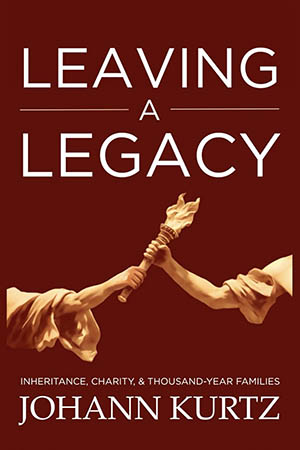
The Great Commission of the modern age is not to bring the Gospel to all nations. It is to CONSOOM! Thus, a man’s perceived success in life is determined mostly by how many resources he can burn through before death, maximizing his hedonic inputs. Leaving a Legacy is a sweeping rejection of this pernicious philosophy, combined with an offering of detailed alternatives—“a classic, Western, Christian vision of family-centric charity.” Instead of single-generation consumption, Johann Kurtz preaches that each of us should strive to leave a legacy—that is, to materially influence the lives of future generations, both of his family and of society.
On the surface, this book seems directed at men who are already established and have substantial discretionary assets. It’s really more broadly applicable, however. Even if you have no money, you will still benefit from this book. After all, maybe someday you will have money, and if you never acquire money or other property, the attitudes you inculcate in your children and collateral descendants are themselves a legacy, one which may more directly implicate the allocation of wealth in a future generation.
You Should Subscribe. It’s Free!
You can subscribe to writings published in The Worthy House. In these days of massive censorship, this is wise, even if you normally consume The Worthy House on some other platform.
If you subscribe will get a notification of all new writings by email. You will get no spam, of course. And we do not and will not solicit you; we neither need nor accept money.
Kurtz analyzes his topic primarily through a Christian lens, though not exclusively a Christian lens—the Funeral Oration of Pericles (not at his own funeral—at the public memorial for soldiers who died in the Peloponnesian War) makes more than one appearance, as do many lessons from the Old Testament. It is evident, and Kurtz would be the first to say, that much of what he says is not really new; it would have been a commonplace in ancient Israel or classical Greece. But most of it has been forgotten, or worse, denigrated and rejected as inapplicable to the modern world. He aims to recover the wisdom of the past so that it may be applied to the future.
We begin with what charity is, for “To understand how to leave a great legacy, we must fundamentally understand charity; only then will we have a clear idea of how to pass on our wealth to do good.” The most famous instruction on charity is, certainly, Christ’s Parable of the Good Samaritan. There, given the Law that we are to love our neighbor, He answered the question put to Him, “who is my neighbor”? Scripture makes clear that our neighbor is not only those people who are within our ethnoreligious community, as the Jews believed (and they and Muslims still believe–only giving to other Muslims satisfies the Muslim obligation of zakat), but others outside that community as well. Not every “person” everywhere in the world, however. Rather, “neighbor,” plesios in the Greek of the New Testament, embeds the sense of someone located spatially close to you. This, combined with the universal Christian view of charity as love for God extended to others, and that we can only actually love those we can meet and know, means that “love and community are inextricably linked, that a mutual knowing is a necessary component of the virtue.” We may extend our community to those currently outside the community, naturally, as did the Samaritan, but he created a personal relationship with the man he helped.
I think this analysis is correct. On the surface, it is in some friction with the apparent message of some of the Fathers of the Church, notably Saint Basil and Saint John Chrysostom, who fiercely directed that all wealth should be distributed to the poor. In some passages, both of those Fathers seem to advocate a sort of leveling, although this was not the dominant view of the early Church (and is traditionally viewed as a “counsel of perfection,” not required for salvation). I have previously extensively analyzed Basil’s and Chrysostom’s demands as they relate to the modern world, and I will not repeat those thoughts here, but in short, the Fathers could not have conceived of any charity other than the type Kurtz recommends. They lived in a world where riches resulted almost exclusively from zero-sum interactions, and the primary activity of wealth was consumption, something Kurtz also condemns. I doubt if either man would have, or rather has, since they are members of the cloud of witnesses, any objection to anything Kurtz has to say.
In any case, in this frame, “we can see why we should be skeptical of the notion that leaving assets in our will to impersonal organizations, to be executed by others upon our death for the theoretical benefit of those who we do not know, should qualify as true charity.” No pre-modern would have thought so, but we have been propagandized by the twentieth-century concept of philanthropy, an attempt to make scientific the giving of charity with the aim of solving problems, many with a political overlay. Rich men were convinced they should be motivated by, in the words of Orestes Brownson, “the love of all men in general, and of no one in particular,” the very opposite of the correct understanding of charity.
This is not an abstract problem; it became universal in America in the twentieth century. Kurtz narrates the pitiful history of the Ford Foundation, founded by Henry Ford and his son Edsel explicitly to benefit the people of Michigan. Henry Ford II unwisely allowed the Foundation to come under the control of others, because he was told he needed to “democratize” its governance. He was very soon betrayed, even in the 1950s, by Judas-like trustees who changed the beneficiaries of the Foundation to the world, not the people of Michigan. Kurtz quotes Heather MacDonald, “When the Ford Foundation flowered into an activist, ‘socially conscious’ philanthropy in the 1960s, it sparked the key revolution in the foundation worldview: the idea that foundations were to improve the lot of mankind not by building lasting institutions but by challenging existing ones.” Thus today the Ford Foundation is one of the most destructive forces on the planet, giving hundreds of millions of dollars annually to extreme left-wing causes, such as actively supporting the Floyd Riots. Essentially all the money the Ford Foundation spends is of negative social utility. When I come to power, hopefully soon, one of my first acts will be to seize all the assets of the Ford Foundation and imprison for many years scores, if not hundreds, of people associated with it, at least if they don’t flee into exile first.
It is not just the Ford Foundation which wastes money, of course; most of the money distributed as false charity to people far away, especially in the Third World, is wasted. Many trillions have been given to the Third World for seventy years, almost all of it wasted or actually counterproductive. (And let’s not even get into “voluntourism.”) Yet the number of people living in extreme poverty in Africa has doubled since 1990 (even if the percentage has dropped somewhat). Giving aid to those far away with whom you have zero connection is both not commanded by Christ and frequently equivalent to burning money, not a good combination.
Kurtz’s does not claim that all giving to places like Africa is wholly wasted, though my opinion is that more that ninety percent of the time, it is (and that as long as your own are struggling, it is morally wrong to give others any money). Rather, he argues that, aside from it being pseudo-charity, giving money to places like Africa rarely is done in a way that allows the giver to tell the difference between wasted and not. If it does not go into a warlord’s Swiss bank account, or to fund shiftless NGO employees (Kurtz notes that twenty percent of the private workforce of New York City is employed by non-profits), it is just as likely to erode local initiative, or to be used to build something that the locals do not understand or care about and which will be dismantled to sell for scrap as soon as the white people depart (the usual fate of development projects, large and small, in the Third World). The disconnection of charity from the necessary local element is the problem, both practically and morally.
That is, “you cannot outsource your charity,” in the definition Kurtz assigns, “nor should you want to. Too many of us are unwilling to risk discomfort by deeply embedding ourselves in the lives of the poor we claim to serve.” We are unwilling to show our love, uncomfortable doing so, except by impersonally donating money through intermediaries, which is not showing love at all. “Our own civilization’s problems like cratering family formation, collapsing social fabric, environmental degradation, and deaths of despair can be ignored when we convince ourselves that we are personally achieving the noble goal of saving millions of lives abroad.”
And back to the main point of the book, in any case, even if you choose to give money in this fashion, it is not leaving a legacy. This can only be done through your family, and Kurtz directs all the remaining chapters of his book towards demonstrating this truth.
Many prominent wealthy people boast that they will leave nothing at all to their children, rather spend it all on pleasures for themselves. Kurtz identifies this as a fundamental abnegation of duty, because “riches are fundamentally God-given and come with duties.” Less hedonism, more duty. He cites Saint Basil, “Why are you rich while another is poor, unless it be that you may have the merits of a good stewardship, and he the reward of patience?” The key to duty is stewardship. What duties a man has varies with his station; Kurtz profiles the execrable Edward VIII, who abandoned his throne to satisfy his forbidden lust, which “communicated to his citizens that their ancient order and morality and faith were dispensable should the temptations be sufficient.” But wealthy men who are not kings also have binding duties, summarized as “elevating those around him through the projection of beauty, taste, manners, and sacrifice.”
Disinheriting one’s children, even if not done for solipsistic, hedonistic reasons, but rather in order to supposedly encourage industry in them, is not the answer either. “One cannot outsource parenting and the cultivation of virtue to the job market. What these parents are doing, whether they realize it or not, is resetting their children to an average position because this is easier than discovering how to make proper use of an exceptional one.” One of the duties which wealth imposes is to use a man’s wealth to raise his children to a higher level, and to instruct them how to use that higher level, that membership in the ruling class, to fulfil the duties they inherit along with wealth.
The usual curt dismissal of this approach is that is not “meritocratic,” meant as a self-explanatory linguistic kill shot. Kurtz, quite correctly, heaps contempt on meritocracy, a term coined as a pejorative in 1956, and far from the central American principle it is often portrayed. A meritocracy is by definition a system in which each person receives what he deserves, but this is meaningless without a common definition of what each person deserves. It is “like saying ‘my political philosophy is good politics.’ ”
When Americans today refer to meritocracy, they mean that each person deserves rewards if he scores highly on “mass standardized formal examinations and evaluations of performance,” seen as leading to economic productivity enabling more consumption. Broader criteria, universally used throughout human history, including whether someone is close to you, by blood, faith, or class, or someone towards whom you have a personal duty, are rejected as irrelevant. But this is a value judgment, and moreover, one which is both stupid and wrong. Nepotism, for example, is affirmatively good; it is only its abuse (in connection with which the term first came into use) that is bad. Aggressive preference for family members is excellent and outstanding, and should be praised—and also demonstrably leads to far better outcomes for family enterprises and for society. It was deliberate preference for one’s own, not false test-based meritocracy, which made both America and the West.
The modern view of meritocracy is, by contrast, intensely societally destructive. It leads to the view that what in the past were regarded as the less fortunate members of society needing uplift instead deserve their low status, and it additionally atomizes each successful man, who sees himself as standing wholly apart from his forefathers and his descendants. (We can leave aside, and Kurtz does, that America is not even meritocratic in the theoretical modern sense, but rather wholly organized around taking from white men and giving what they produce to women and non-whites, compelled by all-encompassing anti-male and anti-white laws enforced by spending billions of dollars of white men’s money.) You should, therefore, “not raise children without merit, but . . . the merit which you pursue should be holistically understood to include your descendants’ health, faith, beauty, fecundity, vitality, vision, curiosity, and virtue.” Disinheriting your children makes this impossible, because wealth allows you to create the structures encouraging this. Otherwise, all you can offer is advice, likely ignored by justly resentful offspring.
The goal should not be only to perpetuate a wealthy family, that is, merely to perpetuate inequality, although of course inequality is the natural state of man and society. It should be to perpetuate a virtuous family, and in this context, most of all this means that “you must justify your wealth with righteous action.” Otherwise, you have only formed a plutocracy, which while perhaps superficially good for your family, is not good for your society, and not ultimately good for your family. The key is becoming part of a virtuous ruling class, which means “submitting to a culture of external obligations” that extend across the generations. The great families which can grow out of this, who rule, make a society what it is. To be sure, the ruling class cannot let itself become sclerotic by forbidding all new entrants; this is the purpose of requiring new entrants to enter slowly, with only later generations becoming fully accepted.
It is not, in fact, true that families rise and decay “shirtsleeves to shirtsleeves in three generations.” Quite the contrary; studies show that aristocratic families often last hundreds of years. (I think Kurtz overlooks that in America, rather than England, from where he offers most examples, this is less true. And yes, the Habsburgs and other less-famed European families have done it, but that was an even more different society.) They accomplish this by the manner in which they raise their children—family rituals; faith; impressing upon children the “family’s identity, mission, and values”; and “initiating children into structures beyond the [nuclear] family.” Rituals include simple matters such as the every-day family dinner, and many more complex, which “assert ‘this is who we are.’ ” They bind the family and they also indoctrinate into culture and taste, something only really fully possible with experiences wealth can bring. Faith imbues the world with meaning and provides “a model of how the world should be.” The family’s identity, most of all the accomplishments of the family, inculcates responsibility and an aversion to bringing shame on the family. And children must interact with other families at both formal and informal social events of many kinds; this forms their proper and demonstrative manners, as well as brings them into contact with potential suitable spouses.
Kurtz chooses a towering figure from American history, John Hancock, to illustrate how this works in practice. His father died when he was very young, but he was literally raised by nepotism—his uncle took him in, gave him graduated but ultimately total responsibility in business, and left most of his estate to Hancock. He, in turn, used his wealth to benefit the people of Boston—not by giving it to organizations that decided how to spend it outside Boston, but by building businesses to employ men, erecting public buildings to benefit the citizens, and acting at every turn to build up something larger than himself. Hancock never hid, rather even flaunted, his wealth, instead of beclowning himself by pretending to be something he was not, while at the same time directly and personally interacting frequently with the poorest citizens, engaging in innumerable small acts of charity directed towards them, such as delivering firewood and food and rebuilding burned houses. He played an instrumental role (though non-military; he was no good at that) in the War of Independence, including reassuring French aristocrats suspicious of the more levelling type of American rebel. Without directed wealth, none of this would have been possible.
A key to Hancock’s success, and to all attempts to leave a legacy intergenerationally, is to avoid bequeathing or even holding large amounts of liquid wealth, the dubious goal of most wealthy people today. Best of all are family businesses, the more permanent-asset-based (such as real estate) the better, which contrary to myth outperform businesses run by strangers. Children should be eased into roles in the family businesses very early, as their talents permit, with an eye to their future leadership. “Remember that you are not attempting to make them the best worker amongst peers, you are forming them into a unique category which transcends other workers: a leader who prioritizes long-term over short-term, ensures that the business fundamentally serves family flourishing before narrower objectives, and harmonizes efforts across family assets.”
All that a wealthy man does should be done in a magnanimous way, in the sense used by Saint Thomas Aquinas, the “stretching forth of the mind to do great things.” And in a charitable way, which means that money should be invested in real businesses “which employ and serve people in our own communities,” not in mutual funds. Moreover, “Invest in a house which is large enough to host large gatherings, and hire whatever staff is necessary to maintain a rich social calendar: cooks, cleaners, organizers. Host dinners and parties in which you introduce local—even national—figures to each other, facilitating connections and community growth. Fill the house with art and relics. . . . Do whatever you can—whatever is necessary—to uplift your community and people.”
And, finally, why? Or, rather, the larger why? “The pursuit of legacy for legacy’s sake is hubris.” “Understanding the impossibility of controlling the future, we are to act virtuously and even to build great things, if this is within our power. But we are to place these as an offering at the feet of the Lord. Only He can carry them into the future.” The aim of leaving a legacy is “to elevate the spirit. The notion that ‘the good’ is best achieved by marginally affecting the material situation of as many people as possible is a modern one. It is materialistic, technocratic and—ignoring God—will cause chaos or achieve nothing.” The duty we have is to act now, not to be passive, and not to “act” only upon our deaths. Certainly, part of leaving a legacy is actual charitable giving, but it is vastly more, and requires continual focused and coherent difficult effort, anathema to the modern worship of hedonism.
It is a powerful message. But for those of my readers who know my own background, you may be saying: very nice, Haywood, very nice, but have you put these principles into action in your own life, given that you are rich and have numerous young children? (Not as many as Elon Musk, but obtained in a more regular and orderly fashion.) In fact, I have a (relatively modest) private foundation of my own, though unlike Henry Ford II, I have not been foolish enough to allow anyone outside my family any portion of governance. Have I left a legacy?
Well, I don’t know. I’m not dead, not yet, and hopefully no time soon. We have certainly followed many of the precepts in this book, perhaps thereby laying the groundwork for a legacy. But I sold my business for cash, and while I have spent a great deal on a massive estate, I do not interact much with any other member of the ruling class. In part this is because I live in Indianapolis, which has no ruling class to speak of, because it is supremely provincial and the prominent rich here are mostly desperate to ape those they perceive as their betters in real urban centers, all of whom are loathsome people who exemplify exactly the lifestyle and outlook which Kurtz condemns.
In part, however, it is because I came late to wealth. I was born and raised without in genteel relative poverty (though as my mother pointed out, as the family of a university professor we were by definition upper middle class, regardless of income, which is true enough). When my children were very young, I had no idea if I would ever have the wealth to leave a legacy. Certainly we have always had family dinner, at which we perform rituals such as having the children chant “Total Haywood Victory!” over some family triumph. Church and evening prayers are an obligation, and every action is viewed through, and taken through, the lens of family strength.
Maybe it is not too late to do more, however. My wife and I plan to become much more social, both in general and with the specific intention of hosting glittering events for young people, with the not-so-subtle aim of helping them find suitable spouses. I may start another business, no doubt in manufacturing, my expertise, in which the children could take root, and continue after I die. I intend to commission art, starting with a life-size bronze statue of my beloved grandfather, placed at a resting place on the mile-long walking path on my property, so that children and grandchildren, along with collateral relatives, may remember their ancestors. That’s just the start, and I am still young enough to do this for decades, if granted the time. And since all such things build on each other in unforeseeable ways, no doubt this will converge on at least the possibility of leaving a legacy.
Ultimately, however, as with so much else, the ability of any individual to execute Kurtz’s program depends on a restoration of virtue in society at large. No matter how we strive to inculcate the correct approach in our children, the acid of liquid modernity and the insanities of our legal system, such as no-fault divorce where a wife can take half or more of a man’s wealth whenever she chooses, along with his children, will likely dissolve our efforts within, at most, several decades. Aaron Renn has recently written several fiery articles on the degradation of America occasioned by the market more and more servicing the ultra-rich on every axis, ignoring the average American, and participation in this flattery and enjoyable cosseting is an irresistible temptation to many. I resist it because of my personality, along with my religious and political beliefs, but that is anomalous.
On the other hand, merely preparing to leave a legacy provides great resilience, so if the necessary, assuredly chaotic and dangerous events arrive which may restore our society, following Kurtz’s plan will also offer the best groundwork to bring all those to whom one owes charity, family and community, through the fire. Demanding certain perception of the future before one takes action is always a crippling vice, so the proper course, it seems to me, is to begin today to follow the advice of this book.
You Should Subscribe. It’s Free!
You can subscribe to writings published in The Worthy House. In these days of massive censorship, this is wise, even if you normally consume The Worthy House on some other platform.
If you subscribe will get a notification of all new writings by email. You will get no spam, of course. And we do not and will not solicit you; we neither need nor accept money.