
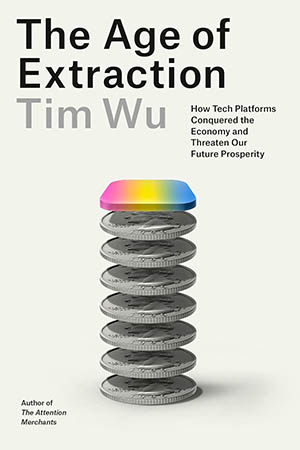
Tim Wu is the Jeremiah of our age. For twenty years, his has been one of the very few nuanced voices attacking concentrations of economic power as destructive of a flourishing society. Yes, others also attack such concentrations, but they are mere looters, and Wu instead wants a stronger society. His message has struggled to gain traction, however, because most Americans who are educated enough to hear his insights spend their days enjoying the fruits of our bogus stock market, fake GDP, and debt-driven consumption, and see few practical problems, rather they see benefits, in their lives resulting from a handful of entities controlling much of our economy. But they are wrong, and Wu is right.
To be sure, Wu has thus far avoided the fate of Jeremiah (being thrown into a cistern). People listen to him respectfully, then ignore him. He ran a somewhat quixotic campaign in 2014 for Lieutenant Governor of New York State, losing to the odious Kathy Hochul, currently the Governor (who certainly does deserve to be thrown into a cistern, or preferably a sewer or volcano). It was quixotic because he refused to pander, instead focusing on the politico-economic matters that are his main concern. “The most pressing issue of our time is . . . inequality and the excessive concentration of private power.” He listed his favorite politicians as “Theodore Roosevelt, Woodrow Wilson, Zhu Ge Liang [a Chinese statesman of the second century A.D.], John Adams, and Marcus Aurelius.”
You Should Subscribe. It’s Free!
You can subscribe to writings published in The Worthy House. In these days of massive censorship, this is wise, even if you normally consume The Worthy House on some other platform.
If you subscribe will get a notification of all new writings by email. You will get no spam, of course. And we do not and will not solicit you; we neither need nor accept money.
Sure, he’s a man of the Left—his campaign website also attacked Hochul, ironically given how she has governed, for being too conservative on immigration and gun grabbing. (Wu was born in America to a Taiwanese immigrant father and a Canadian mother; he grew up in Canada and Switzerland.) He occasionally evinces the tics of a conformist leftist, such as the bizarre claim that Hungary is “an authoritarian semi-democracy,” when it is undeniably freer and more democratic than any other country in Europe. But at least he’s smart and interesting (he clerked for Stephen Breyer, and for a judge on the Seventh Circuit Court of Appeals, the latter as it happens immediately after I did, though I was not cool enough to clerk for the Supreme Court). Such men are not successful politicians in these latter days of “democracy,” but maybe he will find a councilor’s position in the Vance Imperium.
Wu has written three earlier books (two of which I have discussed): The Master Switch; The Attention Merchants; and The Curse of Bigness. All of them revolve around concentrations of economic power and the ill effects flowing from them. In earlier books, Wu focused on concepts such as net neutrality (a term he coined), and on the history and future of antitrust law, through the lens of his heroes Louis Brandeis and Theodore Roosevelt. In The Age of Extraction, Wu has fleshed out his earlier works with a specific focus on technology platforms as they have developed to the present day, and a specific claim that inequality and other ills resulting from centralized economic power lead to mass resentment, which leads to autocracy.
We begin with a clear outline of “platform power.” All civilizations have platforms, mechanisms for reducing the frictions of buying and selling. The Greeks, for example, had the agora; medieval Europe had the town marketplace. All platforms are a “catalytic space,” which by their existence facilitate transactions among people. They match buyers and sellers; they allow the transmission of information enhancing trust; they allow transactions to occur at smaller scale. And they are tolerant of, or even encourage, innovation, by being neutral as to uses.
The Internet Age has created many new platforms, but twenty years ago, the common wisdom was that those platforms would function like the agora, offering low friction interaction among the populace that was earlier impossible. Their size and scope, however, would, it was thought, also fulfil the promise of the internet to hand a great deal of power over to the little people, by creating national or global decentralized opportunity to reach and interact directly with others. The new platforms would allow anyone with talent to bring that talent to the fore, and if he wished, to monetize it directly to his own benefit while also benefiting others—the entire point of a platform. Tools quickly emerged to this end—many early blogs, for example, used Blogger. You didn’t have to use it, but it made it extremely simple to start writing a blog, while other platforms allowed more complicated but more powerful setups, such as using your own domain. Thus, where before you had to physically mail Xeroxes of your thoughts to a mailing list, now the costs of speaking to those interested in your thoughts had plummeted. The same platform-reduced friction was thought to be the future of finding information (search engines); social interaction (social networks); and the buying and selling of goods (online merchants).
A key difference between earlier and modern platforms arose very early, however, without much real notice from anyone. Pre-internet platforms were invariably highly regulated. In pre-modern times, the local lord, for his own benefit and for the benefit of the people, ensured that weights and measures in the town marketplace were accurate, and while he might take a cut, offered security and order in return. In more recent times, financial markets have long been extremely tightly regulated, at least to the extent their services are available to the general public. Internet platforms, however, were from the very first not regulated at all—Congress was convinced early that competition would make them self-regulate to the benefit of users, and that interference might strangle the baby in the cradle.
This hands-off approach was new, even in technology platforms. The history of such platforms began in the 1960s, with IBM opening to third-party offerings the proprietary, customized software which ran on their mainframes. The platform was the mainframe; buyers and sellers could now use it to create and sell software to operate the mainframes. IBM would only set the hardware architecture, and make its specifications available to all. IBM’s action was not its voluntary choice, however; it was the direct result of aggressive antitrust pressure over decades on the company, but this was par for the course, not some special example of enforcement. Wu outlines how, from the late nineteenth century until the 1980s, antitrust laws in the United States were rigorously enforced—earlier, as exemplified by Roosevelt, because of fear of concentrations of economic power as anti-American, antithetical to broad-based private enterprise and dispersed political power, and continuing after World War II, with the added rationale that such concentrations were seen as easing the path to fascism or Communism.
The specific antitrust violation at issue with IBM and its software was “tying”—the long illegal practice of conditioning the purchase of one type of product on the purchase of another type of product from the same seller. European mainframe manufacturers did not face the same legal pressure; rather, they were subsidized by their governments to further a closed system, and you have never heard of their mainframes, or of their software industry, because relative to the United States, their market share is miniscule. This is the direct result of antitrust enforcement opening software as a platform. Regulation ensured it was open to all, and that was enough to create a huge industry, dominated by the United States.
Mainframe software, of course, is only a small component of today’s software industry. The bulk of the industry was created through another instance of antitrust enforcement—the requirement that AT&T, which at one point owned one hundred percent of the telephone lines in America, allow other traffic on its network, that it not be permitted to place strictures on network traffic, and that it not itself be allowed to engage in “electronic publishing,” leaving that to new entrants. The result was, at first, totally open platforms, as many entrants appeared on the scene. The golden age of software platform openness lasted until the 2000s—while platforms such as Google and Amazon, and later Facebook, gradually gained scale, they were largely open and they competed with others, focusing on growing and improving their offerings. But the seeds of future problems had been sown. (I note in passing that I was disturbed to observe that Wu felt it necessary to drop a footnote explaining to his readers what a DVD was, “a disc-shaped form of digital storage widely used from the 1990s to the 2000s to hold films and other video content.”)
What matters for where we are today is that all these platforms turned to maximizing revenue, very successfully, through advertising and related monetization. At one point it was possible to build a business on Facebook while not paying Facebook a dime; I personally know a company that did this and sold for $150 million. Not any more; now Facebook extracts almost all value for itself. The platforms’ prime mechanism for keeping their new revenue flowing, rather than being competed away, was eliminating competition, through purchase of any possible competitor at as early a stage as possible as well as through other anti-competitive devices, including tying. They received zero regulatory pushback. In an earlier age, such actions would never have been permitted. But in the 1980s, the University of Chicago school of antitrust enforcement, or rather non-enforcement, championed by Robert Bork, became totally dominant under both Republican and Democratic administrations.
Thus, Google was able to buy competitors: the mapping app Waze; YouTube; and the advertising powerhouse DoubleClick, among a vast number of others. Facebook snapped up Instagram and innumerable others. Amazon didn’t so much buy competitors; rather, it made smaller merchants totally dependent on it, and then extracted all the value created by its platform. It began by offering a low-fee Amazon-hosted exchange, the Marketplace, on which merchants could sell their products much more easily than by having their own website. Then Amazon jacked the fees it charged from twenty percent of a merchant’s revenue to up to seventy percent, while stealing proprietary information from merchants to create competing products sold directly by Amazon, and imposing rules to keep merchants selling on their site, such as forbidding them selling more cheaply elsewhere—they could maintain their own sales channels, as long as they never actually competed with Amazon, which they now needed because most of their buyers shopped there.
All the new platforms prioritized revenue over all other goals (except political goals, as we will discuss). Consumer satisfaction was and is unimportant, as long as the user, that is, the ad target, could be kept on the platform by some other mechanism. Amazon, for example, manipulates search results so that paid search results, rather than the results buyers actually want, are the majority of those seen by buyers. As a result, the company’s advertising revenue, $56 billion, is twice that of all newspapers in the world (and its total Marketplace revenue from third parties, the rest from taking a huge cut of every transaction, is $185 billion), and has only nominal expenses for Amazon (resulting in advertising being more profitable than Amazon Web Services, often viewed as the main driver of Amazon profit). “In short, sellers (and users) are spending nearly $56 billion to make the buying experience worse. It is a pure example of valueless wealth extraction.” Thus, “With these changes something else has disappeared: the prospect of Amazon’s platform serving as a catalyst of significant independent wealth creation, or the rebalancing of economic power.” That is, the promise of the early 2000s for online buying and selling has entirely vanished.
Wu’s summary term for all these activities is “extraction.” The primary mechanism of extraction is scale. We all know about economies of scale, that bigger enterprises can be more efficient, and therefore both more profitable and better able to serve their customers. But just as real are diseconomies of scale, so at some point “What’s left after a firm has grown too big may not be any great efficiency but just the capacity to bully.” A firm that scales enough is able to simply eliminate competition, if not constrained by some external force. Google spends $30 billion every year “to keep its competitors locked out of distribution channels,” as in by paying Apple to effectively require the Google search engine (which, as has been extensively documented, has been deliberately been made far worse over the past several years by Google in order to maximize advertising revenue—one of many examples of what is aptly called “enshittification,” a term coined by Cory Doctorow).
The same process has taken place over every platform—extraction from smaller value creators, and their loss of any ability to function independently (as well as the ending of any need or interest by the platforms in innovating or permitting innovation). By the mid-2010s, “The main tech platforms had emerged as the dominant tool for harnessing the economic and social energies made possible by an interconnected nation and world.” Their chief focus turned toward extending their successful extraction indefinitely into the future. To continue capturing revenue, platforms must command both loyalty and attention; they must become, as much as possible, all things to all people. This task is made easier by that most people are lazy, and in practice prioritize avoiding pain and inconvenience, even if, when asked, they say they prefer other solutions. They say they want carefully-brewed artisanal coffee, but they in practice consume nasty plastic Keurig cups. Thus, if switching costs are increased, the platform can dig its hooks ever deeper into those who use the platform, totally aside from its simultaneous use of methods to eliminate competition. The result is dependency, and an enervated populace.
The primary daily tool of platforms for this goal is the enormous amounts of data they have accumulated. We all know how, or think we do, how much data Google, Facebook, and Amazon keep on us and use to their benefit—but it much more than most of us believe. To take another example Wu does not use, but which particularly irritates me, Roku’s very inexpensive “boxes” cannot be activated without entering a credit card, despite that there is no subscription and no ongoing payments. The real reason for this, never stated by Roku, is so they can precisely identify who is using a Roku device, and collect, use, and sell extremely granular data on that person’s (and his family’s) viewing habits, which is where they actually make their money. All this data is monetized and used to keep us on the platforms. (I looked up Roku’s financials. They have $3.2 billion of “platform” revenue, with $1.9 billion of gross profit, and $590 million of “device” revenue, with gross profit of negative $2 million.)
Wu then detours to an interesting discussion of the history of so-called artificial intelligence, with an eye to evaluating whether AI will extend platform dominance. No surprise, and accurately enough, he concludes it will be controlled by the platforms and will reduce the power of, and increase the dependency of, all of small firms, employees, and consumers. AI will not undermine, because it will not be permitted to undermine, the platforms, although it may create new platforms. (I personally think AI won’t do much of anything beneficial for most people that is materially different from today, though I am in the minority.)
However, platforms are not limited to technology platforms, and here Wu turns to excoriating one of my favorite targets, private equity, a pernicious force and one of the main drivers of platformization. Healthcare, a considerably bigger industry than technology in the United States, is rapidly becoming platformized, through the mechanism of private equity rollups. Vast pools of money (cheap because of interest rates kept artificially low, which rates are not available to small businesses) are used to buy small physician practices, turning them into one larger entity with claims of efficiency, and then services are reduced and prices raised (and the physicians abused as dependent, if somewhat wealthier, employees). Voila, platform extraction. Similarly, private equity has been buying vast amounts of single-family housing, and performing the same trick. Every so often a few politicians try to stop this; they are defeated by either being bought off, or more pliant politicians being funded and elected in their place. And across our entire economy, credit card companies, also a type of platform, levy a private tax of three to four percent on every credit transaction (whereas in Europe their fees are capped at 0.30%). In other words, every possible economic activity in America that can be turned into a platform is being turned into a platform to extract money from you and me, because smart men with power can get away with it.
Why, however, is platformization of an economy resulting in extraction bad? One obvious reason is consumers, you and me, get worse everything at higher prices, although admittedly in some cases with greatly increased convenience. But Wu’s main answer is that it leads to political autocracy: “feudalism, monopoly capitalism, Stalinism, and fascist command capitalism.” Here things start to go somewhat wrong with Wu’s book, because this encapsulation which opens Wu’s discussion shows blurred thinking. There was nothing wrong with feudalism (by which Wu means, I think, manorialism, since his focus is extraction even in this context); it was a very effective, just, and equitable system for its time and place. And even if the other three are bad, monopoly capitalism is what we’re talking about, so let’s not be circular. The rise of Stalinism (by which Wu must mean Bolshevism) and fascism was not caused by platforms or even other concentrations of economic power; such a history is beyond simplistic. Yet he is not wrong that “aggregating economic and political power in a few people or corporations is dangerous.”
What is the danger? There are really two axes of danger. Wu only discusses one, and unfortunately with a distorted presentation. The first is that economic and political imbalances can lead to societal fragility. He outlines a plausible mechanism: monopolization of the economy leads to extraction, meaning the creation of a large class of losers, “consumers who pay more, workers who are paid less, and local, regional, smaller, and medium-sized businesses that are acquired or driven out of business.” This results in mass resentment. The exact mechanism of this resentment Wu is a little vague on. In part it’s due to inequality, though Wu glosses over the difference between resentment that is mere envy and resentment towards inequality that is substantively unjust. He also seems unsure who is to blame; he emphasizes that “scapegoats” such as immigrants are often blamed, along with “greedy elites,” seemingly unaware that parasitical migrants are a major tool by which the greedy elites impoverish the native inhabitants of a country, at least in the modern world.
In any case, we then arrive at “democratic failure,” by which Wu means “an elected government is either unable or unwilling to respond to majority resentment in a meaningful way,” “compounded if the state is understood or credibly portrayed as supporting or perpetuating the ongoing extraction.” And democratic failure leads to “the rise of the strongman,” which Wu treats as self-evidently a bad thing. He calls this process, riffing off Friedrich Hayek, “the real road to serfdom,” although he does not demonstrate that autocracy means serfdom, apparently thinking that also self-evident.
In The Curse of Bigness, a book I thought was extremely good, nearly perfect, Wu expressed concern about economic concentration simply because it led to concentrations of political power, not autocracy specifically. He cited his hero, Louis Brandeis, “If [Brandeis] had a unifying principle, politically and economically, it is . . . that concentrated power is dangerous, that institutions should be built to human scale, and society should pursue human ends. Every institution, public and private, runs the risks of taking on a life of its own, putting its own interests above those of the humans it was supposedly created to serve.” Wu expressed a conservative vision, as he also did in The Attention Merchants, again citing Brandeis, “For him, the very purpose of life was the building of good character and the development of self. The ‘ideal’ of democracy, he once said, should be ‘the development of the individual for his own and the common good.’ ” Wu has apparently moved away from this vision to a more simplistic, but more politically attuned, at least on the Left, focus on supposed autocracy. But despite Brandeis’s association of democracy with the common good, the choice between democracy and autocracy, or variants thereof, has very little to do with the first-order goals that Brandeis outlines.
Nor do Wu’s historical examples of the process lend much support to his argument. The less said about his main claim, that Haiti has been a shithole for 250 years because in the 1700s it was an extractive economy, the better. Haiti is a shithole because it is run by Haitians; full stop. Tsarist Russia was not a particularly extractive regime—as Sean McMeekin outlines in The Russian Revolution, the last decades of the Russian Empire were times of enormous industrial investment and growth, lifting everyone. It was the Great War and Left ideology, funded by German gold, that led to the triumph of Communism, not popular dissatisfaction (the peasants, after all, almost all supported the Whites). He’s on firmer ground citing American, British, and Japanese turmoil of the 1920s and 1930s, and with a vague reference to the “resource-wealthy economies of Central and South America.” Nonetheless, he is entirely correct that America at this hour has a lot of mass resentment and democratic failure (meaning governmental refusal to address the people’s needs), and at least he doesn’t claim that Donald Trump is his feared strongman.
It is certainly true, however, that a society with a broad ownership component, where the majority of citizens see themselves as having a stake in the society, is a much more stable society. Inequality beyond the point necessary for adequate incentives and to reflect objective differences is bad, because it increases dissatisfaction and also increases elite corruption. The resulting corrosion is often exacerbated for political/ideological purposes. True, some degree of inequality is the natural state of man, and the more undesirably diverse a society is, the more inherent inequality comes to the fore. But if a society can have less inequality, that is no doubt optimal.
Oddly, Wu claims America earlier prevented this cycle by “handing out free or highly subsidized land to immigrants” in the nineteenth century. This is ahistorical. America began as a broad-based, non-extractive homogenous society, and only entered the cycle of extraction upon industrialization towards the end of the nineteenth century, after those distributions. We never experienced “democratic failure,” at least not until now, because the government quickly addressed the resulting problems by laws such as the Sherman Anti-Trust Act in 1890. Shoehorning immigrants into the analysis for obvious political reasons is beneath a man of Wu’s intelligence. Claiming that Denmark prevented modern problems by land distribution in 1784 in a purely agricultural economy isn’t a great example either. Nor is Wu’s pointing to early twentieth-century Germany very relevant—German mass resentment wasn’t due to platforms and economic extraction, but due to impoverishment from the hyperinflation of 1923, followed by economic collapse in the Great Depression.
Still, breaking the cycle, if that’s the goal, is easy in principle, and has very clear historical precedent in America—extremely aggressive antitrust enforcement. For example, antitrust law has a century of experience in precisely defining what a “market” is, for specific regulatory purposes (such as Hart-Scott-Rodino merger filings), although as Wu says today there is never any actual enforcement. It would be easy, in theory, to pass a law saying that no firm could control more than five percent of any defined market, subject to forcible breakup and criminal penalties for subsequent collusion or coordination other than at arm’s length. We won’t get any of this, though, because Congress is a group of disgusting, corrupt Last Men. But it’s nice of Wu to lay out the philosophical case, though as I say, less focus on autocracy would have been better.
The second axis of danger, however, which Wu completely ignores, is that a centralized platform economy, especially where the platforms control information and social interaction, will be ideologically captured and become a tool of one segment of society in its political struggles with other segments of society. This is, of course, exactly what has happened—with the sole exception of X, and that only recently and for unique reasons, every single modern platform is run by the Left for its own political benefit. Blogger quickly turned to kicking right-leaning blogs off its platform. Google hugely manipulates search results to benefit the Left on every axis, and its Gmail deletes emails raising money for Republicans and rushes those for Democrats to your inbox. Twitter did, and Facebook does, aggressively censor and deplatform (in a different meaning of “platform”) conservatives. So do, even more, Reddit and Discord; the former entirely purged all support for Trump from the platform. Airbnb forbids those it suspects of gathering for right-wing protests from using its platform to find accommodation. Wikipedia, which Wu incorrectly praises as still “open,” is instead curated in every article with any political aspect to ensure an exclusively Left perspective and to totally forbid any neutral or Right-leaning edits (and constantly begs for money, not for its operations, but to donate to far-Left causes). And all AI platforms (except, again, X’s Grok) are both aggressively programmed to spread Left doctrine in all matters and to fiercely censor any Right thought, and to ban those who refuse to bend the knee and ask inconvenient questions of their statistical text predictors.
Thus, in reality, today’s platforms have two chief goals—extraction and advancing Left ideology. They don’t have to balance these goals against each other, however, because all consumers, including those on the Right, have little choice but to use the platforms because of their total dominance, and none of the censorship and deplatforming has any material impact on the revenue generated by the platforms. Wu’s solutions would, perhaps ironically given his own political leanings, likely solve both problems.
Today’s platforms even eagerly cooperate with each other to advance Left causes. The most stunning example of this was the 2021 simultaneous joint action of every major technology platform to, on a single day at a single hour, destroy the social network Parler. This was done because Parler was correctly seen as a threat, by allowing low-friction non-Left dominated discourse to exist, to the Left’s coordinated national and international campaign to destroy Donald Trump after they successfully stole the 2020 election. All the tech platforms (along with other platforms, such as the huge banks and credit card companies) were active participants in this campaign (as well as the election theft), and they thought that they had a chance to put a permanent end to the challenge posed by a Republican Party which actually sought to challenge total Left dominance (and to return to the receptive and accommodating catamite Republican Party of George W. Bush and Mitt Romney). Parler was only one example of their using their power in ideological warfare; the same platforms, for example, eagerly volunteered to assist in the unprecedented political terror unleashed against the heroes of the Electoral Justice Protest, turning over bank records, hotel records, and search records of anyone who was anywhere near the Capitol on January 6th.
To be fair, one of Wu’s main recommendations to solve the problems he describes so ably, in addition to a return to basic antitrust enforcement, is a ban on business discrimination by platforms. In essence, this is treating all platforms as common carriers, which would seem to include a ban on political discrimination. He is no doubt correct this and his other offered solutions would redress, to some degree, inequality, as well as reverse the stagnation of wages and the entirely-accurate perception that most of our society is getting the shaft (although forbidding most migration and reshoring all Somalis, Haitians, and so forth would go even further, increasing wages and making housing far more affordable, among many other benefits).
The usual response to criticisms of the type Wu levels is some form of techno-optimism, tied to what Wu calls “the persistent dream of the self-correcting economy,” which assumes that monopolists will not or cannot defend their position, the “passive monopolist fallacy.” Now, there are many varieties of such optimism—I am a techno-optimist, in the sense that I think that technology holds enormous promise for mankind, if properly channeled and governed. There is no absolute reason why in two hundred years the Solar Imperium should not be a reality, although a great many changes would have to occur first, a wholesale remaking of our societal priorities.
The optimism here, though, is of a different kind. It is the facile belief that technology, most of all in the form of so-called AI, will, through no very certain mechanism (though crypto is often mentioned, never with any clear explanation why, as Wu notes), erase the problems Wu incisively demonstrates. As Wu says, technology can help or harm a society—the plow helped mankind; the cotton gin gave us cheaper clothes but extended the life of American slavery. Technology is not “some kind of omni-benevolent godhead that will act by itself to solve humanity’s problems.”
It is unfortunate that Wu’s analysis and prescriptions will gain exactly zero traction. To the extent they are used, they will be used to further looting, stealing from the productive while claiming to address the problems Wu discusses, doing nothing to address the actual structural deficiencies of today’s platforms. When and if there is enough turmoil to allow real political change, however, Wu’s ideas may bear fruit. I certainly hope so.
You Should Subscribe. It’s Free!
You can subscribe to writings published in The Worthy House. In these days of massive censorship, this is wise, even if you normally consume The Worthy House on some other platform.
If you subscribe will get a notification of all new writings by email. You will get no spam, of course. And we do not and will not solicit you; we neither need nor accept money.