
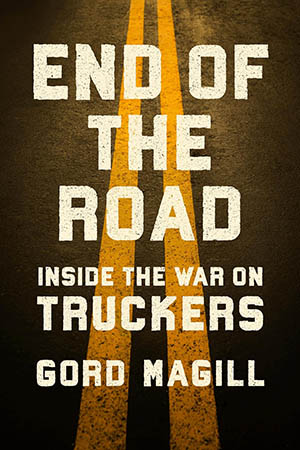
A few months ago, I showed our young children 1977’s “Smokey and the Bandit.” As with so many movies that are more than twenty years old, watching it is like stepping into a different, far better world, before end-stage civilizational enervation exacerbated by Left ideology utterly destroyed the fiber of America. One could write an entire article on the movie, comparing America then to America now, but for today’s purposes, what matters is how it showed truckers as independent, free actors, the modern descendants of cowboys. In End of the Road, Gord Magill, trucker and descendant of truckers, tells us how the profession of trucking was brought low, to the detriment of not only truckers, but of most Americans.
This is a book with a dual focus—both on the existential challenges facing truckers as truckers, and on how those challenges are part of larger undesirable societal changes. It is fundamentally a populist book, directed against the combination of government and corporate power that has reduced the once-proud profession of trucker to, essentially, a powerless and disposable wage slave. In recent years, populism is regularly denigrated by various undereducated internet scribblers, who deny that populism has any political potential, despite voluminous historical evidence to the contrary. Still, for a populist movement to gain political traction, both awareness and some form of proposed organized action are key, and this book offers both, though Magill is not overly optimistic about solutions, which is perhaps why he gave this excellent book its somewhat downbeat title.
You Should Subscribe. It’s Free!
You can subscribe to writings published in The Worthy House. In these days of massive censorship, this is wise, even if you normally consume The Worthy House on some other platform.
If you subscribe will get a notification of all new writings by email. You will get no spam, of course. And we do not and will not solicit you; we neither need nor accept money.
He begins the book with the history of the famous Freedom Convoy, the trucker-organized and trucker-led peaceful 2022 protest against Canadian government tyranny during the Wuhan Plague. That story is of itself interesting, and infuriating, and Magill himself participated. But he asks a question that is rarely if ever asked—why were truckers the leaders of that protest? His answer is that truckers “have been the target of a long-running and mostly silent war,” and the Canadian government’s totalitarian behavior was just the final straw causing truckers to react in anger.
Magill has been a working trucker since high school—that is, for more than thirty years, and so were his father and grandfather. This first-hand experience gives End of the Road an immediacy and credibility that would be lacking in the type of book we are more often offered, a purely analytic book by some think tank geek. Magill’s experience spans three Anglosphere countries—he is Canadian by birth, now an American citizen living in upstate New York, and spent several years along the way trucking in Australia. His smoothly-written book blends in much interesting history, along with compelling autobiography, making the final product far more interesting than would be a dry analysis of supply and demand. Still, the very core of the book is in fact a microeconomic argument: for decades, a malevolent partnership of government and corporate interests has done everything possible, regardless of short- or long-term cost to Americans (and Canadians), to increase the supply of truckers, in order to ensure that truckers’ wages remain as low as possible—about half of what, in inflation-adjusted terms, they were forty years ago.
Naturally, those who have ground down the truckers deny they have any such intent. Instead, they insist they are solving problems, and that truckers must “take it quietly, say nothing, just work harder and harder in the belief that things will get better.” Of course, this is the lie that for thirty years has been sold to those outside the professional-managerial elite, those who don’t work at “email jobs” and instead create actual value in the economy, which the elite reallocate to themselves. But the non-elite lack political power, and so matters have gone from bad to worse, both for truckers and for all other non-elite jobs. Magill’s aim is to galvanize truckers to take back what is theirs. I suspect this is impossible without more radical changes than Magill proposes, but every bit helps, and if there is a new dispensation in the future, beginning to create proper structures now will enable a smoother transition.
After his introductory words on the Freedom Convoy, Magill then draws back the lens, to explain to the layman how the trucking industry works. Prior to the Motor Carrier Act of 1980, which was passed largely in an attempt to help control inflation, trucking was heavily regulated, including government control of rates and sharp limitations on new truckers and new trucking companies. Magill recognizes that in some ways this created an undesirable cartel, keeping prices (and wages) high while discouraging innovation, and notes that some trucking companies at the time opposed the new law, while others supported it. The result of the MCA, however, was to begin a continual erosion of all standards and a never-ending race to the bottom, because those who profited as a result ensured that the vast majority of necessary government regulation benefitting truckers also either disappeared or become ineffective.
In the United States, to drive a vehicle heavier than thirteen tons, a CDL (“commercial driver’s license”) is required. States issue CDLs, and until relatively recently the system typically involved what amounted to an apprenticeship program, where existing companies would invest in new drivers, giving them both book learning necessary to pass the CDL test, and practical learning necessary to safely drive, understanding that a test could not possibly cover all necessary matters. Today, a combination of debased standards, CDL “schools” that are fronts for fraud, and waves of ignorant, culturally incompatible migrants, many brought specifically to this country to drive, now means that many licensed drivers have not actually obtained any of the necessary skills. Many drivers are instead largely or wholly untrained, and a huge percentage of such drivers are now foreigners. The most poignant cost of importing these foreigners, to which Magill returns again and again, is the death and maiming of thousands of Americans and Canadians by these odious foreigners, both because of their lack of training and because many of them, especially the Indians, who are the largest group, come from societies that are largely indifferent to loss of human life.
The big lie, the dispelling of which much of this book revolves around, is that there is a shortage of truckers. You have no doubt heard this lie yourself. The reality is that there is a shortage of trained, competent truckers who will work for $15 an hour or less, the wage created by flooding the CDL system with bottom feeders, under undesirable work conditions. The lie is put out by a combination of corporate groups masquerading as truckers’ associations (notably the falsely named American Trucking Associations), politicians in their pockets, and, more recently, networks of migrants eager to bring in more of their co-ethnics. Sluices of money have been directed for years by federal and state governments to solving this bogus shortage, much of it to CDL “schools,” often aimed at foreigners whom the state brings in, whose only aim is to enroll bodies in order to receive government payments. And to further ensure reduced competition, when a driver obtains a CDL, even if he is not incompetent (for certainly some are not), he is often trapped into a “lease-operator” arrangement, supposedly as an independent contractor, in a structure designed to ensure his total lack of actual independence and to extract every possible dollar from him, while ensuring he has no security at all. Moreover, even those drivers who actually are independent are subject to the whims and price-gouging of 3PLs, “third party logistics” companies, who nearly universally are used by shippers to broker freight loads at the lowest possible cost and are also participants in spreading the lie of trucker shortages. No surprise, 3PLs are increasingly owned by destructive and evil private equity, whose entire mode of operation is to extract value for themselves by any means possible, devil take the hindmost.
Making matters worse, the swarms of migrant drivers imposed on us to drive down trucker wages often have zero command of the English language, including lacking the ability to read road signs. This nightmare resulted in part because a decade ago Barack Obama removed the English language proficiency requirement for CDLs. Obama’s action wasn’t for the same reason “President” Biden later flooded the country with tens of millions of invaders, that is, to punish and replace the non-elite native population while lining the pockets of elites. Rather, it was primarily because politically-powerful shippers such as Amazon demanded cheaper and cheaper payments to truckers (not just truckers—I have never once in the past ten years interacted with an Amazon last-mile delivery person who is a native American), and removing the language requirement was an easy way to get more CDLs.
Thus, work permits were given out like candy during the past ten years to illiterate just-arrived foreigners, who could then get a CDL in a month, because many states ignored domicile requirements as well, allowing foreigners to forum shop to get a CDL in the states most lax about regulation, and who then were put on the highways (if not before, illegally, as often happens). Naturally, truck-involved accidents immediately rose sharply nationwide. President Trump restored the English language proficiency requirement in 2025, but it remains to be seen what effect this will have, especially with the treason of state regulators who regard their main duty as “resistance” to Trump, combined with shell games by foreigners eager to strip-mine our formerly high-trust American society, who, for example, use hundreds of disposable LLCs so that, if a trucking company is shut down for violating the law, they can simply shift the trucks to a new one with the same incompetent drivers.
Magill lays all this out with detail and verve. But truckers face many other problems, which Magill also covers. Some of them are created by regulation, notably extremely intrusive electronic monitoring devices meant to limit driving hours on the road, now moving to include always-on driver-facing cameras. None of these have had any effect on safety in practice, and Magill’s fundamental complaint is that such devices remove dignity from a trucker, treating him with contempt by removing independence of action. He correctly refers to this as a form of serfdom, hearkening back to the time when it was understood that pride and independence of the working man should be, and has to be, a core goal of America. Moreover, the data from such devices are manipulable remotely, usually by Indians assisting their co-ethnics so they can work longer hours on the road, the cause of many of the killings by foreign truckers of drivers on the road. Other problems are simply strange legislative lacunae—bizarrely, something I did not know, unlike all other American non-managerial workers, truckers do not receive overtime pay, because they were carved out of the 1938 Fair Labor Standards Act. Still other problems are not existential, merely annoying, such as the death of vibrant truck stops and their flooding with dirty foreigners who wash their feet in sinks and, as in their homeland of India, use common areas as a toilet.
Another threat to truckers is the apparently looming arrival of self-driving trucks, which Magill discusses at length. I have long maintained that true self-driving cars will not arrive anytime soon, and likely never, and so far I have been proved correct. In the past ten years, since I first started touching on the topic, self-driving cars have unsurprisingly made a great deal of progress on driving under normal conditions (they no longer require the pre-mapping in 3D space of every traffic light, for example), and considerable progress on edge cases. But there is little evidence that self-driving cars will ever be able to drive generally unsupervised, beyond their present status of what is called Level 3 (with Level 5 being true autonomous driving, and Level 4 being able to drive unsupervised under sharply constrained conditions, essentially on known routes with good weather and very few complications, such as Waymo taxis do in a few cities).
The reason for this hard limit, as Magill outlines, citing Matthew Crawford and Michael Polanyi, is that, as with many other areas of human endeavor, trucking (and driving more generally) requires tacit knowledge that cannot be reduced to rules, and thus can never be done entirely successfully by machines, neural networks or not. I wrote some years ago, for example, about the total failure of attempts to roboticize bricklaying for this reason; there are simply too many unquantifiable variables which a skilled tradesman can integrate using his brain and experience, and a robot, powered by “AI” or not, cannot. Along similar lines, once upon a time, I ran a cabinet shop, specializing in built-in bookcases, and every so often I ask “AI” models about such work, curious if they will ever be able to communicate any element of the tacit knowledge embedded in every area of woodworking. Nope. They never do; it is all just regurgitated slop from the internet, “measure and cut.” Disappointing, but not surprising.
Somewhat proving my point, the major developer of driverless trucks, Aurora, valued at many billions of dollars, is currently running a few trucks—in Texas, between Dallas and Houston (with backup drivers riding along). It is, of course, no coincidence that a major highway in Texas, straight, warm, and well-maintained, is the location of choice for these, and that Phoenix is apparently the next proposed test location; these are locations with relatively few of the edge cases caused by weather that are common in more northern areas of the country. I think the chances of truckers entirely losing their jobs to robo-trucks is low, and will drop to zero if such a truck smashes into a school bus. It is possible, however, that totally driverless trucks, or ones with mere babysitters, will be able to run on major highways between known points. Certainly, the same forces that have attempted to drive down trucker wages for decades are keenly interested in at least this result, and these are powerful forces. And it is certainly true that babysitting a truck is both a degrading job and one which allows corporate interests to hire morons, and that any such result would further destroy the trucking profession, along with more of America’s social fabric.
One possible response to all this is that truckers are simply dinosaurs, and should accept their fate. It is the old argument that what we are seeing is merely “creative destruction,” and muh Free Market will in the end make us all better off. You would think that after the ruination of America caused by throwing open our borders to cheap imports, starting around 1990, that this argument would be laughed out of the room. The only people who have truly benefitted are the email job classes, and while it is true that Americans are able to buy cheaper goods from abroad, this does not counterbalance the destruction of the sinews of American society, including the family. It is simply not a good trade that Americans can engage, to a much greater degree than thirty years ago, in endless consumption of unneeded goods, mostly of vastly lower quality. Amazon, for example, is a hugely destructive force, which any future Caesar would do well to dismantle as one of his first acts (although the list of needed first acts is very long indeed). Atomizing our society into internet consumers has been a disaster, and the impact on truckers is only one of its destructive results.
Anticipating the inevitable kneejerk response, Magill addresses the tedious “Luddite” argument directly. He correctly points out that the Luddites have been “incorrectly remembered by history as knuckle draggers who were against technology as a whole,” mere terrorists in the mold of Theodore Kaczynski. Rather, quoting Crawford, a Luddite is “someone with a clear-sighted grasp of the political economy that stands behind automation and has enough spirit to make a claim on his own behalf for his livelihood and way of life.” Society should not be reduced to a quest for cheaper goods; balance is required.
What of solutions? Is it really the end of the road for truckers? Magill tries to be optimistic, but it’s an uphill climb. There are a few trade organizations which actually represent truckers, some of which Magill praises, but they are small and lack power, and they are not unions. Traditionally, unionizing is a powerful, if sometimes flawed, solution to asserting collective rights, but that does not seem possible for truckers, for historical and structural reasons. Magill discusses how the Teamsters, which once purported to represent most truckers but now is a shadow of its former self, have long actually represented not truckers but the elites. Moreover, a new union is extremely unlikely, because truckers cannot adequately unify, the result of decades of importation of close-knit foreigners who act in the interests of their ethnic group above all. And in the one instance where some truckers organized, the Freedom Convoy (to which Magill returns at the end of the book), the response was savage unprecedented repression by the totalitarian Canadian government, which, like all elements of the Regime, fears populism and reacts with fury to any challenge to the elite. If, by some miracle, truckers did organize, the political and economic forces whose ox was gored would certainly require the government to forcibly dissolve any such organization.
It would seem that regulatory and legislative changes are really the only practical solution, or if not solution, way of addressing the problem. Magill acknowledges the Trump administration’s efforts to reduce unqualified foreigners from the ranks of truckers, though he clearly wonders if there will be follow-through, or adequate follow-on efforts. (He does not say, but I note, that the Trump administration’s abysmal failure to attack illegal immigration at one of its main origin points, by prosecuting employers and mass deporting illegals they employ, indicates that the powerful political forces at play will prevent any adequate action.) He suggests that, at a minimum, the federal government should offer to retrain truckers whose jobs are lost to robotrucks, and forbid driver-facing cameras. None of these, however, solve the underlying problem—that America is an atomized, extractive economy on every level, and that truckers are among the groups designated for extraction. Until a complete reworking of the American political and social system arrives, it seems unlikely that the trucking profession will be able to maintain more than a shadow of its 1970s self. If it does arrive, however, those men then in charge would do well to study this book, and use it to inform how to rebuild the trucking system.
You Should Subscribe. It’s Free!
You can subscribe to writings published in The Worthy House. In these days of massive censorship, this is wise, even if you normally consume The Worthy House on some other platform.
If you subscribe will get a notification of all new writings by email. You will get no spam, of course. And we do not and will not solicit you; we neither need nor accept money.