
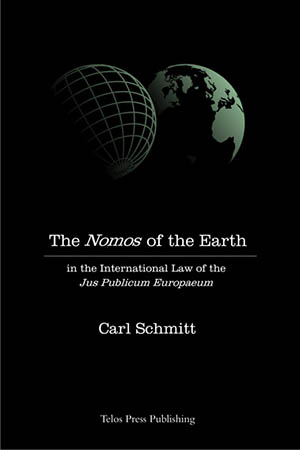
An evil stench has accompanied the term “new world order” ever since George H. W. Bush used it in 1990, formally inaugurating the American Regime’s attempt to subjugate the globe to Left hegemony, dubbed liberal democracy to hide the poison. Nonetheless, it is certainly true, as a simple statement of fact, that we do indeed live in a new world order, different than the one proclaimed by Bush. We have since 1914, and this new order is characterized by disorder, by vastly increased chaos, violence, and uncertainty relative to the past. The hows and whys of this transition are the focus of Carl Schmitt’s 1950 The Nomos of the Earth. And as with all of Schmitt’s writings, it has many lessons for today’s time.
Schmitt wrote this book in a destroyed Europe, when the continent, and all the West, was trying to regain its footing. The feel of that time, which pervades this book, is very difficult for modern Americans to grasp, the result of decades of propaganda designed to artificially create and forcibly impose the now dying “postwar consensus,” exacerbated by the disappearance of objective historical analysis and its replacement by tendentious ideological dreck. When first published, The Nomos of the Earth was an obscure, uncelebrated work. Schmitt had been almost entirely sidelined because of his brief opportunistic embrace of National Socialism in the 1930s, and few had much interest in what he had to say, or in associating themselves with him by giving attention to his work. No doubt this is why Schmitt claims this is a book of jurisprudence, disclaiming any attempt to regain his influence over the political sphere. He is lying, though, because in his nature he was a tireless self-promoter eager to shape the world around him, and so he surely intended this book to inform the politics of the future.
You Should Subscribe. It’s Free!
You can subscribe to writings published in The Worthy House. In these days of massive censorship, this is wise, even if you normally consume The Worthy House on some other platform.
If you subscribe will get a notification of all new writings by email. You will get no spam, of course. And we do not and will not solicit you; we neither need nor accept money.
The Nomos of the Earth is, therefore, explicitly a book which revolves around analysis of international law. Now, as many have pointed out, international law is today a total fiction, because it is not law at all, since there is no sovereign who both promulgates and enforces it. Rather, it is a dubious form of non-binding contract, from which emanates ever-evolving pseudo-law announced by nations which, at any given moment, hold power over other nations. They claim the sanction of this pseudo-law, typically on the basis of infinitely-flexible “values” and “norms,” in order to provide a pleasing sheen to the actions they take in their interest, thereby offering a propagandistic justification for their actions. At the same time, they completely ignore the same when it is not convenient, despite the protests and attempts by those lacking power to throw back this evanescent “law” at its proclaimers. All which makes it no law at all.
So, for example, in the Iran War ongoing at this moment, or as a military friend of mine calls it, “Mr. Trump’s War of Israeli Aggression,” both the United States, and even more Israel, every day breach international law they earlier proclaimed. Among these acts are the assassination of negotiators and other civilian political leaders (not only “illegal” but a classic example of Middle Eastern treachery long viewed as both dishonorable and stupid in the West); the mass killing of civilians by aerial bombing, both for terror purposes and as a byproduct of said assassinations; and the destruction of purely civilian infrastructure necessary for life. If one-hundredth of what we and our supposed ally Israel are doing in Iran were done to us, our rulers would endlessly shriek about violations of international law (alternating with claims of “terrorism!”). But what is sauce for the goose is, apparently, not sauce for the gander.
None of this would surprise Schmitt, however. His overarching point in this book is that a system of actual, effective international law, which largely prevented such barbarism within Europe for four hundred years, died around the turn of the twentieth century, and a new order had not replaced it. Nor, of course, has any new order replaced it since 1950, despite fictions such as the “rules-based international order,” meaning, again, the imposition of Left hegemony over the world.
But let’s get into the meat of the book; we will return to today. The Greek word nomos is usually translated as “law.” Schmitt, however, used the term in a broader sense, as can be seen immediately from his modifier, “of the Earth.” G. L. Ulmen, the translator who also wrote an excellent Introduction, summarizes Schmitt’s use as “the community of political entities united by common rules,” “the spatial, political, and juridical system considered to be mutually binding in the conduct of international affairs.” Schmitt, in an extended discourse on the history of the word from its earliest Homeric use, says “In its original sense, however, nomos is precisely the full immediacy of a legal power not mediated by laws; it is a constitutive historical event—an act of legitimacy, whereby the legality of a mere law is first made meaningful.” His aim is not merely to bore the reader with etymology, however (though he tries in a three-part Appendix); it is to ground the collection of rules under which a civilization governs conflict in the concrete, rather than the abstract.
Up until Schmitt’s youth (he was born in 1888), from the Age of Discovery four hundred years before, there was indeed considered to be a European-created “international law,” which was the order of the earth, at least as applied to relations among states. The Romans had, for themselves, the concept of the jus gentium, law which applied to foreigners, as distinct from domestic law. Europeans appropriated this idea, to apply to the whole world, rather than to one nation, a new jus gentium, international law, derived from European law.
This international law was not the law of a federative body, such as later generated by bodies including the League of Nations. Nor was it derived from—rather, it effectively superseded and replaced—the somewhat equivalent law that held sway prior to the Age of Discovery, that of the res publica Christiana, which had derived transnational law from Christian doctrine. Instead, it was a universal positive law, developed in a manner similar to English common law, through specific application in circumstances requiring joint decisions. But it was not positive law in the sense Schmitt despised, an ever-changing set of abstract, unrooted rules, subject to the whims of those in power at the moment. Instead, it was meant to reflect “the total concept of right that comprises a concrete order and community,” derived from European modes, orders, and experience. Most of all what drove its creation was the desire to “bracket” warfare among civilized, meaning European, states. Thus, the new nomos acted as a katechon, the restrainer of anarchy and chaos, the shadowy power mentioned by Saint Paul in Second Thessalonians, a frequent touchstone of Schmitt’s. This was not an entirely new thing; as Schmitt notes, Christians of the Middle Ages saw Christendom as the extension of the Roman Empire, and therefore as an extension of that empire’s role, seen clearly by the early Church Fathers, as the katechon which held back Antichrist.
Nothing lasts forever, and so it was with this new order. The common, confident vision of Europe and Europeans of themselves which made this nomos possible eroded towards the end of the nineteenth century, and was finally destroyed by World War I, by the war itself and by the resulting failure of confidence in Europe as the defining metric of civilization. The Treaty of Versailles and the League of Nations abandoned much of the Eurocentric jus gentium, while trying, and failing, to create a new international order. No new form of law based on a claim of legitimacy arose, nor had one arisen by 1950, in part due to the rise of American power, which never fully entered into the European jus gentium, and in many ways arose in opposition to it.
As with all of Schmitt’s works, this book is extremely dense and complex, filled with detailed analysis and asides, and moreover containing innumerable references to other thinkers and works, and it is really only possible to offer a summary of Schmitt’s thought. The primary thread that runs throughout The Nomos of the Earth, however, is analysis of war and other conflicts between nations. One of Schmitt’s abiding preoccupations, in several of his works, was how desirable it was to bracket wars, to make them less than existential, not wars in the name of humanity but wars in the name of particular and identifiable national interests, which in their nature have limits and accept tradeoffs. His oft-repeated fear, borne out by later history, was that seeing wars as moral crusades for abstract ideas and ideologies, each seeing itself as pure and good and its enemies as unalloyed evil, would result in vastly greater destruction in war. Schmitt’s unfleshed-out response in this book was to retreat from the already-broken concept of state sovereignty as the basis for the nomos of the Earth, to what might be called a higher level of generality, Grossräume, larger political orders. His particular aim was to sweep America into a new system, not yet worked out in detail, that rejected both the relativism of universalism, the “world state,” as utopian and unworkable, but also rejected no broadly-recognized rules at all, as inherently unspeakably destructive.
Schmitt divides his book into four parts. The first covers “five introductory corollaries,” in essence a historical and legal backdrop. At the very beginning, he introduces his key concept of “land appropriation.” The initial appropriation of any land creates “the first order of all ownership and property relations,” and this “underlies all subsequent law.” It is the “constitutive historical event” that underlies a nomos, though what the nomos is may change over time. The Age of Discovery, because it was “when the earth first was encompassed and measured,” “by the global consciousness of European peoples,” created the first nomos of the Earth.
In connection with this, Schmitt makes a sharp division between land and the sea. On the latter, there can be no similarly absolute appropriation and therefore no real nomos. This division occurs frequently in Schmitt’s later work, including 1942’s Land and Sea. His claim is not that the sea is unimportant. Certainly the sea is an area of constant human interaction, and at points in this book Schmitt hints that under modern conditions both sea-appropriation and air-appropriation are relevant to the creation of a future nomos, though he never fully develops this, because he is unable to say with any precision what the future nomos will look like.
Before the Age of Discovery, a “jus gentium capable of encompassing the whole earth and all humanity was impossible.” Empires might have been aware of one another, but “their interconnections lacked a global character,” they were not “an encompassing spatial order.” Thus the Romans distinguished between the public enemy, hostis, and personal enemies or criminals. But they never developed the concept of justus hostis, just enemy, one against whom war had to be waged within the framework of an overarching order. “Consequently, wars between such empires were waged as wars of annihilation until another standard developed.”
The first version of such a standard, which allowed, if not universally over all the earth, the bracketing of wars and therefore their confinement, developed in the Christian Middle Ages. The key division was between the lands of Christians, within which the new nomos held sway, and lands of others, in which the old standard of free appropriation through war, or missionary activity, was still active, because there resided existential enemies—existential because they were not Christian. This idea, not merely religious particularism, underlay all Christian thought about the dividing line between Christians and enemies, and thus was the basis of the nomos. Nonetheless, this order was not global, because the globe was not yet truly conceived of as a unity, and eroded as Christendom faded into fracture, to be replaced not by some form of modern republicanism, but by various forms of Caesarism, “a typically non-Christian form of power.” The result was new and terrible wars, such as the Thirty Years’ War.
In the second part, Schmitt expands on his theory of land appropriation of the newly-encompassed world, resulting from the Age of Discovery, as a new nomos. The “new spatial consciousness” allowed, and in effect demanded, the creation of new lines of demarcation—not only on maps, but in what order applied where. These included “amity lines” drawn on the globe, dividing spheres of European civilization from spheres of potentially unbridled war, and rayas, lines dividing areas between Christian princes. Amity lines were of prime importance on the sea, where beyond the line piracy and freebooting was permitted, even if the target was shipping of a Christian prince. As the new nomos developed, on the European side of the amity line which ran through the Canaries or the Azores, war was bracketed, subject to generally-accepted rules; on the non-European side there was no bracketing, “meaning that here the struggle for land appropriations knew no bounds.” Brutal conflict, whether against natives or other Europeans, was expected and accepted on the other side of the amity line. “The ‘free’ spaces created thereby may appear in the favorable light of zones designated for agonal tests of strength; however, they may also become a desolate chaos of mutual destruction.”
Here, as almost always throughout this book, Schmitt makes no moral judgments; his is merely a descriptive exercise, not a prescriptive one, though he does discuss moral angles at some length through the examination of various thinkers, notably the relatively obscure Francisco de Vitoria. Vitoria’s thought reconciled Christianity with wars outside of Christendom, in the Americas, but he wrote at the end of the res publica Christiana, when increasingly theological arguments were viewed as properly circumscribed and subordinated to political arguments. The new focus of such arguments was the state, which Schmitt distinguishes as a new thing—“spatially self-contained, impermeable, unburdened with the problem of estate, ecclesiastical, and creedal civil wars. It became the representative of a new order in international law, whose spatial structure was determined by and referred to the state.”
Thus Schmitt rolls into part three, “The State as the Agency of a New, Interstate, Eurocentric Spatial Order of the Earth.” Here he explicates, at length, the jus publicum Europeaeum, the prior nomos of the Earth, which died in World War I. This order arose from the land appropriations of the Age of Discovery and the principles which derived from those events. “This made possible a common, non-religious and non-feudal international law among states that lasted 300 years.” War in Europe became limited to conflicts among sovereign European states, authorized by those states, bracketing war to avoid the earlier creedal wars. This was not a wholly new thing; the Church and its teachings had bracketed European war, mostly successfully, before the time of the so-called Reformation. In a way, rather, it was a restoration of order through a new nomos, but now of the entire Earth. The success of this new order was not due to treaties, though those certainly existed. “That would be a problematic and highly precarious form of law.” Rather, it was due to the spatial order that had been created as a result of land appropriation outside Europe and the creation of European states with defined borders.
In this frame, every European opponent was a justus hostis, just opponent. But war itself was not just or unjust; it simply was (despite continued theological discussion of just wars). This further limited war in Europe, because importing the concept of justice makes war far more terrible. A combatant convinced of its justice, its moral superiority, ignores all limits on the violence it is willing to inflict. Such wars “by nature are wars of annihilation wherein the enemy is treated as a criminal and pirate.” Crucially, the new nomos also allowed for a formal, unremarkable status of neutrality for third parties, further assisting limited war.
Schmitt examines the jus publicum Europeaeum, which as a form of common law was not statutory and therefore had uncertain parameters, through the lens of several different thinkers, most obscure. These include the sixteenth-century Balthazar Ayala and Alberico Gentili; the seventeenth-century Richard Zouch; and the eighteenth-century Immanuel Kant (whom Schmitt attacks for excessive abstraction and for incoherency of thought on the question of war). He also addresses the question of sea war as opposed to land war, through the prism of England, who waged war primarily on the ocean, and thus occupied a unique position in the jus publicum Europeaeum, which almost exclusively addressed land war.
Wars are and were inevitable; Schmitt is not arguing against war. He is arguing that prior to the modern era, wars were fought under this “comprehensive spatial order,” which manifested itself in a system of law and regulation. Bracketed wars “are the opposite of disorder. They represent the highest form of order within the scope of human power. They are the only protection against a circle of increasing reprisals, i.e., against nihilistic hatreds and reactions whose meaningless goal lies in mutual destruction.” Territorial changes may result, but they are still within the existing spatial order, which is most evident in the constant striving for balance of power. Such territorial changes result in a change of sovereign; they result in no change in “the order of economy and property.” Likewise, military occupation that did not result in land appropriation within the framework of the jus publicum Europeaeum was also regulated; it, however, resulted in no change of sovereign.
Unsurprisingly, Schmitt views this order through his constant prism of decisionism, his recurrent theme: “who then is in a position to decide authoritatively on all the obvious, but impenetrable questions of fact and law pertinent to the question of justa causa?” That is, who can decide what is bracketed war, with a defined opponent viewed as having equal rights, and what is unbracketed conflict not deemed war, such as banditry and rebellion (the latter covered in more detail in Schmitt’s 1962 Theory of the Partisan)? His conclusion is that the decision-maker is “each sovereign state-person.”
In the decisionist frame, no decision to engage in war necessarily means a decision to adopt a neutral stance. (Schmitt does not say “If you choose not to decide, you still have made a choice,” but he might as well have.) Under the old nomos, neutrality was a normal and completely accepted position for a state to adopt. Neutral states were not ignored, however—they were often part of peace conferences, for example, because everyone understood they had interests which were relevant and needed to be recognized and addressed, even if they were not involved in a conflict. Schmitt attacks the modern use of sanctions, non-military measures meant to pressure enemies to comply, a tool which was only beginning to come into use in the first half of the twentieth century. He has a jaundiced view of sanctions, not because they are ineffective (he offers no opinion on that point), but because sanctions mean no state can maintain neutrality—each state has to choose, and therefore all conflicts become widened as a result. (The modern American addiction to abuse of our hegemonic position, using sanctions to impose globohomo across the Earth, also falls into this category, but that is a topic for another day.)
Part four details how the jus publicum Europeaeum fell apart. The last major gasp of its formal application was the Congo Conference of 1885, convened to agree upon the appropriation of lands in Africa. In its formal pronouncements, it was a crystal example of European confidence rooted in the now-old nomos of the Earth. But under the surface, the cracks were widening. This was due in part to an increasingly-obvious failure of European will, and also to the participation of the United States, which was invited as a major participant even though it occupied an ambiguous place under the old system, to which it never fully belonged. Its jurists often recognized aspects of the jus publicum Europeaeum, while at the same time recognizing that the United States was not similarly situated to Europe in many ways, and in opposition in some. In practice, after the Civil War the United States increasingly lurched between isolationism and humanitarian interventionism, both completely alien concepts under the old system. This American incoherence “reached its fateful acme in the Paris Peace Conference of 1919, and found symbolic expression in the fate of President Woodrow Wilson.”
Under the influence of the Americans, the Conference recognized, for the first time, a non-state actor as equal to a state—namely, a representative body of a colony, the International Congo Society. This was a contradiction of terms within the existing system. The Europeans thought they were advancing “progress, civilization, and freedom,” but in reality they were cutting off the tree limb on which they sat. By adopting this type of positivism, abandoning the organic roots of the old system, “European international law lost any sense of the spatial structure of a concrete order and of the essential and specific distinctions in soil statuses in international law.” Instead, the world operated under “the spacelessness of a general universalism,” originally falsely viewed as merely the spread of European law to the world, but in fact an entirely new thing.
World War I began as a war under the old system of international law, but soon revealed the fatal flaws that had infected the system, and ended as the type of war of annihilation which the old system had tried to prevent. The Treaty of Versailles exemplified this collapse, by imposing notions of war guilt for one side that would have been viewed as bizarre by any European diplomat or sovereign between 1500 and 1900. “War crimes” in the sense of national guilt were a contradiction in terms under the old system, although offences in war certainly existed and were punishable—but under the old system were all amnestied upon the completion of a peace treaty, for war crimes were not crimes against the law of a particular sovereign, against a state’s criminal law. The vanquished were now treated as categorically, qualitatively lesser, and new crimes were moreover created and punished ex post, violating the ancient maxim nullum crimen, nulla poena sine lege [no crime, no penalty without law].” Nonsensical concepts created out of whole cloth, such as assigning “aggressor” status to a defeated party, became normal, making justus hostis incoherent.
As a result, all questions of land appropriation of international import thereafter were fraught with confusion. The old sharp and unquestioned division of amity lines disappeared. The early twentieth century gave numerous examples of this, from the question of Ethiopia to allowing Belgium to control the Congo even though it had not actually effectively appropriated the land of the Congo. The League of Nations was designed to embody a new nomos of the Earth, and failed miserably. “The system the League adopted in 1920 was less and worse than anarchy.” The attempt to create a new universal order died stillborn, and what was left was a chaos of competing Grossräume, which fought an existential total war unbracketed in any way. Schmitt does not discuss World War II, but it lurks in the background of all of this.
And what will replace the old nomos? Or, put another way, what will be the “constitutive historical event” that will underlie a new nomos? “Every new age and every new epoch in the coexistence of peoples, empires, and countries, of rulers and power formations of every sort, is founded on new spatial divisions, new enclosures, and new spatial orders of the earth.” Schmitt hoped that an arrangement of existing and new Grossräume, including Europe as an independent area with a coherent single foreign policy, along with America, Russia, and presumably some set of Asian power blocs, would form in the second half of the twentieth century, and this would usher in a new nomos, bracketing war once again. Certainly the Cold War, the years 1946 through 1990, could be viewed as a new nomos of the Earth, both in spatial divisions, in land, sea, and air, and in new methods of warfare, realized and potential, including mutual assured destruction.
But if so, that nomos is gone, and none has replaced it. Instead we have the chaos of the decaying, yet still extremely powerful, American hegemon, last man standing after the Cold War, increasingly contesting with other Great Powers, not including Europe, which aim to replace that hegemony with what is commonly called multipolarity, but is in reality merely a possible birth of the more logical and stable system of powers, nations or Grossräume, each supreme in its respective area of influence (the reification of the fresh “Donroe Doctrine,” perhaps). Even if such a new nomos emerges, we can be sure that before that happens, we will yet face much bloody flailing from the American ruling class, as it attempts to retain hegemony, and thus their power and wealth, at any cost, including at any cost to the American people. Maybe instead (though I very much doubt it), “AI” will, as Elon Musk claims, make everyone on the globe rich and satisfied, and wars will bracket themselves of their own accord—although, of course, money is, in the modern world, not the major driver of war, rather ideology. Or maybe “AI” will itself be Antichrist, our civilizations having killed or driven out the katechon. Or maybe we will just have chaos. It is impossible to know. But I think that also would not be a great surprise to Schmitt.
You Should Subscribe. It’s Free!
You can subscribe to writings published in The Worthy House. In these days of massive censorship, this is wise, even if you normally consume The Worthy House on some other platform.
If you subscribe will get a notification of all new writings by email. You will get no spam, of course. And we do not and will not solicit you; we neither need nor accept money.