
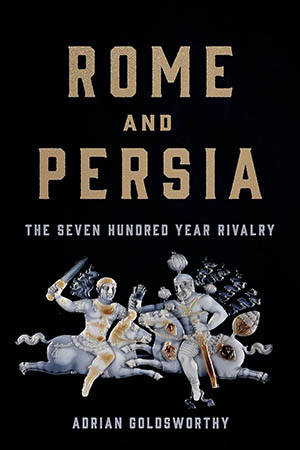
Americans, sadly, know almost nothing about the history of Persia. Of itself, this doesn’t mean a great deal, since most Americans don’t know much about the history of anywhere. But today, as America attacks Iran, that is, Persia, at the behest of Israel for the benefit of Israel, this gap in knowledge has real, deleterious consequences, because it allows our rulers to hoodwink us with cheap propaganda. To be sure, the modern history of Iran has more bearing on current events than its ancient history. Nonetheless, Adrian Goldsworthy’s excellent book on this rich and complex civilization, in its relations with the Roman Republic and Empire, is valuable reading to understand the backdrop of today.
Rome and Persia has a grand sweep, and Goldsworthy is the first to admit that he cannot cover every event, as well as that much of what an author might want to cover is lost entirely to us. His aim is narrative history, and he has choice words for “thematic approaches” to history, meaning ideological approaches for the most part. If there is an overarching theme to Rome and Persia, it is that “neither empire ever brought all its resources to bear in a life-and-death struggle against the other.” Most wars between the Romans and Persians were very limited in scope—there was no compelling reason for either empire to try to conquer the other, and the vast distances involved made such an endeavor essentially impossible, even for Rome at its height. The Persian Empire was never as wealthy as Rome, and had some fraction of its population, perhaps ranging between twenty and forty percent of Rome’s, so there was even less chance of the Persians marching to Italy. Thus, Rome’s relationship with Persia differed in its essence from its with the Carthaginians, or with many other smaller nations that Rome absorbed over the course of its history.
You Should Subscribe. It’s Free!
You can subscribe to writings published in The Worthy House. In these days of massive censorship, this is wise, even if you normally consume The Worthy House on some other platform.
If you subscribe will get a notification of all new writings by email. You will get no spam, of course. And we do not and will not solicit you; we neither need nor accept money.
The historian Victor Davis Hanson has for thirty years flogged his idea of “the Western way of war,” his claim that Westerners, beginning with the Greeks, always favored short decisive wars ending conflicts permanently. Now, to be sure, as my late mother often said, Hanson is “the court historian of the neoconservatives,” and his claim is based on thin, cherry-picked evidence. Hanson pushes his view of history with an eye to modern events, never finding a war in the Middle East that might be fought by the United States in which he does not heartily endorse young American men not related to him dying, despite none of our wars there, at least since the Barbary Pirates, ever having been the least bit decisive, rather defeats for us, to varying degrees. The reality is that if one examines history, decisive war is a modern chimera. It is, essentially, history viewed through the distorting lens of World War II—and worse, through the partially-false history of that war that has taken hold in the past forty years or so. As Goldsworthy reminds us, “Most wars throughout history have been limited wars, fought not to extinction but to a less permanent outcome, usually in a negotiated settlement,” and thus he explicitly warns against seeing every conflict as a replay of 1945. Rather, we should learn from close examination of the variegated events of the past, while keeping in mind that human nature never fundamentally changes.
Despite that peace was the more typical state between the Roman and Persian empires, wars, big and small, and what preceded and followed each, are the meat of this book. Peace is boring, after all, and in any case we know little about the peacetime nature and events of Persia in this entire time, seven hundred years. Written records were not common in Persia, and few even of those have survived, meaning that almost all of what we know directly about the Persians comes only from coins and inscribed stone monuments, and what we know indirectly is filtered through Roman writers, or through a few other sources, such as Armenian and later-written Muslim Arabic histories. Moreover, even Roman sources are very spotty; we have lost the vast majority of Roman writings, and thus a complete picture of any given historical episode in the competition between Rome and Persia always involves quite a bit of educated guesswork.
Another hurdle is minor confusion resulting from nomenclature, because during this time period, there were really two empires in Persia. The first was that ruled by the Parthians, or Arsacids, who preceded the Persians, the Sassanid Persians, who were a distinct ethnic group from a different area in Persia. But Parthia and Persia as geographical concepts are the same thing, meaning roughly the lands east from Syria and Armenia (not including those) to the western Chinese and Indian borders, north to the steppe lands of Central Asia, and south to the edge of Arabia. Therefore, Goldsworthy treats them as one for the purposes of this book.
The Parthians were not the first rulers of a Persian empire. That distinction goes to the Achaemenid Persians, of whom Cyrus the Great, who died around 530 B.C., was the most famous emperor (or king of kings, as the Persians liked to say). But this area had been, and has been, civilized for longer than any other area on Earth. Before the Achaemenids centralized control, in the Bronze and Iron Ages, other peoples ruled in parts of Persia, notably the Medes, Assyrians, and Babylonians, all well known to us from the Bible, at least they were, when the Bible was common cultural currency in the West. True, again, written records are few, but we know that the level of civilization in Persia was very high when Italy was completely uncivilized.
The Achaemenid empire was destroyed by Alexander the Great in the years immediately after 330 B.C., and among the Diadochi, Alexander’s generals who split up his empire, Seleucus I Nicator emerged as the ruler of much of Persia, creating the Seleucid Empire. All such summaries are simplifications, however; constant warfare continually changed who controlled what, and in the usual manner of ancient empires, those lands far from the imperial center, provinces, satrapies, and sub-kingdoms, were often effectively quasi-independent, ignoring the king of kings, if they felt that they could get away with it. The Seleucids (who, like the Ptolemies in Egypt, maintained a distinct Greek cultural emphasis, especially in their major cities) gradually declined, and around 238 B.C. one Arsaces, leader of the Parni, an ethnic group to the north of Persia, in what is today Turkmenistan, began a campaign of conquest to his south, into the northern Persian province of Parthia. He soon permanently stripped both Parthia and another major province, Bactria, from the Seleucids. Under one of his descendants, Mithradates I, the Great, around 165 B.C., the Parthians expanded further at Seleucid expense, dominating the central and eastern parts of the empire, between the Euphrates and western China, and the Seleucids were ultimately confined to a small portion of the western part of their empire, around Antioch (which eventually was taken from them by the Romans, in 63 B.C.).
It is around this time, in 92 B.C., that the first Roman record of formal contact with the Parthians occurred. We know of this from Plutarch’s biography of Lucius Cornelius Sulla, who was governor at this early stage in his career of Cilicia, in Asia Minor, and had travelled to Cappadocia, also in Asia Minor, the closest area controlled by Rome to the Parthians, at the order of the Senate in order to restore a king friendly to Rome to the throne. The result was, after diplomatic flexing, a vague treaty, essentially expressions of goodwill, for neither empire saw any need for, or profit from, immediate conflict between the two.
In the years following the Romans became increasingly involved in lands adjacent to the Parthians, Armenia and Pontus. The Parthians also had interests in these regions, and inevitably conflict began to arise between them and Rome. This was the time of the First Triumvirate, of Julius Caesar, Pompey the Great, and Marcus Licinius Crassus, the richest man in Rome. Caesar was in Gaul, making himself famous and popular, and Crassus decided that pushing back on the Parthians, who were in disarray because of one of their innumerable civil wars, was the path to increasing his own power and satisfying his ambition. He assembled seven legions (about 40,000 men), marched to Syria (looting the treasury of the Jewish Temple along the way), and pushed from there into Parthia and across the Euphrates, winning several small battles. In 53 B.C., however, at Carrhae, near Harran, where Abraham stopped on his way to Canaan, a much smaller Parthian force wiped out the Romans, killing Crassus and most of his men. Here and with all the battles he narrates, Goldsworthy does an excellent job of description, including in this case the Parthian use of cataphracts, heavily armored cavalry, a novelty to the Romans, combined with horse-mounted archers.
This was a heavy blow for Rome, but occasioned no notable reaction. The Romans had suffered significant defeats before, and being a larger empire now, did not need to react the same way as they had to Cannae, in 216 B.C.—and, moreover, unlike Hannibal, the Parthians posed no threat at all to the heartland of Rome, so the Romans did not treat this as an emergency. Instead, the Romans focused on their own immediate concerns, mostly having their own civil war. Roman power remained strong in Syria, but it stayed in Syria (although Caesar was preparing a campaign against Parthia when he was assassinated in 44 B.C.). Within a few decades, however, the Parthians forced their way into Syria, briefly conquering most of it, before the Romans forced them back out, inflicting heavy defeats.
Goldsworthy notes the difference in Roman behavior toward the Parthians under the Republic as opposed to under the Empire. Under the Republic, Roman behavior was constantly changing, because most of the time policy vis-à-vis the Parthians was dictated by the Roman magistrate in control in Syria, and magistrates changed frequently, often adopting more or less aggressive policies for personal reasons. The Parthians, by contrast, tended to take the long view, a usual characteristic of monarchies. But the Roman Empire “fixed” this problem, making longer-range discussions and action between the two empires more feasible. However, even under the Empire, much of the interaction was actually conducted by Roman subkings bordering the Parthians, such as Herod the Great, with their own concerns. Herod and his successors, for example, had a particular interest in the large Jewish communities in the Parthian Empire, many of whom came to pilgrimage in Jerusalem. Still, Augustus and one of the Parthian emperors (Phraates IV) signed a treaty, after which each claimed to his own domestic audience that he had won a great deal at the expense of the other side, while giving up nothing—a pattern which repeated itself several times in the following centuries.
This ushered in a period of, if not exactly cooperation, benign neglect between the two empires. The major point of conflict was Armenia, where various rulers and pretenders involved the Romans and Parthians to advance their interests. None of this spread to wider war, however, and diplomatic relations were maintained with pomp and formality, though meetings of envoys were not frequent. Trade flourished, as goods from the East—silk, spices, incense—came through Persia to Rome, while metals, coral, and glass went back the other way, much of it to China. The Romans were aware of the Chinese, but the distance was so vast that no formal contacts were ever attempted. Goldsworthy is at pains to note, however, that contrary to some modern claims, both the Romans and the Parthians were very well informed about the geography and characteristics of the other empire. They didn’t have GPS, but they were more than capable of precise maneuvering across long distances. They did not just wander idly across an unknown landscape; it is a silly modern trope that the ancients were less competent than us, when, in fact, the reverse is more often true.
In the early second century A.D., however, the Roman emperors began to take a more aggressive approach to Parthia, after having consolidated control over Armenia. Trajan invaded deep into Parthia, taking Babylon and sailing downriver to the Persian Gulf. But the Romans could not hold this Persian core territory, most of it mutinous, and rebellions elsewhere in the Empire demanded attention. Trajan died on the way back to Rome, and his successor, Hadrian, abandoned most of the newly-created provinces. In the late second century, the Parthians returned the favor by invading Armenia, continuing the cycle.
The Antonine Plague, followed by civil war, put a thirty-year pause on most fighting, though the Romans held more of the eastern Parthian Empire than they had earlier (Carrhae, for example, was now within the Roman Empire). But perceived Roman weakness led to more fighting, and in A.D. 224 the Sassanid Persians overthrew the last of the Parthian emperors (more precisely, Ardashir I killed Artabanus IV). The Sassanids were a different ethnic group, from the heart of Persia (near Persis, the modern province of Fars), more “Persian,” arguably, than the Parthian “outsiders.” They supposedly wanted to restore the Achaemenid Empire destroyed by Alexander, although Goldsworthy views some of that as “inventions by Roman observers trying to understand the world through the prism of history familiar to them from Herodotus and other accounts of the distant past.” Under the Sassanids, who constructed a “far more centralized and powerful state,” including a state religion of what appears to have been a more coherent form of Zoroastrianism, Persian strength grew, in part due to a highly competent and organized military, especially with respect to siege-craft. The Sassanids did their best to suppress all memory of the Arsacids (which is in part why our lists of Parthian emperors contain numerous gaps and uncertainties), but in practice their empire was not all that different in composition. It was still a multi-ethnic empire, with a significant amount of power devolved to the more remote provinces.
The Sassanids reached their zenith under Shapur I, Ardashir’s son. They won several campaigns against the Romans, and in 260 Shapur captured the Roman emperor, Valerian, who died in captivity (a Persian decorative stone carving of this event graces the cover of Rome and Persia). They conquered the Roman city of Dura-Europos, of itself not of particular interest, except that the city then was buried under the desert, and was rediscovered in the twentieth century, the “Pompeii of the Syrian Desert,” providing fascinating insight into both life of the period and military operations in and around the city.
By the third century, the Roman Empire was decaying, and so large-scale conflict also became rarer. Diocletian extensively fortified the eastern border, but made no attempt to regain lost territory, although Armenia was still contested. Constantine planned a Persian war, but died in 337, before he could launch it. Julian the Apostate, however, mounted a full-scale invasion, and reached Ctesiphon, the Persian capital. But he did not have resources for a siege, so retreated, then was killed in a skirmish with Persian cavalry in 363. Thus, his expedition was a disaster, and his successor, Jovian, sued for peace, giving up substantial Roman possessions to the Persians. And by the end of the fifth century, the Western Roman Empire was gone entirely.
But even if the Eternal City was no longer the center, the Romans remained, now centered on Constantinople, and conflict continued. Goldsworthy draws a parallel between the two now-ancient empires—both presided over by a powerful monarch, wielding a large bureaucracy, and with an established church (meaning that the Persians actively persecuted Christians, a point of friction with the Romans). A type of stability emerged, helped along by that both empires faced increasing invasions by peoples such as the Huns. The Persians began to build giant walls in response, such as the Gorgan Wall stretching 150 miles south from the Caspian Sea. Yet the Romans and Persians still fought; the famous Belisarius beat back a Persian invasion in 531. In 561, after an invasion by the Persians under Khusro I, Justinian signed a fifty-year peace, which also bound the Persians’ Arab allies, but required Justinian to pay five hundred pounds of gold a year. Needless to say, the peace did not last fifty years, but really, nothing much changed over the next several decades.
In the seventh century, however, the Persians made substantial advances at Roman expense, while also repelling the Turks and other nomadic peoples elsewhere in their empire. The Romans shrank. The Persians conquered Jerusalem in 614, and Constantinople was besieged by the Avars in 626, which ended a fairly successful campaign by the Emperor Heraclius against the Persians, in which he had regained much of Syria. He also fomented trouble for the Persians in the Arabian Gulf, funding the Christian Axumite kings of Ethiopia in their wars against the Jewish kings of Yemen, well covered in G. W. Bowersock’s The Throne of Adulis.
And then, it all came to an end, as the Arabs, regarded before as essentially irrelevant auxiliaries of the Persians, coalesced under the doctrines of whoever wrote the Koran. Goldsworthy notes that initially “Muhammad’s and his followers’ sympathies lay far more with Rome [than with the Sassanids],” but soon enough the Muslims were fighting both, in the middle of the seventh century. They were strong, united under the so-called Rashidun Caliphate (meaning the immediate successors of Muhammad), and not susceptible to division or bribery, traditional methods of breaking up major threats in the wars between the Romans and Persians. At Yarmuk, in 636, the Arab armies defeated Heraclius, and “Heraclius withdrew to Asia Minor and began creating a new frontier line there.” Belatedly realizing the new massive threat, the Roman response in the following years “was poorly coordinated and lacking in strength,” but the Romans did the best they could. Still, Egypt was quickly conquered, and the Caliphate entirely defeated the Sassanids. The son of the last king of kings, Yazdgerd III, fled to China, vainly hoping for aid against the Arabs, and he and his descendants lived there as pretenders for a century, “serving with their retainers as Chinese generals and dreaming of taking back all they had lost.” The Romans took much longer to dwindle away entirely, but did, in 1453, one of the great tragic dates of all the history of mankind.
And to return to today, what does any of this say about the Iran War? It may seem, not much. But when you grasp that the people of Iran today are descendants, though with a good admixture of other peoples, of the proud and successful warriors and rulers Rome and Persia chronicles, you will better understand our opponents (that is, Israel’s enemies, and as a result our opponents). Americans are frequently told, and tell ourselves, that all Muslims in the “Middle East” are retarded goat-herders, in order to increase contempt for them and make Americans feel there is little cost to starting wars there. There is doubtless some truth to that characterization, if you are talking about Afghans or, in many cases, Arabs (who, if not retarded, are usually miserable chip-on-the-shoulder fabulists of no accomplishment), though that does not mean they cannot impose great costs on us, as we have found out again and again over the past twenty years.
But Islam has many adherents from many different cultures. If you get a Persian Muslim (or a high-caste Indian Muslim) to talk freely, they despise Arabs, regarding them as ignorant and dirty. They speak quietly about it, because Muslims are supposed to honor Arabs as the people of Muhammad, and Arabic as God’s language in which the Koran was written by God Himself. Still they, with much justification, regard themselves as far superior to other Muslims, because their culture is far superior. In truth, Persians are, in every way, different from and superior to most Muslims. If, for example, you read Marshall Hodgson’s magisterial three-volume The Venture of Islam, the rarefied culture of medieval Persia, at least until the Mongols arrived, comes through very clearly. Arabia, by contrast, was a backwater for all of history until they discovered oil (as you can learn from Wilfred Thesiger’s Arabian Sands and similar books). The Persians, unlike other Muslims, even have contributed something to modernity, in the form of scientific discoveries (though those are very exaggerated, to be sure).
In any case, Americans would do well to find out the type of people against whom we have allowed ourselves to be dragged to war. It prevents an overly-simplistic view of the world, one of the banes of modernity, and this book is a good place to start.
You Should Subscribe. It’s Free!
You can subscribe to writings published in The Worthy House. In these days of massive censorship, this is wise, even if you normally consume The Worthy House on some other platform.
If you subscribe will get a notification of all new writings by email. You will get no spam, of course. And we do not and will not solicit you; we neither need nor accept money.