
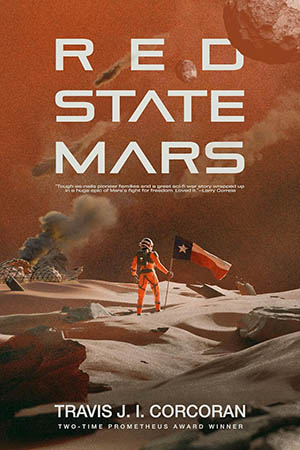
The great civilizations of mankind, few in number but everything that really matters in the history of our species, always require an internal common goal to bind them together and pull them forward. Bare life is not enough; what impels a civilization to the heights, what inspires its accomplishment, is the drive to create splendid works of Man under the eyes of God. It is therefore a pleasure to come across a book which shows how we Americans, the only great modern civilization, now falling back in confusion from our own achievements, might get our society back on track with such works.
[This article first appeared in Frontier. You should subscribe!]
Red State Mars is a compelling work of fiction with a serious, but not didactic, message. You will not find Ayn Rand-type rants here, rather well-drawn characters behaving in the way that normal men and women behave, although under particularly dramatic conditions. To be sure, these people are on and around Mars, for the most part, and that is certainly different than America today. But for the nature of mankind, there is no thing new under the sun, and this truth is well illustrated in Travis Corcoran’s book.
You Should Subscribe. It’s Free!
You can subscribe to writings published in The Worthy House. In these days of massive censorship, this is wise, even if you normally consume The Worthy House on some other platform.
If you subscribe will get a notification of all new writings by email. You will get no spam, of course. And we do not and will not solicit you; we neither need nor accept money.
The basic frame of the story is straightforward. While this is “hard” science fiction, Corcoran avoids excessive exposition about technology. It is 2126. China and the United States fought a limited nuclear war, around 2050, after China unleashed an engineered plague that killed one-third of the American population. Following thirty years of chaos and local conflict, both countries re-built themselves. The Chinese veered heavily toward technology interlocking with their traditional culture, including by introducing a severe caste system based on mandatory embryonic modification. The Americans, it is shown through the plot (though without going into much detail), adopted a system which mixes advanced, but liberating, not totalitarian, technology with a rationalized political system.
Similar to many remade empires, American political structures have the same names as before, even if the federal government sits in Pittsburgh, but those structures sit atop a changed society. Here, it is not that the structures have lost power and become shells under an authoritarian leader, the more usual path of such changes. Rather, a cultural renewal has given the country back its moral fiber and realistic approach to societal structure, allowing the old systems to work well again. Mostly this is implied rather than shown. For example, no women appear in national politics at all, which is as it should be, for the public life of any society that wishes to accomplish anything must be totally dominated by men.
In any case, little detail is offered about Earth; this is a book about Mars. Both nations—the Americans first, the Chinese after—have established modest colonies on Mars, some decades old. Terraforming is a distant dream; these are pressure-domed towns, not unlike small towns in America, complete with bars and high school football. Most of the Americans seem to originate from Texas, which it seems has assumed outsized importance in the new United States, in part by defeating Chinese-backed Mexican invaders in the vicious “cartel wars.” Each of the nine American towns is independently run by an extended family, although one family, the Mackenzies, is the most powerful, because it owns and operates the three American spaceships that orbit Mars, crucial for any number of activities. The families differ markedly in personality—some rougher Scots-Irish types, some highly religious, some just average Americans, or rather average Americans of 1850 or 1900 transposed to the future (they even engage in dueling).
Corcoran sketches plausible technology of a century from now. Three core technologies make getting to, and life on, Mars possible—a type of fusion engine; sophisticated quasi-nanoscale matter printers; and artificial intelligence. All of these are certainly feasible in a hundred years, at least in an America where we return to unfettered freedom of association and end the boundless parasitism of the old and shiftless (which hopefully will not require a nuclear war, although that’s certainly a way to get there fast). Corcoran posits a very believable form of artificial intelligence, unlike a great many commentators in 2026, essentially ubiquitous always-available forms of customized LLMs which are advanced versions of today’s statistical text-predictors. They are not conscious, merely tools which each family maintains for itself alone in a secure form (the Mackenzie AI is “TradeNet”). They are forms of agentic AI making possible extremely rapid collective action, not true intelligence.
The core of the story is war between the Americans and Chinese on Mars. Until the story begins, the two groups have gotten along well, trading and sometimes intermarrying. The Chinese have been very loosely controlled by the Chinese government back on Earth; many of them came to Mars to avoid the forced embryonic modification program. Then the Chinese government decides to impose its will, both on its own people and on the Americans, whom they see as divided and weak. And the Americans are in fact divided and weak—they have no central government, rather what amounts to an informal discussion group of town leaders, and they are totally independent of the American government, which therefore has no obligation to protect them. When the newly-arrived “genemod” Chinese military arrive and try to forcibly confiscate essential American trade goods and transport vehicles, the Americans respond with violence, using, among other weapons, missiles dropped from AI-controlled drones. “Somewhere behind him, Liam issued the command, ‘TradeNet, designate all, kill, kill, kill.’ TradeNet said, ‘Heaven brings forth innumerable things to nurture man.’ ”
No surprise, the Chinese don’t take this sitting down. I won’t spoil the plot; suffice it to say it is gripping. I read most of this fairly long book in one sitting. It is a quintessential story from long-ago American history—how a few tough men struck out in a hard land, and found that only by coalescing together, despite their differences, and by taking existential risks, could they establish and defend a new society against the enemies and challenges that inevitably arose. The characters are drawn incisively; the central personal frame of the story is the coming-of-age of a fourteen-year-old Mackenzie boy, which ties the story together very well. The battle scenes are realistic and compelling. The social scenes, from individual decisions regarding the war to fashions in clothing, are equally so, and Corcoran also accurately depicts incessant political maneuvering, a constant of every human society. And again, something almost never found in modern books or shows, sex roles are realistic (with a few exceptions, such as a woman spaceship pilot—but that’s the basis of a romantic subplot, so it doesn’t seem wildly out of place).
You will not regret reading this book. Mulling over it, the only question I really had at the end is—why are the Americans on Mars? It makes some sense for the Chinese to spend enormous resources on settling Mars, as a matter of national pride for the “Unitary Sovereign State of China.” Their functionaries have little choice in the matter; they are, for example, indoctrinated to recite “Cheerful in battle, we serve the state,” and that attitude pervades most Chinese activities here. They are not stupid, but they most definitely think differently from, and perceive the world differently than, the Americans. But the Mackenzies are portrayed as consummate capitalists, almost anarcho-capitalists, obsessed with accounting and choosing to invest huge sums in spaceships and their colony towns. Yet all Mars seems to produce is cattle and crops, primarily grain, to feed the locals. The planet is utterly dependent on “feedstock” for the matter printers that can only come from Earth, and there appears no ability in the foreseeable future to manufacture this material on Mars. Nor can they manufacture other crucial technologies, such as fusion engines. Unlike Phlebas the Phoenician in T. S. Eliot’s “The Waste Land,” the Mackenzies as a family never forget the profit and the loss, and there is no profit visible here, even in the future. What’s the play for the Mackenzies on Mars?
This gap is fine for the plot, because this isn’t an economics textbook, so a question like this doesn’t detract from the reader’s enjoyment. But we should give some thought to why, other than the quest for glory, America might expand beyond Earth. David Gress said, “Hernán Cortes conquered Mexico for God, gold, and glory, and only a mundane imagination would distinguish these impulses, for they were one and the same.” Yet God is absent in the motivation to conquer Mars; there are no Martians to convert (although religious belief has assumed its normal historical importance for the local Americans), and there is religious freedom in America, which means that traditional driver of voluntary exile is not a motivation. Gold also appears lacking; there is no talk, for example, of mining anything, and life back in America appears pleasant, with opportunity for everyone, such that there is no reason for men to go to Mars simply for a better life. And while there is certainly glory, most of that is in the fighting the Chinese—the daily life of the colonists is really not all that different than a 1950s Texas town. There is not even that much danger to measure oneself against, because the technologies, especially the AIs, are able to sense and rapidly respond to physical threats such as dome ruptures. Moreover, even were there glory here, glory is not enough as the single driver of achievement, except for a handful of men. If neither God nor glory is a driver, gold, or the hope of gold, seems essential to drive expansion beyond Earth.
Certainly there are men today who see Mars as an overriding goal, the only goal that matters. The most prominent, of course, is Elon Musk, who it was recently reported has received a potential giant pay package from SpaceX, contingent on his establishing a permanent human colony on Mars with at least one million people. Most sane men, even those fully supportive of the goal, would see this as extremely unlikely in Musk’s lifetime, but who knows? Arguably Musk seeks glory by going to Mars, in the form of being the savior of mankind by making us multiplanetary, so perhaps glory is enough, if resources are funneled to the right man, and he is unleashed, not tied down by the Lilliputians. That’s not likely on our current trajectory, but as George Orwell said, one should never merely predict the continuation of the thing that is happening.
Along those lines, the key limitation that might be removed on settling Mars is energy. A well-run society with access to essentially unlimited energy, something that has never existed, has nearly incomprehensible options. Combine that with the tools that AI might give us, many possibilities open up. Perhaps, in that case, all it would take is enough adventurous men to settle Mars. Their descendants would see it as home, and not need to make the continuous choice to remain. I suspect something like this is what Musk contemplates—but there is no visible source of essentially free energy on the horizon.
On the other hand, upon reflection, it seems like there is no real need to begin with human settlement on Mars. That might arise naturally, if we instead began with colonies on the Moon. Such have been talked about for decades, to the extent they are nearly a joke. But colonies on the Moon, because it is possible to much more easily launch mass from the Moon, would allow us to obtain materials such as metals and other minerals from the asteroids, and use those resources to colonize Mars. Maybe, just maybe—if our society is first totally remade to reward extreme accomplishment that benefits all Americans, the opposite of America today. I’m not terribly optimistic, especially that this can be done without great suffering and pain, but this book sketches a plausible path, and that alone makes it very much worth reading.
You Should Subscribe. It’s Free!
You can subscribe to writings published in The Worthy House. In these days of massive censorship, this is wise, even if you normally consume The Worthy House on some other platform.
If you subscribe will get a notification of all new writings by email. You will get no spam, of course. And we do not and will not solicit you; we neither need nor accept money.