
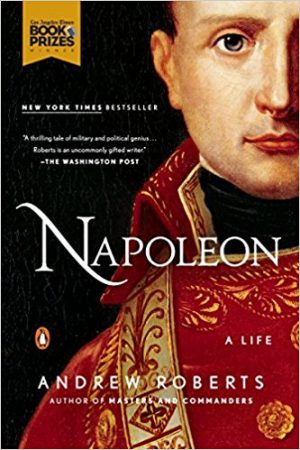
For some time now, I have been claiming that what we are likely to get, and probably need, whether we like it or not, is a Man of Destiny. The original man called that was, of course, Napoleon Bonaparte. Neither my claim nor Napoleon is popular nowadays. We have gotten used to hearing that individual men don’t matter—that history is instead, take your pick, a matter of struggle for economic advantage, or of the opinions and actions of the masses, or of blind and random fate, or of group politics of one type or another. This book, Andrew Roberts’s generally positive take on Napoleon, shows the falsehood of those claims, and proves that what matters is men. Not men in general, but a tiny subset of men who make, and have always made, the world what it is, and what it will be, good and bad.
This is obvious. We are today made to pretend it’s not obvious because it offends two shrill and culturally dominant sets of ideologues: egalitarians, who think that somehow it is humiliating to mankind that the mass of people does not matter at all in history; and self-appointed leaders of groups from whom great men have never arisen, who likewise find it humiliating that reality excludes them from prominence. But it’s still obvious. I should note, too, that I keep saying “men” not as a verbal tic, but because women in this sense, of individuals who directly and sua sponte change the course of history by reaching out and bending the world to their will, don’t exist in any significant number. Certainly, the sum total of such women who have ever existed can be counted on the fingers of one hand, if there are any at all. Now that I mention it, in fact, I can’t think of any. Thus, of course, “feminists” are prominent among the latter set of offended ideologues. It’s not that women are not very important to history, but in the nature of things their influence tends to be indirect—the essential differences among men and women make it unlikely that any woman has ever wanted to be like Napoleon, or his forerunners such as Alexander and Julius Caesar, since megalomania is a nearly exclusively male trait.
And it’s Napoleon’s megalomania that comes through most in this biography, along with the extremely rare ability to lead and inspire men in good times and bad, and a variety of other traits, including off-the-charts charisma and charm, an inexhaustible capacity for work, an insatiable desire for knowledge (often gained by rapid-fire questioning of whomever he was with), a wry sense of humor and a limited sense of vanity, a practical approach to solving all problems, excessive loyalty to family, and the timing and sparkle of the showman. An additional characteristic I found particularly fascinating about Napoleon, to which Roberts recurs several times, is his ability to compartmentalize his life. “He could entirely close off one part of his mind to what was going on in the rest of it; he himself likened it to being able to open and close drawers in a cupboard.” Coupled with a prodigious memory (like Bill Clinton, he could remember people he had met briefly many years before) and a trap-like mind that excelled in mathematics and absorbed history, this allowed Napoleon to focus on what he chose to do, and not to be distracted. In effect, he was able to accomplish more than other men, because of the combination of talents with which he was blessed.
Finally, Napoleon had that most important personality characteristic for a winner—he was decisive, so he got things done. We are often told that large organizations and bureaucracies defeat those who are putatively at the top of the hierarchy. This is false, or rather it doesn’t have to be that way, if the man at the top has actual power and the will to use it. Donald Trump can’t effectively defeat the Deep State, even if he were disciplined and focused, because he lacks the necessary power—the structures of the American system don’t permit him to accrue such power (though Trump would be happy to change those structures to his benefit, I’m sure). On the other hand, in the modern world, there are some leaders with that power—a good example is the Pope. Supposedly, Pope Benedict quit because he couldn’t exercise his power because of the bureaucracy, which opposed him. But Benedict, unlike Trump, was an absolute monarch, with limitless financial resources. If he had had the will, he could have burnt out the malignancy at the heart of the Roman Catholic Church, starting by simply firing the entire Curia—it only has three thousand people, and as John XXIII responded, when asked “how many people work in the Curia?”, “about half.” I guarantee that if I were Pope (admittedly an unlikely possibility), within a week I would have solved the institutional problems of the Catholic Church. (Napoleon would have done it in two days.) I would have a lot of new problems as a result, but those can be dealt with in order of priority (another thing as which Napoleon excelled). The career of Napoleon proves that things like that can be done—but they need the right person to do them.
Not that Napoleon didn’t have faults. Like Julius Caesar, he was fond of generously pardoning his enemies and those who betrayed him, and also like Caesar, this harmed him in the end. He had a lot of bad character traits, too. He was an inveterate liar, compulsively unable to admit the magnitude of defeat, or any defeat. He was sometimes brutal, though in some cases he was willing to admit it, and admit the error. He cheated at cards, because he could not face losing (although he paid the money back afterwards). But what Napoleon was not, most of all, was a prototype of the mass killers of the twentieth century. This, apparently, has been a very common comparison for decades, although it is transparently silly. If anything, Napoleon was more like a megalomaniac Eurocrat, desperate to create a new system and indifferent to the human cost to the little people. The dictators of the twentieth century killed for ideology, and killed a vastly greater number of people, both absolutely and in relative numbers. Their progenitors were the men of the Committee of Public Safety, of whom Napoleon was the heir in time, but not in thought. He had no ideology at all, other than wanting glory for himself and for France, between which two he didn’t distinguish much, and he didn’t kill anyone deliberately except soldiers and others directly opposed to him. Unlike Robespierre and Saint Just, he was no totalitarian, and he had no interest in dictating how people lived their daily lives or in ruling their thoughts, though he was happy to assist in making those lives a little better. Napoleon did not even want to dictate the details of how conquered countries and territories were to be governed. Rather, like all such conquering men before the twentieth century, he was driven by an internal spring wound around his ego, and not given to overmuch self-analysis as to how or why he got that way, or to who had to bear the costs of his choices.
I have to admit that my knowledge of Napoleon before reading this book was pretty basic. It appears that Roberts goes against the grain of quite a bit of scholarship about Napoleon, in that the English-speaking world has traditionally viewed him as aggressive monster, and Continental scholars have either agreed or, on the Left, (accurately) seen him as betraying the principles of 1789. Perhaps drawing my conclusions about Napoleon from reading one book is a mistake. Still, Roberts apparently had access to fresh resources, including all of Napoleon’s letters, many published recently for the first time, so at a minimum this book is unlikely to be completely wrong in its views and conclusions. Time travels fast, though, as Napoleon would be the first to say. Perhaps this biography, published in 2014, will be superseded—it is, for example, prominently noted on the inside cover that “it has been optioned by The Weinstein Company for a TV series.” Sic transit. For now, this book seems to set the modern gold standard. But this book isn’t for the weak of heart. It’s engagingly written, but still very long. Names of people and places are endless (though the excellent maps help with the latter). So it’s a commitment—but a worthwhile commitment. And it has other highlights—for example, Roberts appears to have personally visited nearly all, or perhaps all, of the scores of Napoleon’s battlefields. References to such visits are only occasional, but they add a lot—both flavor, in how a site looks today, and insight, in how a battle proceeded and why it went one way or the other. The author is, for this reason and because of his writing, outstanding at giving the feel of battles—a very difficult, and hard to pin down, ability in an author, but one which makes this book much more than a dry recitation of the facts of battles, even though battles take up many of its pages, just like they took up most of Napoleon’s life.
Napoleon was born in Corsica, as everyone knows. Corsica is beautiful, though not a place of wealth, then or now. It was 1769, so Napoleon was only twenty when the French Revolution began, a young military officer, in the artillery (an occupation that required mathematics knowledge—it was, of course, the Europeans who turned artillery into an actual science, even if artillery was invented by the Chinese). He generally sympathized with the Revolution, liking some of its ideals, such as meritocracy and that it promised more autonomy for Corsica, though ideology as such was totally unimportant to him. As seems to have been the case for officers in many pre-modern militaries, he sometimes showed up for duty, and sometimes didn’t, spending many months on Corsica dealing with family business matters. Napoleon was a reliable Jacobin in his concrete actions, though, and was instrumental in recapturing Toulon from the British for the (nascent) Republic in 1793, the first major battle in which he personally participated, and where he showed his customary personal bravery. So, at twenty-four, he was made a general.
He ended up in Paris, as the Terror concluded and power was solidified by the central government, a process Napoleon helped by scything down rebellious sans-culottes with grapeshot in the autumn of 1795. His success there enhanced his public profile, and benefited both himself and his family. The new Directory gave him command of the Army of Italy, fighting the Austrians and the Italians (the latter playing second fiddle, like always) and conquering the entire peninsula (although Italy was only one of the many fronts on which France was then fighting). Then he partially defeated the Ottomans in Egypt, discovering the Rosetta Stone and causing a fashion sensation for things Egyptian in Europe. (All the scientific documents he left behind, hundreds of thousands, were burned in 2011 during the so-called Arab Spring uprising, showing why the West should never return anything of value to the Third World countries from which they stole them—after all, for example, the Elgin Marbles wouldn’t exist if the British hadn’t taken them, since the Ottomans used the Parthenon as a powder magazine.)
After returning to Paris in 1799, Napoleon seized power from the Directory in the coup of 18 Brumaire (the annoying French revolutionary calendar was, thankfully, retired a few years later), becoming (shades of Augustus), “first consul,” backed up by (somewhat fraudulent) plebiscites confirming his new role under a new constitution. That was supposed to be for ten years, but by 1802 Napoleon had had himself declared consul for life, then in 1804 had himself declared emperor, accompanied by another plebiscite, whereupon he famously crowned himself, with the Pope standing by. Although the vote totals were altered, there is no doubt that the mass of French, high and low, were happy to have Napoleon in charge. Anarchy becomes tiresome after a few hours, much more so after a few decades. Occasional conspiring grumblers, whether Jacobin terrorists or Bourbon restorationists, had to be executed, but at this point Napoleon, an unalloyed success, was pretty much on top of the world.
Following some more fighting in Italy, in 1802 the wars of the Revolution had already formally come to an end through the Peace of Amiens, signed with Britain. It wasn’t much of a peace, though, since by 1805 the Third Coalition had been formed to combat Napoleon, combining Britain, Austria, and Russia, the Holy Roman Empire, and a few others, against France. This set of campaigns contained many of the most famous Napoleonic battles, such as Ulm and Austerlitz, as well as Jena, where Hegel saw him riding through town and maundered on about his “world soul,” a phrase that was used a little too much at times in the twentieth century. Following that (I should speed up, or this review will never end) came the disastrous Peninsular War, the even more disastrous invasion of Russia, the loss of the Battle of Leipzig, abdication and exile to Elba, the return and the Hundred Days, final defeat at Waterloo, and exile to St. Helena, where after nearly six years, Napoleon died at fifty-one (not apparently poisoned, something Roberts totally rejects—rather of stomach cancer, of which his father also died, at thirty-eight).
During all these incessant wars, Napoleon managed to do a lot of other things. Some of that was having affairs with a wide variety of women, but he also managed to oversee the creation of the Code Napoléon, replacing the hodgepodge of customary law and Roman law that applied in different places in the Empire. To Americans, or at least Americans until a few years ago, codified statutory law on the Roman model was inferior to the common law model of organic development that we inherited from Britain. On the other hand, the Code Napoléon didn’t purport to have a rule for everything, but rather laid out general principles within which judges could work, thus it had elements of the common law as well. To us today, groaning under tens of thousands of pages of unreadable and ever-changing federal statute law and hundreds of thousands of pages of (mostly unconstitutional) administrative law, the light touch of the Code Napoléon can only seem like the greatest beneficence, and to the extent it created more certainty and equality before the law among Frenchmen, it was certainly a great accomplishment. Along with the Code Napoléon, other codes (such as civil procedure) were promulgated, as well as standard coinage, weights and measures, and so forth—all worthwhile modernizing programs. He also engaged in a wide variety of Colbertist economic practices, heavily subsidizing and protecting by tariffs French industry in an attempt to catch up to Britain.
So that’s Napoleon’s life. It is fascinating, but it seems to me that the wrong conclusions and lessons are frequently drawn from that life. For example, Napoleon is often viewed as an avatar of the Enlightenment, in contradistinction to prior monarchic darkness, but that is obviously wrong. He certainly didn’t want the Bourbons back, because they would have executed him, and he didn’t want the social structure of pre-Revolutionary France back, either. Too many encrustations and decadences make a society sclerotic, something on full display in late monarchical France. (This is something modern conservatives often fail to recognize—political systems do reach the end of the line, and there is no Burkean solution to revive them at that point.) But you wouldn’t catch Napoleon believing in the Rights of Man. He wasn’t interested in expanding liberty in the abstract, much less atomized liberty untethered to virtue. John Locke held no interest for him (his political reading tended to the Roman classics). Emancipation of the supposedly oppressed wasn’t on his list of things to do, except to achieve instrumental gain for himself. Utopia was not a goal; he would have sneered at anyone who suggested that to him. Instead, he wanted realistic glory for France, a modicum of virtue for the people, and for everyone, order and the rule of law. These are profoundly conservative, or more accurately in context, Reactionary, sentiments. That Napoleon was not an avatar of the Enlightenment is easy to prove by mere modern observation—if he really were such an avatar, the Left would love him. But they hate him, especially in France, where very little praise is lavished on Napoleon—he has two statutes in Paris, and one small street named after him.
Probably Napoleon is seen by some as an Enlightenment figure as a result of the binary choice that propagandists for the Enlightenment like to pose: modern, decayed, end-state liberalism, on the one hand, and the France of Louis XVI, on the other hand. They ask, in effect, why would you want to go back to the latter, and if you don’t, you are required to love instead what we have to offer, as nasty as that is. But you can be anti-Enlightenment and not want to go backwards at all. In fact, if you are anti-Enlightenment, like me, you know you can’t go backwards, and it’s stupid to try. As I have repeatedly said, the idea that Reaction is a return to some imagined Golden Age is wrong; rather, it is moving forward to meet the needs of the present informed by the wisdom of the past, rather than by ideology. And really, that’s what Napoleon did his whole life. Thus, the closest historical analogue to Napoleon was probably not, as is usually supposed, Alexander the Great, a pure conqueror, but Caesar Augustus (although Napoleon has parallels to Charlemagne as well). Both Napoleon and Augustus restored order after anarchy; centralized power; operated a propaganda machine; collected admirers across society; and modernized where modernization was necessary, using where possible the structures of the past, modified for the present to a greater or lesser degree. True, Napoleon was not as fortunate in his enemies as Augustus, and he had to engage in more radical change, given the situations he was handed. And Fate led him to a different end. But in a slightly different world, Napoleon might have founded a long-lasting but modernized structure of non-democratic government that could have helped avoid the twentieth century. We’ll never know, but that doesn’t mean we can’t apply lessons drawn from Napoleon to the decisions we are likely to face in the future, when history returns.