
As a very young boy, I experienced the Bicentennial in 1976, an event which captivated the entire nation for a year or more. By contrast, the 250th anniversary of America’s founding, counted from the Declaration of Independence, passed a few weeks ago with little fanfare and few Americans caring much at all. This was unsurprising, because America is a fractured nation, heading either for the ash heap of history or for a supremely contentious renewal. If we favor the latter, we should always remember that America was born in war, and therefore studying the War of Independence sheds light on our possible future.
In part, however, I read this book because my interest in the War has a personal angle. One of my direct ancestors, also Charles Haywood (then spelled Heywood), lived from 1723 to 1805, and fought in the War, though most of the details are lost to history, other than that he fought in 1775 in the militia company of one Major Raymond. Thus I am a bona fide heritage American, an ever-more-important distinction as we all come to realize that diversity is the very opposite of strength.
You Should Subscribe. It’s Free!
You can subscribe to writings published in The Worthy House. In these days of massive censorship, this is wise, even if you normally consume The Worthy House on some other platform.
If you subscribe will get a notification of all new writings by email. You will get no spam, of course. And we do not and will not solicit you; we neither need nor accept money.
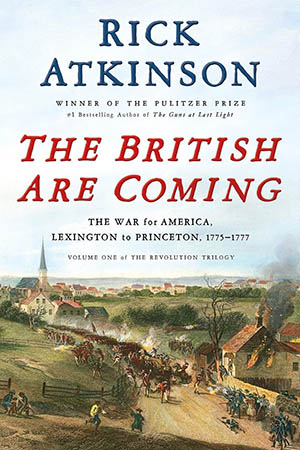
Rick Atkinson’s smooth history of the initial two-and-a-fraction years of the War, the first volume of a trilogy, has as its main focus not the causes of the War, which are to this day much debated, but its conduct. The basic causes, however, are not disputed. In the early 1770s, Britain was still recovering from the Seven Years’ War, in effect a global war, partially fought in America, and therefore known to Americans as the French and Indian War, for those were their local enemies, as part of the British Empire. A crucial part of that recovery was financial, and both King and Parliament believed it only fair that the American colonists accept higher taxes to defray the debt. Americans paid very low taxes relative to Englishmen in England, but as everyone knows, many Americans viewed those taxes, when combined with numerous onerous restrictions on the colonists’ economic activity, as oppression. The peerless slogan “No taxation without representation” captured the political dynamic, but what many influential and vocal Americans wanted was actually more sovereignty, not more representation.
It is somewhat strange to us that these men saw King George III’s rule as tyranny. When you read the Declaration today, the main feeling one gets is that the tyranny we live under today is a hundred times worse—in fact, completely unprecedented in an English-speaking nation (although to be fair today’s United Kingdom is worse off than America). We wonder why violent rebellion seemed so natural and inevitable to these men, while we accept far greater tyranny with barely a murmur, and certainly without wholly-justified rebellion. Maybe we are just weak men, feminized and tranquilized with Netflix and weed. Maybe it is something else.
Violence had been brewing in America for some years, in a descending spiral of action and reaction. The Boston Tea Party happened in 1773. In response, in 1774 Parliament passed what the Americans called the Intolerable Acts, aimed mostly at punishing Boston (including by entirely closing its port) and reducing Massachusetts self-government to essentially nothing. Parliament also passed the Quebec Act, actually unrelated but perceived as punitive by the colonists, expanding Catholic Canadian boundaries far south, further confining the largely Protestant colonists to the Atlantic seaboard. Colonists throughout the colonies moved to support Massachusetts economically, while militias began to stockpile munitions and train. In January, 1775, King and Parliament responded by formally declaring Massachusetts to be in rebellion, forbade all the colonies from any foreign trade or fishing in the North Atlantic, and ordered thousands of soldiers and tons of war material to be shipped to the colonies. As with so many other events in history, events took on a life of their own, and quieter voices of moderation were drowned out in the clamor on both sides that something must be done.
In Boston, the townsfolk, led by now-famous names such as Samuel Adams, spoke to enormous crowds in tones the five thousand British soldiers garrisoning Boston, as well as the substantial numbers of loyalists in town, viewed as treason. Yet there was no martial law, nor even press censorship. In September, the local British commander, Thomas Gage, sent troops to seize militia gunpowder stores near Boston, an event known as the Powder Alarm. Fed by rumors war had started and the British were killing colonists (they weren’t), twenty thousand militia mobilized in response. Cooler heads prevailed as the rumors proved false, but the ratchet had turned again. Now the colonists knew the imminent danger of military action, and began to move munitions further from British troops, notably to Concord, eighteen miles from Boston, while dispersing and hiding them. They also sharply intensified militia recruiting and training, including forming units of “minute men,” who carried weapons with them everywhere, even to church.
In April, 1775, orders arrived to Gage to “arrest and imprison the principal actors and abettors in the provincial congress.” This was not as easy as it sounded, and Gage lacked cavalry for lightning raids, although he had excellent infantry. Thus, he decided to strike in force at Concord, to seize the colonists’ main military stores. He sent eight hundred men marching in the middle of the night, as the watchful and well-informed colonists sent two men, Paul Revere and William Dawes, riding thorough the countryside to warn first Lexington, along the route, then Concord, and to raise the militia.
When the British reached Lexington, forming up into battle lines on the town green in response to the colonial swarm, the war began. Nobody knows who fired first, but eight Americans died (and no British). The British continued marching to Concord, but found almost no munitions, which had been moved to new hiding places. Sensing their risk, the British reversed course, but it was too late for safety—the militia was everywhere along the route back to Boston, having converged from the surrounding towns and farms (including from Bedford, where Charles Heywood lived, five miles from both Concord and Lexington). In a series of running skirmishes, seventy-three British soldiers and forty-nine Americans died, strewn across the fields and stone farm walls.
The British were now besieged in Boston, as the colonists ringed the entire city, which promptly began to empty of civilians. In June, the British decided to drive the rebels from Charlestown, north of Boston across the harbor, and at Bunker Hill they succeeded, technically (while Charlestown burned), but with massive losses. It was here that most British realized that restoring supremacy in America was not going to be the cakewalk that many had hoped and expected. Rather it was going to be long, difficult, and, worst of all, expensive.
These events are just the first hundred pages of a very long book, and Atkinson narrates every event with skill. He draws both the battles and the major players well, along with numerous minor players, several of whom died during the war, which adds interesting color to his narrative. No surprise, George Washington appears over and over, not only commanding men in battle but administering endless details from providing bread to paying spies. In the early days of the War, obtaining gunpowder was the hardest and most urgent task, ultimately solved by smuggling powder from the West Indies, Holland, and France. The second most urgent task was getting and retaining soldiers, for most of the militia had agreed to serve only for short periods, and often simply dispersed upon the end of their enlistment terms. The reader is reminded yet again of how invaluable Washington was to the birth of our nation. He wasn’t perfect—far from it. His tactical mistakes were on full display in the lost battles in and around New York, and he sometimes showed a lack of confidence in his own leadership. But every mistake and flaw was ultimately redeemed.
The war expanded. The Americans invaded Canada at the end of 1775, hoping to make it the “fourteenth province,” but were repulsed at Quebec and retreated back into New York. Yet they also had early successes, such as the seizure of cannon from Fort Ticonderoga and their delivery overland to the colonists in Massachusetts. British opinion was sharply divided—as was American, where around twenty percent of the colonists, mostly relatively recent arrivals, were loyalists without deep roots in America, an increasingly precarious position given that British control never extended much beyond areas under actual occupation. Crucially, the opinion of British military strategists was also divided, because it was not clear how to defeat the decentralized American armies, which resulted in several British armies being sent to widely-separated areas, from New York to the Carolinas, and therefore being unable to fully concentrate their forces. Most of all, the British did not really understand why Americans were fighting, which tangled their strategic response in incoherency.
In March, the British left Boston, increasingly difficult to defend and offering no good springboard for a larger campaign. The main focus of the war became Manhattan and the areas around, where British naval supremacy counted for much. Washington organized American forces, while also dealing with the Continental Congress, begging for men and supplies. The chief political matter was a formal statement of independence, delivered, as everyone knows, on (more or less) July 4, 1776. (We should remember that war created the Declaration, not the other way around.) Unity among the Americans was seen by them as paramount, which meant that loyalists were more and more abused, subject to beatings and property confiscation—though by historical standards this internecine conflict was mild, as I noted in a review years ago of Holger Hoock’s Scars of Independence, which tries, and fails, to make the opposite case.
And so the story goes, well drawn, as I say, helped along by excellent maps (nor does Atkinson waste the reader’s time on irrelevancies such as the non-existent important roles of women and black people, though certainly, as always, the former were very important behind the scenes, in their private counsel offered to men). The book ends with the famous New Jersey battles of Trenton and Princeton, in January, 1777, which saved the Americans from losing the war. Atkinson has already published, in 2025, the second volume of his trilogy; the third is no doubt due within the next few years. The reader learns much, and notices much. For example, most of these men were quite young. Washington was forty-three in 1775. Benedict Arnold was thirty-four. Alexander Hamilton was twenty. James Madison was twenty-five. The only old man was Benjamin Franklin, seventy. And Charles Heywood was fifty-two, yet still fought. Maybe there are interesting times remaining for those of us today in our fifties.
One matter that occasions debate on the Right is whether the War was inherently left-wing, a position long staked out by Curtis Yarvin. This has always struck me as mostly wrong, but not entirely wrong. At an abstract level, rebellion against a legitimate ruler, that is, against a legitimate hierarchy, smacks of at least one of the two chief characteristics of the Left, the desire for emancipation. Moreover, much American rhetoric during and after the Revolution, including the Declaration itself, seems to embody egalitarianism, the second chief characteristic of the Left. But this is an unsubtle reading, for it is forced, never-ending egalitarianism that the Left has always desired, not recognition of equality of natural rights, which was the chief aim of the Americans. Forced equality through expropriation from those whose talents exceed those of others is a very different thing from denying that any man is born lesser in political right than another.
Similarly, the emancipation the Founders wanted was emancipation from tyranny, not from unchosen bonds. Any of the Founders would be revolted by what emancipation has come to mean today, the rejection of ordered liberty in favor of license (and would immediately order many, many hangings). Moreover, the Founders hoped not for Utopia, for some change in the nature of man leading to his perfectibility, but rather hoped they had found a political system, suited for a particular people in a particular time and place, which avoided specific problems that had plagued Europe for hundreds of years. Theirs was the opposite of the Left’s Utopia, an anticipated, yet never-arriving, sea change in human nature and affairs that is inevitably used to justify killing those who oppose or delay it.
Nor were the Founders wrong that the European systems of monarchy were reaching their natural end, in the world as it was developing in early modernity. A temporary end, perhaps; monarchy may yet return, in a very modified form for a very modified world. Yet, on the other hand, many of the Founders were indeed influenced by the claims of the so-called Enlightenment, which in its very essence is, and always has been, a movement of the Left. Thomas Paine and Franklin were the most prominent of these, and many of their statements, taken at face value, can be shown to feed directly into the Left hellscape the modern West has become (though Paine in particular, even if his florid writings were very popular, was regarded as a loose cannon by nearly all the Founders). We can best chalk this up to forgivable error fed by hope for a brighter future. In the same way, it was not wholly clear in 1900 that Communism was an insane dead end. We had to undergo its practice to see that it, and all its Left siblings, including so-called liberal democracy, inevitably end in the destruction of any society which adopts them. Sometimes, there is no substitute for experience. Nonetheless, there is no plausible reading that the Revolution was left-wing in its core philosophy or aims, nor was the system enacted by the Constitution in 1787 (which long ago disappeared entirely, along with all the characteristics of Americans which made it possible) left-wing in any meaningful way.
Another, completely different, matter of interest is the militia, which played a hugely outsized role in the early days of the War of Independence. The American cause would have died stillborn if it had not been for the universal existence of, and raising of, militias in the years before the War. With good reason, all centralized regimes, tyrannical or not, are and always have been very afraid of militias, because they place in the hands of the common people the tools of organized violence, which can quickly be turned against tyranny, real or perceived. Certainly, despite that the Constitution and the laws of Congress explicitly endorse militias, they are effectively illegal today, at least for white men to the right of center. But, to be fair, that’s actually the normal political situation in history. America was different because immediate threats to the colonists, primarily Indians (whose savagery was boundless), necessitated the maintenance of quick-reaction armed forces, and the British had neither the ability nor the inclination to station tens of thousands of regular troops all over America to deal with such threats, which meant the militia was an absolute necessity. It was an accident of history, not likely to be repeated, that American militias were available, and used, to overthrow the King’s rule.
That’s not to say that we don’t need militias today. We do, and for the same reason the colonists did (not Indians). Americans are fortunate that military-grade weapons are ubiquitous, and while it is true that we are not allowed to train as militias, it is equally true both that such training can be conducted quickly at need, and that there are many thousands of still-young men capable of providing such training. Thus, the often-heard complaint that Americans do nothing with their Second Amendment rights, while it has some truth, misses the mark. We have yet to face the situation where it is essential to form and use militias (though we have certainly reached the situation where it would be desirable). True, there is no political solution to the problems we face, but that does not mean armed rebellion is called for. Not today, at least. Maybe tomorrow. It is impossible to know, but it is not impossible to execute, for a determined set of men—as were the colonists of 1775.
You Should Subscribe. It’s Free!
You can subscribe to writings published in The Worthy House. In these days of massive censorship, this is wise, even if you normally consume The Worthy House on some other platform.
If you subscribe will get a notification of all new writings by email. You will get no spam, of course. And we do not and will not solicit you; we neither need nor accept money.