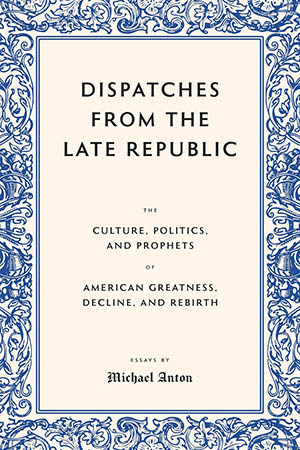
When reading a work of politics or history, substance tends to overshadow quality. Whether the writing is felicitous, whether it has that rare, compelling “flash,” is too often ignored, even though it is writing quality which draws the reader in and fixes the substance in memory. Michael Anton is primarily known as a political writer. But this work, because it is a collection of mostly apolitical essays, showcases not just his topics, ranging from California to Anthony Bourdain, but also Anton’s brilliant writing. Thus, you will not regret spending some hours reading this book; you will be both enriched and uplifted.
Anton, who is what used to be known as a Renaissance man, has worn several hats during his career—investment banker, national security counselor, clotheshorse, professor, chef. Only the last makes any significant appearance in these pages. Dispatches from the Late Republic collects a small portion of his writings from the past fifteen years, and, as he says in the Preface, “Most of what follows was intended to be fun.” And that is what he delivers, though also food for thought. That said, this volume also contains the single most important political essay I have ever read. But we will return to that.
You Should Subscribe. It’s Free!
You can subscribe to writings published in The Worthy House. In these days of massive censorship, this is wise, even if you normally consume The Worthy House on some other platform.
If you subscribe will get a notification of all new writings by email. You will get no spam, of course. And we do not and will not solicit you; we neither need nor accept money.
We begin with California. As a Midwesterner born and bred, I have always thought, perhaps unfairly, of California as a faraway, quasi-alien land, full of Valley Girls, potheads, and more recently, tech bros. Anton, however, grew up in California and is a fifth-generation Californian; he refers to it as “The Motherland.” Or, rather, he sees as his motherland what it was, before it was ruined by the Left.
Most of what he offers here is history of California. What we know about daily life in California immediately before it was taken over by the Americans comes from Richard Henry Dana’s Two Years Before the Mast, published in 1840, chronicling the Bostonian Dana’s time on a merchant vessel which sailed around Cape Horn and to California to take on cowhides, when California was an extremely sparsely populated Mexican province. This I knew (having read that book). What I did not know is that California was, in essence, conquered by the Americans by accident.
The Mexicans maintained several missions, along with a few forts on or near harbors (in today’s San Francisco, San Diego, Monterey, and Santa Barbara), as well as several giant, but mostly uncultivated, latifundia. The Mexican government had desultorily tried and failed to attract more Mexican settlers, but a thousand or so Americans had settled (including John Augustus Sutter, at whose mill gold was famously first found in 1849). John C. Frémont, consummate climber, born a bastard but who married a powerful senator’s daughter, as a low-level Army officer led several ad hoc expeditions to California, sending maps and narratives back east, piquing the public’s interest. In 1846, with only a small group of men, Frémont conquered California without really intending to, after a handful of local Americans near today’s San Francisco came into conflict with the Mexicans, in part over seized, or stolen, horses, and declared the month-long California Republic. Frémont’s freebooting approach swept this into a broader conflict; the Mexicans folded almost immediately, in part because some of their leaders preferred the Americans, and anyway the Mexican-American War was ongoing elsewhere, which meant the Mexicans weren’t really able to do anything, even if they had wanted to, about Americans grabbing land in little populated and unimportant California. A few years later came the Gold Rush, and California became fully part of the United States in 1850 (skipping the usual stage of being a territory). Frémont later was the first presidential candidate of the new Republican Party, but that is another story.
That’s it for straight history. We get discourses on other history-related California topics, though: the wine industry of Napa Valley; the Beach Boys and their 2011 album Smile; and, beginning a thread that runs through the book, the author Tom Wolfe and his relationship with California, including his fascinating analysis of “status groups,” a uniquely American phenomenon. Anton is a huge fan of Wolfe, and once pledged to write his biography, even if now he sees little chance of that happening. Here, Anton does not focus on California’s precipitous decline since the early 1960s, other than with an excoriation of “San Francisco values.” If you want his thoughts on California’s broader collapse, read the first few chapters of his The Stakes.
Moving on, the longest section of the book is “Teachers and Heroes,” meaning individuals who have influenced and guided Anton. Harry Jaffa, historian extraordinaire and booster of Abraham Lincoln. Tom West, historian of the Founding. John Marini, the progenitor of modern analysis of the administrative state. Angelo Codevilla, analyst of the modern American ruling class. Michael Uhlmann, political scientist and statesman. And, of course, Wolfe, whom Anton was privileged to get to know quite well personally.
Anton’s piece on West is particularly apt for the present moment, because it contains an excellent short analysis of the thought of the Founders on equality. Very often nowadays, even on, or particularly on, the Right, the phrase “all men are created equal” is treated with disrespect, even contempt, as the equivalent of the Left’s worship of forced egalitarianism in the quest for utopia. But as Anton outlines, what the Founders wanted was equal political rights, for and only in a society composed of men they deemed fit for such rights, and certainly not universal suffrage, much less other forms of forced equality. Their belief was that men are not divided into natural rulers and the ruled. That did not mean they thought—very much the reverse—that all men do have or should have actual equality, whether in political power or in other matters. “West shows that the Founders wished to excise from their new republic the stagnating caste system of the old world for reasons that were at once utilitarian, political, and moral.” Anton makes the obvious, but neglected, point that the Founders might very well have not found their system at all suitable for America today. After all, it is wholly obvious that the United States “is not now, and has not been for some time, a constitutional republic as the Founders and their heirs understood that term.”
At the midpoint of the book we do get some politics, including, as I say, the most important political essay written in modern America. This is “Unprecedented,” originally published in The New Criterion in 2021. Anton’s essay both asks and answers, to the extent possible, the question in all our minds—can it really be true, as it seems, that we are ruled by a Regime which is the worst in human history? After acknowledging both intended and unintended historical precedents in America’s founding and development, Anton notes that the traditional trope of cycles of regimes, which focuses on conflicts between the few and the many, assumes a common ethnicity. When there is excessive dissimilarity, however, ethnic conflict inevitably takes precedence over class conflict. Thus, assimilation of any newcomers into a country is absolutely essential for civic peace. But our ruling classes have “utterly repudiated the traditional understanding of assimilation, which is now denounced by all elite opinion.” This is an entirely new thing in history. It has never happened before that a nation has “willingly opened its doors to millions of immigrants only to insist that they must never adopt to the traditional ways of their new country.” This, the Great Replacement, “a regime importing foreigners to harm its own people,” “hatred of the core stock of the nation, by other members of the same stock,” is as impossible to deny as it is to deny the Sun rises in the East, and is unprecedented.
But it is only the tip of the unprecedented iceberg. The same ruling class is “determined to make the American population fat, weak, ugly, lethargic, drug-addled, screen-addicted, and hyper-sexualized, the men effeminate and the women masculine.” Degeneracy and “mass barrenness” are pushed relentlessly. Ugliness is celebrated and beauty denigrated. The education system is organized around all these goals; under “President” Biden, for example, when a father reported a tranny raping his daughter at school, the United States Department of Justice investigated the parent as a “domestic terrorist.” At the same time, the education system does very little, often no, education, other than in inculcating anti-white hatred. (One of my children is being forced at this moment in AP English to read the execrable The Nickel Boys, pure Rwandan-level pseudo-historical propaganda designed to demoralize white people, while laying the groundwork for their expropriation and extermination.)
Anton goes on. Our ruling class, in the Floyd Riots most prominently, encourages the destruction of the nation’s cities, including the capital, the supposed center of their power. The Regime-manipulated economy is largely fake and modern digital technology pushed by the Regime a double-edged sword at best. Our ruling class lusts for a continual Year Zero for the entire nation, as long as their wealth and power is maintained. “They are cultural locusts devouring everything in their path.” “Any one of the above elements would appear to be unprecedented; just a few of them in combination surely are. All of them together? How, therefore, can anyone be confident that he ‘knows’ what is going to happen—whether imminent collapse, drawn-out decline, or centuries of tyranny?”
Anton says, “If forced to bet, I would have to place my chips somewhere between imminent collapse and drawn-out decline.” He points out, as I have, that the Regime is totally incompetent at almost everything it does. “And that’s to say nothing of all the things it should be doing, that all non-joke countries do, that it refuses to do.” “Couple all this unprecedentedness with all this incompetence, and going long on Wokeamerica seems a sucker bet.” Yes, no doubt if written today Anton would note that Donald Trump has tapped the brakes on a few of the Regime’s worst excesses. But anything he does is merely a Band-Aid on a slashed jugular. We have bought the ticket, and we must take the ride.
Two other extremely worthwhile political essays round out this section. The first is Anton’s classic article on Bronze Age Pervert, which brought respectability to BAP’s thought and person on the mainstream Right. The second is “That’s Not Happening and It’s Good that It Is: A Quick and Dirty Guide to Regime Propaganda.” This is excellent both to see through Regime propaganda, and to show to right-leaning normies so they can break out of the iron cage in which they are imprisoned. These three political essays alone are worth the price of this book.
The fourth section is foreign policy, one of Anton’s particular areas of expertise (almost by accident, as he adverts to, while also pointing out that foreign affairs can’t be taught except by “on-the-job training”). Of note, he worked for some time in a high position in President Trump’s State Department. He heaps contempt on the idea that Taiwan is worth America engaging in a war with China, which we couldn’t win anyway. He analyzes the “liberal authoritarianism,” and history, of the United Arab Emirates, where he has spent a fair amount of time. (The most interesting takeaway from this is that the UAE aggressively pushes feminism, so we can be certain the clock is already ticking on their success.) And he discusses the near-nuclear war of 1983, and George Kennan’s long career, both very interesting episodes of history.
Finally, we get “Diversions,” the only purely “fun” part of the book. Much of this is about cooking, or rather food preparation, Anton’s true love (though he mentions he also loves swimming, but declines to offer any written pieces on that sport). In a parallel universe, Anton is a French chef—maybe famous, maybe not, but happy to work the line. We get two articles centering around the late Anthony Bourdain, one written before and one written after his death, which Anton uses as a springboard to talk both about his own intermittent absorption in chef training and the industry from the inside more generally. He notes that Bourdain was a fabulist who caught the “star chef” wave at exactly the right moment; perhaps out of professional courtesy, he mostly omits that Bourdain was an insufferable shitlib eager to advance the Great Replacement. And we end with a lengthy historical discourse on the final decades of transatlantic liners, their design, construction, and competition for fastest crossing, immediately before the airplane ended that era forever.
No doubt much of the reason Anton titles this book by reference to the “Late Republic” is that he sees America can be viewed as nothing but that. The subtitle, however, refers to “American Greatness, Decline, and Rebirth.” We get plenty of the first two and, really, almost nothing about the last one. I don’t think that’s because Anton believes rebirth is impossible, but rather because any possible path to it is completely unclear, while also certain to be extremely rocky and disruptive, were it to occur. Of course, Anton knows as well as anyone that no civilization in its late stages has ever been reborn, except in the sense of the phoenix, a new thing rising from the ashes. True, America is unique, and might find a new path forward. You won’t find details about that here, but you will, indeed, have fun.
You Should Subscribe. It’s Free!
You can subscribe to writings published in The Worthy House. In these days of massive censorship, this is wise, even if you normally consume The Worthy House on some other platform.
If you subscribe will get a notification of all new writings by email. You will get no spam, of course. And we do not and will not solicit you; we neither need nor accept money.