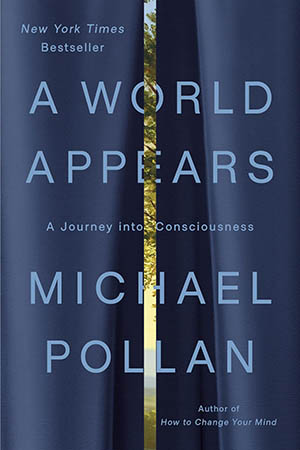
Materialism, the ideology which believes that everything in the universe can be explained by causes and effects tied to matter, has had a bad twenty-first century. It is not so much that it has been definitively disproven, as that in many fields, from physics to near-death experiences, it has proven utterly incapable of providing the explanations to knotty problems its proponents keep promising are imminent. In no area is this as true as with the problem of consciousness. Michael Pollan is here to analyze, in layman’s terms, various theories of consciousness—and to admit, against his will, that materialism has failed, because it will almost certainly never explain consciousness.
Pollan is a professor who has written several bestselling books on the intersection of food and social matters, as well as a book on psychedelics (How to Change Your Mind, which I reviewed favorably). The latter, and his experiences undertaken while writing it, seem to have sparked this book, for the primary perceived effect of psychedelics is alteration of consciousness. But where to begin, given that all consciousness is entirely and ineluctably subjective? As René Descartes famously said, “I think, therefore I am,” but no man can prove his consciousness to another.
You Should Subscribe. It’s Free!
You can subscribe to writings published in The Worthy House. In these days of massive censorship, this is wise, even if you normally consume The Worthy House on some other platform.
If you subscribe will get a notification of all new writings by email. You will get no spam, of course. And we do not and will not solicit you; we neither need nor accept money.
Pollan begins with a type of apophatic analysis, describing the failure of materialism to make any progress whatsoever towards explaining consciousness. Forty years ago, Christof Koch, then a young postdoctoral student, inaugurated the modern study of consciousness when he joined with Francis Crick (who discovered the structure of DNA), with the explicit public goal of providing a materialist explanation for consciousness. In the late 1990s, the pair announced they would, within twenty-five years, succeed in identifying the structures in the human brain which created consciousness, and in finding how those worked. This was, in short, a claim they could solve how and why subjective experience exists at all, instead of all operations of the human organism taking place “in the dark,” autonomically, with no subjective experience at all—the so-called hard problem of consciousness.
They didn’t solve the problem, and to their credit they admitted it. Koch and Crick (the latter died in 2004) made exactly zero substantive progress, though one benefit of their very public search was that it gave respectability to the field of study, which had not really existed before. As the years passed, the result was a proliferation of dozens of different theories of the physical origin of consciousness, all very complex and impressive-sounding, and not a one with any concrete evidence supporting it.
Most of these theories relate to information processing in the brain, speculating about brain networks, competing attention centers, and other plausible-sounding mechanisms. These now coexist with older theories, which have gained new currency as physicalism (another name used for materialism in this context) has failed to explain anything. (To be sure, consciousness can be modified in physical ways, such as by ingesting chemicals or being struck in the head. That says nothing, however, about the source, or the mechanisms, of consciousness.) One such is the very old panpsychism, which holds that everything, even inanimate objects, is conscious to some degree. Another is idealism, which holds that consciousness is a fundamental property of the universe, preceding matter in importance; the brain is, in this frame, perhaps a type of antenna allowing access to this property, rather than its generator. Aldous Huxley proposed a variation on this, in essence that there is a universal field of consciousness, only a tiny fraction of which is filtered by and to our brains. Or, perhaps, consciousness is just an illusion. Or, in a theory which is quasi-material, consciousness is some type of quantum property, or quantum properties are downstream of consciousness, as some maintain. Or we live in a computer simulation. Or it is all a type of dream; maybe we are brains in a vat, and nothing at all is real. How would we know, after all?
To be fair, it is also true that the non-physicalist theories have no repeatable, non-anecdotal, and non-subjective evidence to support them. Materialists, of course, hate the non-physicalist theories, without being able to disprove them. No doubt this is in large part because such theories are generally compatible with religious belief, to which materialists are universally allergic. They recoil when the forbidden word “soul” rears its head in connection with consciousness. But we should note that the materialists are themselves actually very religious. They are religious not in a denominational sense, true, but they are in the broader sense, for as Saint Paul said, “faith is the substance of things hoped for, the evidence of things not seen.” Their faith is that they can explain consciousness through material explanations, despite that they have proven completely incapable of doing so.
This religious belief appears, among other places, in the persistent and frankly at this point obvious, great underlying error of modern neuroscience materialists—the assumption, always existing but only sometimes spelled out, that consciousness is a computational process. Pollan notes that the modern science of neurobiology followed, and was the result of, the arrival of computers after World War II, and this is not a coincidence. And despite that brain-as-computer is not fact, or even a decent theory, but rather “metaphor parading as fact,” the belief is essentially universal among materialists. But, of course, the brain is nothing like a computer; it is not hardware on which software runs, but an organ “continually being physically reconfigured” by conscious thought itself. Moreover, even viewed purely physically, neurons are nearly infinitely more complex than transistors. Thus, the idea that “artificial intelligence,” large language models and so-called neural networks, will ever create consciousness, the latest iteration of this type of thinking (which had analogous predecessors in the mainframe era and in the early internet era), is a category error.
Pollan divides his book into four sections: Sentience, Feeling, Thought, and Self. These, as it were, ascend the ladder of consciousness. As Pollan well knows, definition is both crucial and difficult. So, what is consciousness? Pollan uses a common general definition—the possession of a subjective experience, sometimes simply referred to as awareness. Since Descartes the West, meaning all the science that has accomplished anything in the modern world, has accepted the duality, the separate spheres, of mind, meaning consciousness, and body. (Pollan, mostly incorrectly, repeatedly tries to also tie Galileo Galilei to this distinction, supposedly introduced to avoid being “burned at the stake,” having apparently absorbed a Protestant grade schooler’s dubious understanding of Galileo.)
Sentience is, in Pollan’s definition, something along the continuum to human consciousness, of the same type but not the same substance—some lesser degree of self-awareness and personal agency, in other words. Few would dispute that most animals are sentient, but Pollan pushes the boundaries, discussing at length the possible sentience of plants. (Here, as throughout the book, his main technique is discussions with individuals who focus on a particular sub-topic related to consciousness.) Supposedly, for example, certain plants, when viewed in time-lapse photography, appear to choose advantageous directions of movement for their stems and roots, in a way suggesting perception of objects not contiguous to the plant.
How this would work is anyone’s guess; plants don’t even have neurons. Maybe it is some kind of emergent network effect from other types of cells. In an interesting aside, Pollan notes that plants can be anesthetized by the same drugs that work on humans (and that we don’t really have any idea how anesthetics work, either). This suggests that consciousness might actually be some property of physics we don’t understand, which is used by all living organisms, even cells, to maintain homeostasis—a survival goal where an organism resists the universal pull toward entropy. Thus, plants somehow “infer” benefit or danger, and react accordingly. Animals do the same.
But there is a simpler explanation for these actions, which Pollan only mentions in passing. It used to be commonly understood that all animals, and perhaps other organisms, acted largely by hard-wired instinct. Instinct is the shadow of intelligence, which latter William James defined as “a fixed goal with variable means of achieving it.” For example, this summer I watched three different types of birds, finches, robins, and swallows, build nests under the eaves of my porch. The birds are obviously sentient, but their knowledge of how to build nests is not learned, not intelligence—it is inborn, as nobody disputes. Or, for another example, pit bulls, every one of which should be shot, attack babies and children because driven by instinct.
Aside from this, it is certainly true that human consciousness is entirely different from that of any other animal, something Pollan adverts to but shies away from emphasizing. As Herbert Terrace wrote in Why Chimpanzees Can’t Learn Language and Only Humans Can, all attempts to discover human-type consciousness or intelligence in even the highest primates has run into a brick wall. High-sentience animals are not unintelligent humans. They are an entirely different category, completely incapable of thinking in the same way as humans, as shown by their total inability to learn or use language (despite popular myths to the contrary).
Sentience is really background to Pollan’s next section, on feeling. He points out that most of the materialist theories which revolve around information processing ignore feeling, or affect. This is changing, in part because of the abandonment of study of visual processing in the brain as the key of consciousness. Notably, after years of effort, Koch and Crick dropped their efforts to tie consciousness in any way to the vision centers of the brain. Vision seemed like a promising avenue for inquiry because of its seemingly objective characteristics, but failed to yield the hoped-for results. The book’s title, in fact, comes from the quote used as the book’s epigraph, “I open my eyes and a world appears.” But, after all, a great amount of our awareness, as Pollan discusses throughout the book, is purely internal and has nothing to do with vision. Feelings are one such.
Feelings seem irrational, because they are, and thus unlike vision don’t seem a promising door to understand consciousness. To be sure, there are many kinds of feelings—some are merely reactions to stimuli, such as pain. But others are much more abstract and have little or no connection to stimuli as such. Most of this chapter, however, focuses on attempts to build feelings into machines, again, as usual, with zero success, but much talk by proponents about how it is certain to happen, to emerge automatically when the right combination of technologies is thrown together. Blake Lemoine, the Google engineer briefly famous in 2022 for claiming a Google AI was sentient, makes an appearance, as does the risible Ray Kurzweil, who for three decades has been making bogus claims about how soon everything will be Totally Different. (In 2010, among many other dumb and falsified forecasts, he predicted we would be uploading human brains to computers right about now, because it would just require “a million lines of code.”) The reader starts to get the impression Pollan thinks little of all the materialists he talks to, though he is too kind to say so.
Next we have thought. This is a surprisingly introspective section, where, in cooperation with a researcher, Pollan tries to capture his own thoughts, and finds it extremely difficult. One of his points, however, is that the vast majority of thought is essentially banal—certainly not tied to ongoing survival, to homeostasis, in any conceivable way. He begins to perceive that theorists of consciousness “have grossly simplified the phenomenon in order to make some sense of it,” which seems about accurate. Thoughts are extremely difficult to analyze objectively, because we cannot step outside of “our own stream of consciousness,” and thoughts are rarely distinct, rather “layered and colored by other thoughts and co-occurring sensations.” Moreover, the relation of language to thought is complicated and opaque; some of us have “inner speech,” others not. Does thought precede language? Who knows?
And, finally, we have self, which is the core of consciousness. We all think we have a self, but we have no way of proving that, even to ourselves. After all, like the Ship of Theseus, our bodies are always remaking themselves, so “self” is not a physical thing, or not a unitary physical thing. It appears (though we don’t know) that the sense of self emerges gradually in babies. There is plenty of evidence that babies experience the world much differently than we do, that their experience is “numinous,” in Pollan’s interesting word choice. I suspect, though obviously cannot prove, that babies sometimes, or often, see things we cannot, probably including things not of this world, such as angels. Pollan argues that psychedelics can restore or mimic the phenomenological state of babies, maybe that is true. Either way, even the self is not a fixed thing; it varies as states of consciousness vary.
Somewhat related, when discussing internal perception of the self, Pollan diverts to examine the claim that emotions are merely the brain’s interpretation of a change in the state of the body. The only evidence he adduces for this offbeat conclusion appears in a footnote, citing a 1974 study where a woman offered her phone number to both men who crossed a sturdy bridge and to men who crossed a rickety bridge. The latter group were much more likely to call the woman. The study’s author, and Pollan, says this is because “their brains had misattributed the physical arousal caused by crossing a perilous bridge to sexual chemistry rather than fear or anxiety.” This is stupid, and a woman’s guess at what’s happening (a woman ran the study). Every man knows that danger heightens sexual desire immediately after the danger is successfully navigated. I’m pretty sure there is no similar result in women. (This effect is one reason why rape is so common in war.) While the exact tie between danger and sexual arousal isn’t clear to me, it’s probably tied to a heightened sense of the fragility of life, not some kind of irrational “misattribution.” Although it is true that this emotion may be indirectly tied to “a change in the state of the body,” the idea that all higher emotions are just the result of physical changes seems obtuse to anyone who experiences emotion.
Along another line of inquiry, Pollan observes that memories are an integral element of self, but the physicalists can’t even explain much about the mechanism of memories. A caterpillar which transforms into a butterfly retains memories, but every cell has been replaced or its purpose changed. He also points out that experiences where the self transcends itself, possible with meditation or psychedelics, “ego dissolution,” are typically experienced as blissful, not frightening, which seems entirely counterintuitive. His conclusion, not obviously wrong, is that the self may be more of an mutable construct than we are willing to admit or conceive.
We then come full circle, with Koch, now in his late sixties. One expects him to hold the line, but he has admitted defeat. “I’ve certainly moved beyond garden-variety physicalism,” given “the abject inability of physicalism to explain or even deal with consciousness.” Instead, he’s taken to ingesting psychedelics and musing about quantum theory. Koch has become an idealist, holding “the universe itself is made up of mind.”
The problem with this conclusion for materialists is that it is more or less indistinguishable from “God exists,” “and in Him we live and move and have our being” (Acts 17:28). Or, in the words of a core Orthodox prayer, God is “everywhere present and filling all things.” Pollan quite often dances around, but only once directly addresses, that consciousness is in many ways a proxy for the soul—that is, if consciousness does not have a material cause, it necessarily implies that the soul, broadly conceived, exists. No matter for Pollan; he ignores this obvious conclusion and, noting there are eighty-four current non-physicalist theories, expresses sympathy for that line of thought, without coming to any specific conclusion (for how could he?). “So where does that leave us? Exactly where we already were: wandering in the exitless labyrinth of consciousness.” Certainly physicalism is almost certainly wrong, but he won’t place his chips on anything else. Which is fair enough, given the lack of hard evidence.
I’m not sure the reader learns much from this book. Mostly, it consists of tentative-feeling exploratory rambling, conducted largely through discussions with highly-opinionated people with little concrete basis for their opinions. It can be interesting, though, and it does cause the reader to think, if no better able to form his own conclusions. Pollan, no surprise, struggles against the anti-materialist conclusions his exploration produces. He protests that consciousness must be “the product of evolution,” even though he admits there is exactly zero understanding of how that could be, much less how it supposedly happened. Trying to buttress his claim, he also repeatedly states, without discussion, that we know how life arose on Earth, a completely false claim. Pollan’s main mode in this book is a type of dignified flailing.
Moreover, the reader is too often jarred by Pollan’s hobbyhorses, including his view that Western science is despoiling the world because of too narrow a view of consciousness. We lack “empathetic resonance,” he says. Of course, he gives no examples of how other cultures have that resonance, and does not grasp that it is only ever been in the West where any significant number of the populace have taken care for the natural world. Pollan recites the usual silly cant about “indigenous ways of thinking”; like many others, such as Paul Kingsnorth, he seems to think that the reason Australian Aborigines didn’t wholly pillage their surroundings was their sensitivity and empathy, rather than their total lack of ability to do anything to the surroundings caused by having retard-level IQs. The reader sighs.
Still, there is some value to asking questions, and this book is a relatively easy read. You can do worse than checking it out, if you have an interest in the topic. And as a discrediting of materialism, it’s actually pretty good. Hand out copies to your atheist Boomer relatives and watch them squirm!
You Should Subscribe. It’s Free!
You can subscribe to writings published in The Worthy House. In these days of massive censorship, this is wise, even if you normally consume The Worthy House on some other platform.
If you subscribe will get a notification of all new writings by email. You will get no spam, of course. And we do not and will not solicit you; we neither need nor accept money.