
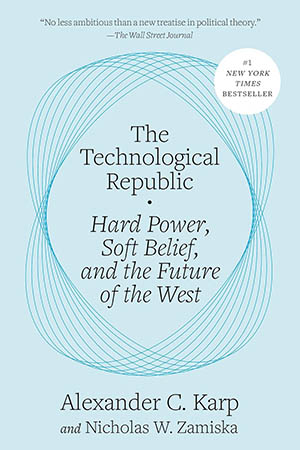
This was not the book that I thought it would be. It is not an apologetic for Palantir Technologies, except incidentally. Nor is it primarily a cry to extend the American empire. Rather, it is a call for America to recover a common identity and purpose, to reverse the fragmentation that has overcome us in recent decades, and thereby to achieve fresh greatness, if not a particularly well-defined form of greatness. What makes The Technological Republic fascinating, however, is that the author, Alexander Karp, CEO of Palantir, claims to be a man of the Left, yet this is inescapably a book of the Right. The result is a twilight feel.
Perhaps this blurring of old political boundaries is not so strange. We tend to overlook that throughout the past two centuries, and especially in the past hundred years, elite politics in the West has been a protean thing. At any given moment, political positions seem immutable and permanent. This condition often remains for some years, but soon enough, the sands shift, and the powerful adopt new positions and new allies which would have seemed bizarre only moments before. In recent years, the best example of this, and perhaps harbinger, is Elon Musk, even if he has not yet completed his inevitable political journey. But he will not be the only one.
You Should Subscribe. It’s Free!
You can subscribe to writings published in The Worthy House. In these days of massive censorship, this is wise, even if you normally consume The Worthy House on some other platform.
If you subscribe will get a notification of all new writings by email. You will get no spam, of course. And we do not and will not solicit you; we neither need nor accept money.
True, this phenomenon has in the recent past almost always meant movement further Left, but that is historical accident, not inevitability. And also true, the Left itself never changes its core beliefs, but merely its external manifestations and practices aimed at achieving its utopian goals. Yet, as I often point out, true believers in Left ideology are only a small percentage of our society, and for certain our future includes widespread abandonment of past opportunistic embrace of the Left. Arguably this process has begun in the 2020s, a decade of flux. Therefore, Karp’s thought here gives us valuable insights into the important fault lines of the years ahead, most of all into tendencies among our elites.
Karp is, no doubt, an elite (as is his co-author, Nicholas Zamiska, a high lieutenant of Karp’s). In 2003, he founded Palantir (along with Peter Thiel and some other men), and for more than twenty years has been its CEO. Palantir’s main forte is using algorithms, and more recently, AI, to sift enormous amounts of data to offer analysis on the basis of which humans can take action. (As most people no doubt know, in J. R. R. Tolkien’s The Lord of the Rings cycle, a palantir is a scrying stone, permitting remote seeing, with considerable risk, by a user sufficiently mentally powerful.) These capabilities obviously have military applications, and that is Palantir’s main claim to fame, but they also have law enforcement and other government applications, as well as value to private business. The company has done extremely well, and now Karp is one of the richest men in the world. Palantir, along with other companies that deal in what might be called surveillance technology, such as Flock, is frequently criticized by segments of both the Left and Right as furthering an oppressive technological panopticon. My own opinion is that as with all technology, potential misuse is unavoidable, and the question is not whether the technology will exist, but who will be master. That, however, is a topic for another day.
If I were a guessing man, though Karp is opaque on his motivations, I would say that Karp’s turn against the Left, on display throughout this book, perhaps inchoate or not even self-recognized, is due to his realization that in the West today the Left is no different than it ever has been in its ideology, but the nature of its destructive program has become more and more manifest. And Karp, like me, seeks American greatness, not our destruction. In very short, this book is a bemoaning of the many failures of modern America, of the box canyon we have been led into by our elites, combined with a program for rebooting the nation through a combination of virtue and technology.
He begins by attacking his home base, Silicon Valley, ruled by what I refer to as the Lords of Tech. Until quite recently, all of Silicon Valley was either directly or indirectly a project of the American government, starting in the 1940s. This was a two-way street; and in fact many American leaders, in the 1940s and 1950s and going back to the Founding, have been “remarkably fluent in matters of engineering and technology.” As a result, Silicon Valley’s leaders recognized a “moral debt” to America. This partnership created the American Century, allowing us to win World War II, defeat the Soviet Union, and become the global hegemon.
But most of Silicon Valley, at every level, has today “lost its way,” meaning that the men and women who own and work at technology companies no longer view themselves as owing any moral duty to the nation, much less as servants of the nation. They instead see themselves as our rulers. However, they fail to provide, and fail even to recognize that they should provide, to the ruled what a ruler must, and this has consequences. “[A] failure by leaders to deliver on implied or explicit promises to the public has the potential to provoke a crisis of legitimacy for the government. When emerging technologies that give rise to wealth do not advance the broader public interest, trouble often follows.” Instead, the Lords of Tech are “decadent,” presumably here meaning focused on personal pleasure and failing to truly innovate and be creative.
The chief obvious symptom of this disconnect is not (usually) malicious behavior, but that the Lords of Tech use their enormous power, wealth, abilities, and influence to generate mostly—slop. With the exception of the companies run by Musk, they create not real advances to actually benefit the public, but infinite variations on “photo-sharing apps and chat interfaces for the modern consumer.” Given their goal of personal profit maximization, this is natural, but it is bad. Silicon Valley produces not collective benefit but products rewarding the “narrow attentiveness to the desires and needs of the individual.” (You will not find in Karp a libertarian economist yearning to use subjective personal utility as the measure of all things, and I doubt he has any respect for GDP as the measure of national flourishing.) The Lords of Tech constrain our sense of the possible. And at all levels, these companies affirmatively refuse to acknowledge that the cooperation and resources of the national government were indispensable in their creation. They therefore often reject working with the government toward the ends of the nation, most of all national defense, but also to all our common ends.
However, this gross dereliction of duty has not been particularly visible to the general public, because most of America suffers from the “winner’s fallacy.” The past hundred years have evinced, at least when seen from the easiest viewing angle, the triumph of the United States over our various enemies and challengers. But other nations, notably China, have pulled alongside, and in many areas, ahead, and we are not responding. Instead, we mouth fine phrases about “soft power,” which is mere “soaring rhetoric.” What America needs is hard power, built on software, and the Lords of Tech are mostly failing to contribute, and in many ways actively eroding, hard power.
Thus, both the leaders and the rank-and-file at many technology companies have repeatedly tried to frustrate partnerships with the government in national security matters, demanding that they, in effect, not the nation that made their power possible, be sovereign (although Karp doesn’t ask how many of those employees are even actual Americans, rather than foreign-born Indians or Chinese—far less than fifty percent, for certain). But whether we like it or not, the Atomic Age, in which America could dominate because we held most of the cards, is ending, and along with it the illusion of permanent peace. The age of AI weaponry has begun, and “The United States and its allies abroad should without delay commit to launching a new Manhattan Project in order to retain exclusive control over the most sophisticated forms of AI for the battlefield.” Yet the AI companies in particular either resist or actively oppose this goal, and as we have seen since this book was published in 2025, actually try to condition the use of their products by the government, while demanding the government both protect them from competition and refrain from any attempt to control their actions.
Karp isn’t done yet. He continues by berating many other aspects of our modern elite. Intellectual courage is out of fashion, both because technocracy and managerialism is rampant and, more, because free speech is widely punished. By this he means, even if he does not intend to, only Right speech; he certainly offers no examples of Left speech being suppressed. It is certainly true, for example, that university culture “systemically punish[es] anything approaching moral courage and incentiviz[es] its opposite”—as long as that target is Right moral courage, and what is incentivized is Left victory and domination.
Therefore, Karp’s chief conceptual failure is to claim that the Lords of Tech, and in general our elites, are “neutral,” “agnostic,” and have a “capacity for forming their own authentic beliefs about the world [which] has been severely diminished.” To the extent this is true, it naturally follows that they refuse to get on board with Karp’s program, which requires a positive conception of the good of the nation, and thus a rejection of neutral pluralism, followed by actions to advance that good. But the problem is, it is not true. With a few exceptions, such as Musk, Palmer Luckey of Anduril (whom Karp oddly does not mention in the book), and perhaps recently Mark Zuckerberg (though in the past he has given hundreds of millions of dollars to Left causes, and zero to Right causes), nearly every one of the Lords of Tech mouths and advances every Left goal, with the only limit being when his own wealth and power might be threatened. This is the genesis of their refusal to act on behalf of the nation as a whole, not some form of agnostic neutrality. At the same time, the reader frequently sees, or thinks he sees, glimpses that Karp is perfectly well aware of this, but is merely playing to as broad an audience as possible.
At a minimum, though, Karp is fishing in the correct waters. He sneers at those who say our loyalty should not be to our actual community, to our compatriots, but to “justice itself.” He castigates those who reject the peerless inheritance of the West, favorably quoting on this topic the historian William McNeill, who he points out would be instantly cancelled today. He repeatedly criticizes looking down on religious belief, and acknowledges that “a significant subset of Silicon Valley today undoubtedly scorns the masses for their attachment to guns and religion.” Yet he laughably maintains at the same time that it is “axiomatic in contemporary culture that all views should be tolerated” and that “the new prime directive [was] to offend no one.” Then he immediately says that “the fundamental issue is that the left establishment has decided, essentially unilaterally, that it need not be in conversation with the right—that mere engagement with the other is a sign of cultural betrayal.”
These two lines of thought, occurring throughout the book, cannot be reconciled except with either an admission of incoherence or with an esoteric reading. Karp tries hard to see the world clearly, either with limited success or while hiding his true opinions. Thus, he admits that all the leading AI systems are aggressively coded to “police wording and tone” and “patrol the limits of acceptable discourse.” What he means, of course, is that one of their core functions is to protect and advance Left interests and doctrines, but can only bring himself to admit the reason is to avoid “causing offense,” an obvious falsehood. But he formally rejects dividing the world into “oppressors and the oppressed,” thereby rejecting one of the two core doctrines of the Left, emancipation. The reader continuously wonders what the author really thinks; it seems unlikely a man as intelligent and incisive as Karp is uncertain.
In any case, for Karp, the expressed broad problem is the failure of our elites to engage what the nation is and should be, what should be our “collective identity”—concretely, not some set of abstractions. How can we create a “foundation for a broader sense of cohesion and shared purpose”? It is grossly inadequate to believe that being part of the American community consists only of “a respect for the rights of others and a broad commitment to neoliberal economic policies of free trade and the power of the market.” He continually excoriates excessive consumerism, especially the nearly total devotion of technologists to satisfying consumerism, which “comes at the expense of other broader and more significant endeavors.” And, again, the public has a right to demand what we get in exchange for the power ceded to this dubious group of “technological agnostics.”
It is perhaps no surprise to the reader, now halfway through the book, that Karp thinks there is one firm that does exemplify right action—Palantir. His company got its big break in 2010, assisting the United States Army with software to identify IEDs, the most devastating weapon used against us in the Afghan War. Not that Karp seems a big fan of that war; he points out it cost us two trillion dollars, or $300 million a day for twenty years, and that in 2006 only three members of Congress had a child serving in the military. (He seems very hesitant about foreign military adventures, despite that he undoubtedly profits from them, saying only that if we fight a war, there should be a draft, and we should fight to win.) Sclerotic elements in the Army resisted the expanded use of Palantir, as did the broader public, focused on bread and circuses (he notes that the game company Zynga was simultaneously going public at a valuation of seven billion dollars, and Groupon at twenty-five billion), but Palantir gradually gained a foothold, far from the public eye. And Palantir’s growth has rapidly accelerated, its stock price gaining 2000% between 2020 and 2026.
Karp attributes Palantir’s success largely to its, that is to say, his, refusal to buy into the “grievance industry, [which] is at risk of depriving a generation of the fierceness and sense of proportion that are essential to becoming a full participant in this world.” What Karp wants, and Palantir to him exemplifies, is “ambition,” which we have lost, or rather traded for ideological poison. We need to reject forced conformity and bring back natural hierarchy at firms (and by implication in all of society), which encourages ambition, and leads to achievement. Reinforcing all this, Karp endorses René Girard’s theory of mimetic desire; such desire, which results in pursuing stupid apps and consumerist garbage, has made Silicon Valley “toxic to creativity.”
So far, so fine. But what exactly does Karp want instead? He wants America to rebuild itself as, or to return to being, “a technological republic.” To do this, we must direct “engineering instinct, an indeed ruthless pragmatism, toward the nation’s shared goals.” (Note, however, that both engineering and pragmatism, being necessarily embedded in reality, tend to lead to Right-leaning thinking and action.) In other words, he wants to remake the nation, through a combination of state action and renewing the virtue of both the people and our leaders. A core component of this is, which, given that Karp holds nineteen billion dollars of Palantir stock, one could argue is special pleading, is that technology should be used to advance weapons systems and related methods by which the United States government can maintain military superiority.
Karp doesn’t offer a detailed program, even if he does boldly address “the next thousand years.” This isn’t a very long book; it’s more of an outline than a set of blueprints (and in fact earlier this year Palantir released a Manifesto distilled from the book). Determined state action is necessary to advance America. The free market is not enough, and in fact has caused many of the problems we face, including permitting far too much action that harms the nation. But on specifics, for starters, we should admit that the wisdom of crowds is bogus. We should reject those who say, “in the name of inclusivity,” that all cultures are equal, and instead celebrate and advance America and its unique and better culture. The West is in fact better than the rest, and Karp bemoans that we have lost the heroic, which built the West, because it is viewed as a “relic of a past we tell ourselves [is] irredeemably rooted in a history of domination and conquest.”
On more technical recommendations, we should ensure that our leaders are paid extremely high salaries, so that we get the best people (citing, among others, Singapore’s Lee Kuan Yew’s successful similar directive). Karp very much admires Lee (the “thousand years” phrase comes from Lee, as well), though he refrains from noting that many of Lee’s initiatives, from banning jury trials because of diversity and jailing his political opponents, would be, let’s say, unpopular in today’s America. Becoming more philosophical, Karp quotes Ernst Renan, who in 1882 addressed “What Is a Nation?” It “presupposes a past,” but is “summarized in the present by a tangible fact: consent, the clearly expressed desire to continue a common life.” We must renew that common life, construct “a collective identity and a shared mythology.” Tolkien’s writings demonstrate such a common mythology; Karp rails at leftists who complain Tolkien is somehow “far right” as emblematic of the problem at hand.
And then he goes full Right. I can’t really do better than quote Karp himself, so here are some representative passages from the culmination of the book:
“The challenge is that a commitment to participating in the imagined community of the nation, to some degree of forgiveness for the sins and betrayal of one’s neighbor, to a belief in the prospect of a greater and richer future together than would be possible alone, requires a faith and some form of membership in a community. Without such belonging, there is nothing for which to fight, nothing to defend, and nothing to work toward. A commitment to capitalism and the rights of the individual, however ardent, will never be sufficient; it is too thin and meager, too narrow, to sustain the human soul and psyche. James K. A. Smith, a philosophy professor at Calvin University, has correctly noted that ‘Western liberal democracies have lived off the borrowed capital of the church for centuries.’ If contemporary elite culture continues its assault on organized religion, what will remain to sustain the state? What have we built, or aspired to build, in its place?”
“The leaders of Silicon Valley are drawn from a disembodied generation of talent in America that is committed to little more than vehement secularism, but beyond that nothing much of substance. We must, as a culture, make the public square safe again for substantive notions of the good or virtuous life, which, by definition, exclude some ideas in order to put forward others. It is the ‘pluralism which threatens to subsume us all,’ as the moral philosopher Alasdair MacIntyre has written, that must be resisted. It is now time, as he made clear, to construct ‘new forms of community within which the moral life can be sustained.’ An aspirational desire for tolerance of everything has descended into support of nothing. The contemporary left establishment inhabits a prison of its own making. . . . We must instead now conjure a new ‘resolve,’ as the author and art critic Roger Kimball has written, and indeed ‘self-confidence, faith in the essential nobility of one’s regime and one’s way of life.’ ”
“Our persistent unease with broader forms of collective identity must be set aside. To abandon any hope of unity, which itself requires delineation, is to abandon any real chance of survival over the long and certainly very long term. The future belongs to those who, rather than hide behind an often hollow claim of accommodating all views, fight for something singular and new.”
Finally, he asks that we adopt an “aesthetic point of view,” by which he means reject all forms of relativism, in art and elsewhere. He cites Kenneth Clark’s 1969 Civilisation series favorably, which portrayed the West, especially its art, as the high point of human civilization, and is therefore utterly anathema to today’s ruling elite. “So much of what Clark said could never be said today.” It is not that Karp is an aesthete; quite the contrary. He is a man of action, and “This abandonment of an aesthetic point of view is lethal to building technology. The construction of software requires taste, both in crafting the programs involved and in selecting the personalities required to build them.” Moreover, founder-led companies, that is (not that he uses these words), those founded and run by great men, rather than by committee or by Human Resources harridans (the latter is not something he mentions, but is the bigger problem), are the only way forward.
The result will be, or can be, the technological republic Karp advocates. It will be “a rich and thriving and raucously creative communal experiment—not merely the bacchanal of permissive egalitarianism of which [Leo] Strauss warned. But it will require an embrace of value, virtue, and culture, the very things the present generation was taught to abhor.” The other way leads to doom, for, citing Sallust, “the fall of empires has been accompanied before by an abandonment of the pursuit and nurturing of virtue.” Moreover, supposedly new alternatives to the wisdom of the past are a dead end. For example, effective altruism is bullshit; they “were shrewd in co-opting the language of moral philosophy, but their move merely delayed a reckoning with man’s search for meaning.”
Crucially, those who oppose America and our interests on the global stage are ahead of us in creating a technological republic. “Other nations, including many of our geopolitical adversaries, understand the power of affirming shared cultural traditions, mythologies, and values in organizing the efforts of a people. They are far less shy than we are about acknowledging the human need for communal experience. The cultivation of an overly muscular and unthoughtful nationalism has risks. But the rejection of any life in common does as well.”
My opinion, based solely on this book, is that within Karp is a right-wing leader aching to break out of his shell. He may not be a devotee of Curtis Yarvin, or of Foundationalism (though much of his program is very Foundationalist, especially virtue politics, the primacy of politics over economics, and techno-optimism, what he calls techno-nationalism). Certainly, MacIntyre, Kimball, Roger Scruton, Strauss, Irving Kristol, and others Karp quotes and admires are definitively men of the Right; he quotes no men of the Left with approval. What he will openly become in the future is interesting to speculate.
A counter to this is that Karp is a strong advocate of Israel’s interests, and of Jewish interests in general, and that perhaps the rising anti-Semitism and anti-Zionism on the Left have driven him rightwards, rather than a more general sympathy for the Right. Certainly the United States being militarily strong benefits Israel, and Karp’s call for a universal draft to bind the nation together is something those prioritizing Israel often find attractive (and it is equally unattractive to those who recognize that most young Americans would benefit not at all from a draft, at least until the question “what is our common good?” is resolved). Yet at most this is an incomplete explanation; the vast majority of Karp’s philosophy is focused on America and is only tangential to the interests of Israel or to the interests of Jews more generally.
Regardless, I disagree with very little of what Karp analyzes and recommends. The problem is, if anything, that he doesn’t go far enough in either his recognition of problems or in his recommended solutions. To take only one example, how can a nation where part of the nation, against the strong opposition of the rest of the nation, admits tens of millions of illegal migrants, culturally incompatible and required to make no effort at assimilation, possibly make progress towards regaining a shared culture without first finally resolving the conflict within the nation? Similarly, the only way to restore ambition, to unleash Silicon Valley and the entire nation from its self-imposed chains on achievement, is to erase all the so-called civil rights laws and restore total freedom of association. No solution to the problems Karp identifies is possible without massive upheaval and political action inconceivable because of the utterly incompatible ends that characterize all American politics. For another example, because of the political power of the Boomers, more than half of all federal outlays are payments to older Americans to live in luxury and unworried comfort, while young Americans are squeezed and punished. But everything Karp desires for America depends on unleashing, and therefore incentivizing and rewarding, the young. Nor does Karp address whether America should be empire or merely nation, another crucial question. Half a loaf solutions relying on compromise or good will can, unfortunately, never resolve these conflicts and questions.
In the end, it does not matter if Karp is a crypto-Rightist, or merely a man trying to hew between the actual Scylla of the Left and the phantom Charybdis of the Right, because our nation has found no way to converge on common goals. Rather, it diverges on many axes at an ever-increasing rate. “Our society has grown too eager to hasten, and is often gleeful at, the demise of its enemies. The vanquishing of an opponent is a moment to pause, not rejoice.” This is true, philosophically, but other than decisive conflict, how can irreconcilable aims and goals be resolved? Karp would do well to read some Carl Schmitt on these issues. In fact, at the most basic level, most of America rejects any conception of the common good, which is a curse word on much of the Left and on the catamite Right, and until that situation is rectified, no progress can be made in the direction Karp eloquently soliloquizes.
Viewed more abstractly, Karp’s project might take America in an entirely new direction, a new thing for a new age. Or maybe a new-old thing. Alexander Dugin, about whom I know little except that he rejects the West, has complained that Karp is advocating “Western techno-fascism.” He’s not wrong, or not entirely wrong. But really, maybe techno-fascism is our inevitable future, if fascism is viewed not as an epithet, but as a broad type of political organization that has had many variants, and is today largely enfleshed in the modern Chinese system of governance. I’d prefer a mixed-government republic, not dissimilar from 1787, but America and Americans were immeasurably different 250 years ago. Karp would say, out loud at least, that he wants liberal democracy, but it’s far from clear that his program, if followed to its logical conclusion, some distant variation on Singapore (since America is very different along many axes), would be anything else than what Dugin claims. We will see.
You Should Subscribe. It’s Free!
You can subscribe to writings published in The Worthy House. In these days of massive censorship, this is wise, even if you normally consume The Worthy House on some other platform.
If you subscribe will get a notification of all new writings by email. You will get no spam, of course. And we do not and will not solicit you; we neither need nor accept money.