
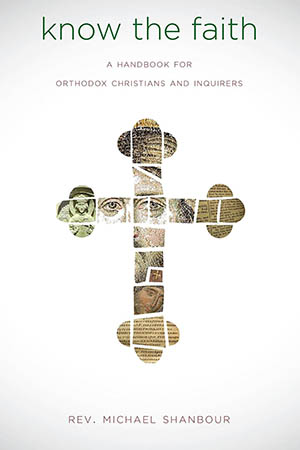
Orthodoxy is the coming thing, so I often say. But part of that is mere prediction, and while certainly American Orthodoxy is experiencing a very significant influx of converts, including me some years back, the absolute numbers are modest. One reason more have not yet converted is that few Americans have any latent knowledge of what Eastern Orthodoxy is. They (probably) know it is Christian, and they may know it is the oldest form of Christian practice, but how and why it differs from Christian branches better known in America they usually have little or no idea. Michael Shanbour, an Orthodox priest born in Kansas, wrote this stellar book to fill this gap in knowledge.
Shanbour covers eleven crucial theological topics, clearly stating the Orthodox position and its derivation, both from Scripture and the writings of the Fathers of the Church. He then offers a comparative analysis to Catholicism and to the main varieties of Protestantism (essentially older non-Reformed branches such as Lutheranism; Reformed; and Evangelical). This is not, therefore, a complete handbook for someone considering Orthodoxy. It does not attempt to cover every aspect of Orthodox belief and practice; for example, it does not discuss all of the sacraments, nor does it cover practical application of Orthodoxy in daily life or structure of the Church, nor does it attempt any form of pastoral care. The focus is on core spiritual elements of the faith.
You Should Subscribe. It’s Free!
You can subscribe to writings published in The Worthy House. In these days of massive censorship, this is wise, even if you normally consume The Worthy House on some other platform.
If you subscribe will get a notification of all new writings by email. You will get no spam, of course. And we do not and will not solicit you; we neither need nor accept money.
The reader interested in Orthodoxy should certainly read this book. Other books I can recommend, which provide a rounded view of Orthodoxy and are classic works, are Kallistos Ware’s The Orthodox Church, which focuses on history; Thomas Hopko’s four-volume introduction to Orthodox practice; and Robert Payne’s The Holy Fire, a history of the Fathers of the Church. For those who like this sort of thing, search the topic “Christian Theology” on my site, and you will find reviews of those and several more related works.
Shanbour carefully avoids polemicism. I am given to understand, although I do not know from first-hand experience because I religiously (ha ha) avoid Orthodox internet content, that online polemic is common among some Orthodox converts. To be sure, this is a frequent problem with all converts to any religion; I have no reason to believe it’s worse with Orthodox. But Shanbour is not here to yell at readers; he carefully delineates Catholic and Protestant beliefs and contrasts them to Orthodoxy. As far as I can tell, which is pretty far because I was raised a very orthodox Roman Catholic and attended a strict Calvinist (Dutch Reformed) elementary school, his summaries of belief are accurate and complete, if brief.
Before theology, he begins with concise history. He notes the divergence over the past thousand years between the Eastern Church, that is, Orthodoxy, and the Western Churches—initially Rome, but after the Reformation, all the varieties of Protestantism. The Western, Catholic rupture with Orthodoxy revolved around the role of the papacy and various matters of doctrine (most memorably the filioque clause, where in the eleventh century Rome added text into the fourth-century Nicene Creed stating that the Holy Spirit proceeded from the Father “and the Son”). While important, Shanbour sees none of this as the crucial divergence in the past millennium and more between East and West.
Rather, the most important division is that in matters of religious inquiry the West came to prioritize reason and logic, while the East to this day retains the view of “theology as the fruit of authentic prayer and purification of the heart.” Shanbour quotes the standard Orthodox view, from Saint Evagrius: “If you are a theologian, you will pray truly. And if you pray truly, you are a theologian.” “In other words, theology was [and is] understood as the fruit and consequence of a holy life leading to direct union with God the Holy Trinity. Accordingly, a true theologian . . . has been illumined by God’s grace, making him a vessel of the Holy Spirit.” In the West, by contrast, a theologian is someone, usually a very intelligent and learned man, who systematizes belief and its supports in writing—a man who, most of all, provides useful and illuminating information to others. In the Eastern typology this is philosophy, not theology. Thus, in the East an illiterate monk, or even a simple layman of whom nobody has ever heard, can be a great theologian, something not conceivable in the West.
In practice, this means that the Orthodox are much more comfortable with ambiguity and lack of precise delineation than are Westerners. For example, how and precisely when in the Divine Liturgy transubstantiation (the changing of the bread and wine offered by the priest into the actual Body and Blood of Jesus Christ) occurs is not a matter of significant concern for the Orthodox, but is for the Catholics. For the Orthodox, it merely is, and that is enough. Similarly, the Orthodox pray for the dead because we are told by Scripture and the Fathers we are to pray for the dead; the precise method of efficacy of those prayers is not our concern or worry. But for the Catholics, it was, which led to the creation of the doctrine of Purgatory.
Shanbour’s aim is not to re-litigate this history. It is to make clear that discussions and comparisons between East and West are made difficult by the divergent starting points. Words such as “sacrament” and “grace” have different meanings in different traditions, and until those meanings are clearly understood, it is difficult or impossible to discuss and bring light to the discussion. Thus, he is careful throughout the book to make clear what he means by important words, and what others mean by those same words.
We begin our exploration of doctrine at the beginning, with the Church. It is indisputable on a historical basis that the early Church was a corporate organization with a unified system of belief and practice, not a “loose affiliation of self-determining Christian congregations and individuals free to discern for themselves the implications of belief in Jesus as Messiah and Lord.” This Church was that founded by Christ through the Apostles, and the “doctrine, governance, worship, and ascetic discipline” was passed down to the community of believers. Catholics agree, although they refract it through the lens of papal supremacy. Protestants, however, to a greater or lesser degree, dispute this, because it is not entirely clear within Scripture. Thus, for most Protestants, the Church is where “two or three are gathered in My name” (Matthew 18:20), and for Reformed Protestants, the Church is found wherever there is purity of preaching and sacraments.
Thus, we immediately come to the crucial matter of the role of tradition in Christian belief (and Shanbour returns later to this topic as one of the eleven chapters). Tradition quite clearly holds the Orthodox or Catholic view of the Church. But Scripture is not so clear, though to be sure tradition is repeatedly endorsed in the New Testament. However, as Shanbour points out, Scripture itself notes that many details of very early Christian practice were not in early years written down, and in fact were hidden from the unbaptized, in order to avoid “throwing pearls before swine.” (This secrecy, along with certain Gnostic practices, unfortunately contributed to false rumors and accusations of Christian rituals as degenerate gaining traction, something discussed at length by the late Robert Louis Wilken in The Christians as the Romans Saw Them).
Every Church Father endorsed tradition as the key element of determining both what the Church was and what its practices were to be. Protestants generally have little or no interest in the non-Scriptural writings of the Fathers, so their position is, up to a point, internally consistent. But Shanbour claims this is somewhat incoherent, for how could belief have been cohered and transmitted other than tradition, before Scripture even became Scripture?
In the Orthodox view, tradition is guarded and transmitted by the bishops who are in apostolic succession; what is tradition is shown by consensus and long-standing practice. On a point of order, we should note that such consensus has typically been arrived at through the mechanism of councils, often very disputatious and fiery affairs. When we hear the word “consensus” today, we tend to think of the modern, hyperfeminized, longhouse version of it, which means avoiding open disagreement and substituting passive-aggressive mealy-mouthed interminable talking to reach vague and formless, “safe” conclusions. Such bogus consensus is wholly alien to Orthodoxy, which seeks definitive answers through clear and vigorous disputation. And the Church consists of those who are in communion with each other, and therefore with Christ, as a result of this common understanding.
There is therefore only one Church, reified in what is today called the Orthodox Church. When Shanbour speaks of the Catholic Church, he means that body as it has existed for approximately the past thousand years—prior to that time, Orthodox and Catholics were formally one Church, although some of the differences that led to the departure of the Catholics were visible even before that time. Other churches are, simply put, not the Church. However, Shanbour notes we should be very clear that none of this means that only Orthodox can be saved, or, for that matter, that all Orthodox are saved. Those are matters for the judgment of Christ; Orthodox faithful pray very often for “a good defense before the awesome judgment seat of Christ.”
Having established the foundation, we next turn to the most crucial, yet perhaps also the most poorly grasped, major concept in Christian belief—grace. This chapter alone is worth the price of the book, and was of great help to me personally. The term grace is used throughout the New Testament and all patristic writing, yet to the average person it means little more than a vague feeling related to God’s action in the temporal world and on the hearts of each of us. According to Shanbour, the Catholics have long focused on how grace operates, whereas the Orthodox focus on what grace is. For the Orthodox, as for the Catholics, the essence, the inner being, of God is, and always will be, completely incomprehensible to us. We, therefore, can never truly know God.
But, and this doctrine was developed most fully by Saint Gregory Palamas in the fourteenth century, we can know God to an extent through his communication of His “energies,” “a real communication of the uncreated God.” Grace is therefore not created, it is uncreated, as are all aspects of God. It is part of God, yet not his essence, in the same way as the Sun’s radiance is part of the Sun, yet not its essence. Crucially, the indwelling of grace in man is the natural state of man. Therefore man participates through grace in “the very life of God,” through all three Persons of the Trinity individually and collectively, but in particular through the Holy Spirit. Grace is “the outward movement of His one Being that manifests His uncreated, eternal deity and power.”
To be sure, man must choose to accept God’s grace, His energies, and he may choose to reject it. When he chooses to accept it, he receives the possibility of permanent union with God, eternally, what the Orthodox call theosis, a process which, quite literally, never ends—for God is infinite, and therefore a human being may always approach closer to Him, both in this life and the next. This is where man’s works, his deeds, good and bad, enter the equation (also a topic to which Shanbour returns for an entire chapter).
For Catholics and Protestants, by contrast, grace is an activity of God, that He gives or withholds. For Catholics, who parse grace into specific named categories with different characteristics, this grant or withholding is in part controlled by the Catholic Church. Grace is something created by God and bestowed by Him, not a manifestation of His own being. For Protestants, grace is the “unmerited favor of God,” again not an element of God’s existence, also often viewed as a legal release from guilt, which in either case leads to salvation.
Next, logically, Shanbour addresses salvation, and then the related topic of justification by faith. For Orthodox, salvation is the process of union with God, again a never-ending process, not “one and done.” By contrast, both Rome and Protestants tend to view salvation as a legal matter, of guilt that can be vitiated by repentance. Certainly, for the Orthodox, repentance from sin is part of the process, but it is a process, not a binary of guilty or not. Sin is illness, and the Church is viewed, in a famous Orthodox metaphor, as a hospital for the cure of souls (and perhaps no coincidence, it was Saint Basil, one of the most important saints of the early Church, who founded the first medical hospital). Salvation is not accomplished by works, but by grace through faith; on this all Christians agree, despite polemics that sometimes try to blur this doctrine. To be sure, works assist in increasing the individual’s receptivity to grace; antinomianism (the idea that believers are entirely freed from God’s law by grace) is a recurrent heresy.
As to justification by faith, it is a common Protestant belief, emerging from the words of Saint Paul, that we are justified by faith alone, which relieves us of Adam’s guilt, attached to all mankind through original sin. Catholics, similarly, firmly hold the doctrine of original sin, though not that of justification by faith alone. The Orthodox reject the idea of original sin; Adam’s guilt was his alone, and none of us are born guilty, although certainly we all sin. The consequence of Adam’s sin, rather, was that it brought death into the world; “Christ did not come to save us from guilt but from sin and death.” Faith places us in the position to receive grace; it is therefore a necessary voluntary choice.
Shanbour’s longest chapter is on the Eucharist and liturgical worship. The Eucharist is, of course, the “central act of Christian worship,” focused on the transubstantiation of bread and wine, conducted by the Catholics in the Mass and by the Orthodox in the Divine Liturgy. In Greek, Eucharist is “thanksgiving” or “gratitude,” and it is this which is being offered by the faithful in the liturgical service. The Eucharist restores us, or rather can restore us if engaged in with faith and a well-directed heart, to communion with God, the state in which Adam and Eve existed before the Fall. Catholics share much Orthodox doctrine, but view the Eucharist as a re-sacrifice of Christ, or a re-presentation of that sacrifice, something rejected by the Orthodox, who see the Liturgy as a participation in the actual, ongoing Liturgy taking place in Heaven.
Protestants, in large part due to a reaction against abuses of the Catholic Church, especially indulgences, either reject entirely the idea of the Eucharist as involving the actual Body and Blood of Christ, or place less emphasis on it. Although as I say Shanbour studiously avoids any polemic, the reader cannot at times but feel like the Catholics are not coming off well, and that Luther had a point—not only under the circumstances of the corruption that characterized much of the Catholic Church in his day, but more generally that it had tied itself in knots with its devotion to deriving the specifics of doctrine with the overly profligate use of reason. This comes through most clearly in the discussion of original sin and the related dogma of the Immaculate Conception.
Other chapters cover ordination and the priesthood, emphasizing that ordination conveys a substantive difference in the man ordained, the “tangible gift of grace by the Holy Spirit”; confession and repentance; icons, veneration, and worship; the intercessions of the saints; and the veneration of the Theotokos (“God bearer”), the Virgin Mary. All are excellent.
I have no doubt that both Catholics and Protestants would not agree entirely with Shanbour’s presentation of their beliefs. At a minimum, they would probably emphasize certain points more, and they would have their own logical refutations of Orthodox positions, even if Shanbour does try to present counter-arguments. The audience for this book is explicitly both those already Orthodox and inquirers, the Orthodox term for those interested in learning more about Orthodoxy. For that purpose, it serves admirably.
You Should Subscribe. It’s Free!
You can subscribe to writings published in The Worthy House. In these days of massive censorship, this is wise, even if you normally consume The Worthy House on some other platform.
If you subscribe will get a notification of all new writings by email. You will get no spam, of course. And we do not and will not solicit you; we neither need nor accept money.