
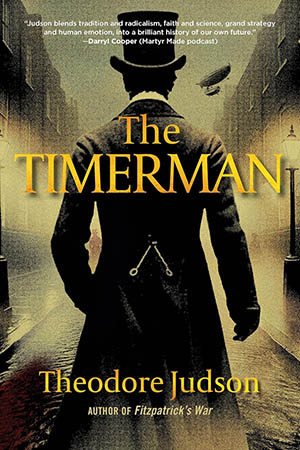
For years I have been waiting for this moment—the republication, courtesy of Ark Press, of Fitzpatrick’s War, by Theodore Judson, and the first appearance of its sequel, The Timerman. What Judson offers in these books is future history. This is compelling escapism of itself, but Judson blends his stories with keen insight into both actual history and human nature, within his fictional frame examining the America of four hundred years from now, as well as the America of today. Moreover, The Timerman considers a question rarely examined today, and when examined, it is almost always superficially. Namely, what are the positive obligations, if any, of Christians to inhabitants of other nations?
Fitzpatrick’s War, first published in 2004 but until this month long out of print, is the finest fiction work of the modern age—a history of the twenty-fifth, and also the twenty-first, centuries, written in the twenty-sixth. I will not repeat what I have said earlier about that book, but today focus on the sequel, which takes place twenty years after the events of Fitzpatrick’s War. These are books about the Yukon Confederacy, which replaced the United States in the middle of the twenty-first century. The Confederacy rules most of North America, along with England, Australia, and New Zealand. In politics, it is a mixed government with the aristocratic element dominating, having a limited franchise and a very weak central government. In morals, it is Reformed Protestant (though Catholics and Jews are tolerated to a degree), with aggressive stigma as the main mechanism governing social behavior. In economics, it is autarkic and prioritizes social optimization and the common good over amassing wealth. In other words, it is, by coincidence, very Foundationalist.
You Should Subscribe. It’s Free!
You can subscribe to writings published in The Worthy House. In these days of massive censorship, this is wise, even if you normally consume The Worthy House on some other platform.
If you subscribe will get a notification of all new writings by email. You will get no spam, of course. And we do not and will not solicit you; we neither need nor accept money.
Therefore, as with Fitzpatrick’s War, this book can be read as right-wing fiction. I don’t think that’s Judson’s intention, and I have no idea what his politics are (his other works, such as Tom Wedderburn’s Life and The Martian General’s Daughter, are apolitical, except to the extent that any fiction which accurately depicts and explores reality always has a distinct right-wing tinge). In any case, if read as right-wing, it is not didactic or triumphalist right-wing fiction. Judson’s prime overarching focus, rather, is to count the cost, to illustrate in the struggles of one man the moral conflict and compromises that arise even among those doing God’s work. For nothing for nothing, and nothing’s free.
The Confederacy, compared to other strong societies in the actual history of mankind, has a unique characteristic essential to the plot. Although it is mostly opaque to the citizenry of the Confederacy, ultimate power is held by a secret society, the Timermen (named for the mechanical pocket watches they carry to identify themselves, with an inscription from Horace: Eheu fugaces labuntur anni— “Alas, the fleeting years slip by”). The Timermen were formed at Purdue University in 2047, and since the twenty-first century they alone have had access to electrically-powered technologies, all of which are otherwise completely absent across the entire globe. Instead, advanced forms of non-petroleum combustion engines are the primary energy sources, although the Yukons have made biological advances, leading to long lifespans (around 110 is typical among them, though not, as we will see, typical in the rest of the world). The Timerman control, or rather forbid, all electricity use by others, using two pieces of technology, operated from their base in what used to be named Hawaii (now again correctly called the Sandwich Islands, as originally named by the great civilization which made something of them, unlike the primitives who arrived a few centuries earlier and remained primitives). The first is the Storm Machines, balloons tethered to satellites which are used to disrupt any manmade electrical field the Timerman detect from orbit. The second is the Blinking Stars, satellites used for global instantaneous communication (but only to tightly-controlled reception devices).
The result is that the Yukons dominate the world, for their military is nearly impossible to defeat, and the Timermen act solely in the interests of the Yukons, if independently of the political system. How this domination came to completion is detailed in Fitzpatrick’s War—where young Lord Isaac Prophet Fitzpatrick, following the pattern of Alexander the Great, conquered and subdued the nations of the Earth for his own glory, reducing to near-barbarism the empires of the Indians, Chinese, and Turks, while killing hundreds of millions in the process. But Fitzpatrick’s reach exceeded his grasp. Like Alexander he became lost in his own mind, and the Timermen assassinated him.
They did so not for the reason one might think, that Fitzpatrick threatened their power. Rather, the Timermen exist for one reason and one reason only—to short circuit the inevitable cycle of civilizations, where a strong, virtuous, robust young civilization becomes corrupt, loses shared solidarity of purpose, Ibn Khaldun’s assabiyah, and falls. Their aim, their entire purpose for four hundred years, is to take all necessary actions to halt this process among the Yukons. Thus, they allowed Fitzpatrick to reach the towering heights to which his hubris and talents could take him, reducing the Yukon’s potential foreign enemies to impotency, and, more importantly, as they foresaw, resulting in Fitzpatrick attracting to himself all those elements in the Yukon aristocracy who lacked virtue, who threatened to corrupt the civilization and bring it to dust, one with Nineveh and Tyre. These the Timermen view as domestic enemies, far more dangerous than foreign enemies.
The Timerman completes the story of how the Timermen reset Yukon society. After Fitzpatrick’s death (in Neopolis, the new city he built to his glory outside of Samarkand), the ruler who rose was his cousin, Lady Chelsea Virtue Shay, called “the Chrysanthemum Woman,” after the symbol of the Shay noble family. Lady Chelsea is vicious, amoral, and exceedingly competent, and her ascendancy collects in her court and circle all the elements of Yukon society who desire modernism, who wish to “advance” the Yukons. Such modernism is primarily the rejection of strict Yukon Christian morality and mores, combined with the exaltation of the degenerate practices of the execrated “Age of Electricity”—the age in which you and I live in 2026.
That age ended in the destruction of the United States in the middle of the twenty-first century. The Yukons were originally not from the Yukon; that was a name their enemies gave them to deride them for their provincial, backward ways. Rather, they were farmers and other producers from flyover country—those who created actual value in America, who ultimately rebelled against a tyrannical regime which represented and weaponized the urban and suburban parasite classes. The Timermen did not plan what the Yukons call the Storm Years, but they were instrumental in the successful overthrow of the tyrant Bartholomew Iz, schoolteacher turned lawyer and leader of paramilitaries formed from the urban underclass and invading migrants. The war was won in part due to the Timermen’s invention of, and distribution of, man-portable EMP weapons, obviating Iz’s possession of air power and nuclear weapons. And so, for four hundred years, very little has changed in the Confederacy, but as the Timermen see, nothing is forever—unless made to be so.
We can ignore that this system is not realistic; the Yukon Confederacy is a thought experiment, not a recommendation for a political system, at least not a complete recommendation. After all, why would the Timermen be themselves exempt from the temptations which drive the fall of civilizations? True, there have been tight-knit groups which have managed to maintain coherency and take decisive action to advance their goals over centuries; the Jesuits are perhaps the best example (leaving aside other similar groups, such as the Rothschilds or the Illuminati, the power of which, I hate to break it to you, is a fantasy). But that also proves the point—the Jesuits are now a cabal of effete homosexual leftists, only nominally Roman Catholic, all of whom Saint Ignatius Loyola would beat with iron rods if he returned to see what had become of the Society of Jesus, while disinterring Pope Francis and throwing his decayed, most definitely not incorrupt, remains into the Tiber.
The Timerman of the title is, and the book is narrated by, one John Randel, who as the book opens in 2444 is not a Timerman at all. Within the Confederacy, Randel occupies an anomalous position. He is a famous botanist and decorated soldier. He fought in India during Fitzpatrick’s campaigns and now lives quietly in Hanksville, in what once was Utah. Randel lives quietly in part by choice, but also because despite his fame and wealth (the result of his patented crop inventions), he is a social outcast. This is because he is a bastard, and worse, the son of a prostitute. In the extremely rigid social structure of the Confederacy, this makes him the object of open contempt from the vast majority of people, high and low—though this is offset a tiny amount by his botanical ability, which has brought greatly increased crop yields to the Confederacy. Nonetheless, he has no social position, in a society where position, based on kinship, extended family, and allegiance to a local Lord, is crucial to fitting in, other than on the denigrated margins of society.
What makes Randel psychologically different than most Yukons, however, is that he has, and executes on, a second goal for his botanical endeavors—to share them with the world beyond the borders of the Confederacy. Without being propped up by the West as they are now, and with the effects of Fitzpatrick’s war upon the world, other countries live at a very low level of civilization. Their life expectancy is no different that that of the eighteenth, or perhaps the eighth, century. Randel shares his botanical creations at no cost with other countries, with the explicit goal of improving the lives of the poor there, something to which other Yukons are completely and contemptuously indifferent. The Yukons regard all lands outside the Confederacy as irrelevant and unimportant, except that they must be kept in a state of barbarism and never challenge Yukon supremacy. There is only very minor trading with the rest of the world, although Lady Chelsea, as part of her lust for modernization, maintains formal and informal contacts with foreign countries. This includes embassies from, for example, the Panslavs (the most coherent other civilization, presumably an expanded Russia; most of Europe, however, is part of the backwards Moslem world), as well as various underhanded connections with foreigners meant to strengthen her power and advance her ideology. Nearly all the Yukons regard Randel’s open-handedness and generosity toward non-Yukons with something between bemusement and contempt; they care not at all if a Chinese peasant starves.
This, then, is the tension at the heart of the book. The Yukons are enormously successful, a virtuous, content, and happy society that bids fair to dominate the world for thousands of years. In many ways, the society Judson depicts is the mirror image of the globe, and America, as it exists today. Our ruling class views “citizen of the world” as the highest goal and honor, and eagerly spends many trillions of dollars stolen from those they rule on handouts to undeserving and ungrateful foreigners, many of whom would promptly starve if not for our largesse. Our rulers invite the world to invade the West, to steal from and abuse the indigenous inhabitants. In this, and in everything else, whatever our ruling class does today, the Yukons do exactly the opposite. But at what cost?
As the book opens, the Timermen have a problem. They are aware that Lady Chelsea is plotting to overthrow the entire order of Yukon society and attempt to directly dominate the nation, not merely erode its morality among segments of the ruling class, and to do this they suspect she has found a way to both manufacture energy weapons (used in the last years of the United States) and to disable the Storm Machines so those weapons can be used. They further suspect one of the Timermen is a traitor serving Lady Chelsea. Thus, they recruit Randel, whose outcast status is less relevant in the fluid, amoral society of the Capital, and whose internationalist tendencies make him an object of interest to Lady Chelsea, as a Timerman and spy.
The Capital is Cumberland City, fifty miles west of what was once Washington, D.C. Power is held by the Consul and the Senate, the assemblage of Lords; the latter elects the former. The Consul is Lady Chelsea’s husband (women cannot hold office in any capacity), but she holds the real executive power. The Senate, strictly an aristocratic body (the major Yukon organizing principle is a form of quasi-elective feudalism, with men and their families all pledged to a Lord), is divided between those who represent the mass of Yukons and those who support Lady Chelsea. Regardless, the central government has almost zero power outside Cumberland City, and it has been that way for nearly four hundred years. Neither Lady Chelsea’s writ nor her support extends more than a hundred miles from Cumberland City, unless she can convince a Lord with an army to cooperate with her. But she intends to change that.
Much happens in this book—it is gripping and a fantastic read, so I will mostly avoid spoilers. Randel spends more than a decade in Cumberland, with his first aim to determine how Lady Chelsea is able to distribute vast sums of money to her retainers, in a country with a hard, gold-based monetary system. He is able to gain social position soon enough—at first, he is treated with contempt, but ingratiates himself with Lady Chelsea, despite her mistrust of “saintly men.” She suspects he is a Timerman, but when he does things no Timerman would do, such as plead against the destruction of a small foreign country when some of its citizens conduct a terror attack in the Capital, she rejects her suspicion, and sees Randel as intelligent but weak, and thus incapable of being a Timerman. “Timermen are not the sort to put themselves out for some brown beggars on the other side of the world.”
Lady Chelsea is very clear about her intentions. “The members of my court wish to destroy the old order because it represses their sundry inclinations; I wish to destroy it because the first rule of the powerful is we must eliminate everything else the people might give their loyalties to, or they will never be completely servile to us.” Despite, or because of, her intentions, she comes to a bad end, the same as Bartholomew Iz. We know this already, if we read Fitzpatrick’s War (it makes sense to read that book before this one, because it explicates the Yukon order more fully). The Timermen accomplish their goal, and all corrupting elements among the Yukon aristocracy are wiped out, to the last man and woman. Randel, now granted social position and therefore able to marry, returns to Hanksville, still a Timerman. It’s a happy ending.
But is it a good ending? That is, is it a morally good ending? After all, the Yukons claim to act to advance the aims of God. Is this a true claim? Not really. The Yukons, or rather the Timermen, are a strange, but not unprecedented, blend of godliness and utilitarianism. One of their leaders responds to Randel’s hesitations: “Don’t quote Jesus to me. As much as we respect Him in the Guild, we know He would have made a terrible Timerman. Not everyone is cut out to be one of us. We do the Lord’s work, of course. To do that work, we sometimes have to do much the Lord would not condone. That is one of the paradoxes God has created for men. You might say we in the Guild have built and are constantly maintaining a great edifice here on Earth. Some of the pieces of that mighty structure we have erected are admittedly rotten, yet the edifice, as a whole, is pleasing to us and to God. As long as we keep the grand structure standing, God will forgive us if we fashion a few bricks within the building that are not up to His standards.”
The Timermen’s justification for their actions is, “You must recognize that evil exists the world and that the only long-term response to evil is the destructive power of force. Reason and compassion do not work against evil, for reason and compassion are virtues, and evil rejects everything that is good.” Yukon soldiers, similarly, are fond of dishing up quotes from the Book of Joshua as they slaughter their enemies, praying God will sort the wheat from the tares as they harvest both. Yukon churchmen are wholly in agreement with the Yukon way of life, even if they are not as likely as the Timermen to publicly mouth equivalencies to Dostoevsky’s Grand Inquisitor. The result is a united society as strong as iron, a society of rigorists. Still, the question haunts, or should haunt, us. What may men do, on this Earth but under the stern eye of God, to secure their future and that of their progeny?
There are two aspects to this question. The first I treated at length in my discussion of Fitzpatrick’s War—what violence is permitted to Christians, under what circumstances? But there is another aspect, exemplified in the career of Randel. Given the Christian absolute and central obligation of charity, to whom is charity owed? To some extent I have discussed this before, but primarily in the context of charity within a nation—both to our fellow citizens, and to those not of that nation yet still living here, usually against the will of most of our citizenry. What, however, of charity to those outside our borders, whose inferior and unaccomplished societies result in their lives being far more precarious than ours? Charity to brown beggars, one might say.
Until the industrial age, this question rarely arose for Christians. The dismissive Yukon attitude is merely the typical Christian attitude for most of the two thousand years since Christ walked the dusty paths of Galilee. In large part, however, that attitude was the default because those far away could only be helped, or even their needs known of, with great difficulty, while charity was always very obviously needed close to home, in times when poverty meant starvation or selling one’s children into slavery. Thus, Saint John Chrysostom and Saint Basil did not focus on distant charity. Nonetheless, the concept existed very early in Christianity. Saint Paul, for example, collected for needy Christians in Jerusalem from the Christians in far-away Macedonia, who were themselves very poor (2 Corinthians 8). But today, with easy international travel and communications, we both can know of the needs of others outside our nation, outside our society, and take action to alleviate their suffering.
To be sure, no nation or society other than the Christian West has ever helped any other people. Even today, the Chinese and Indians don’t help anyone else as a charity; such an idea is utterly alien to both their religion and their culture. Nor do wealthy Muslim nations—“charity” for them is when they aggressively advance Muslim triumphalism and political power across the West, aided by traitors within our nations, and only occasionally do they grant actual charity, always only to Muslims (for, after all, the Muslim obligation of zakat is strictly limited to Muslims, and Muslims are in most schools of Muslim thought are in fact forbidden to give charity to non-Muslims). The Red Crescent is not a Muslim group; it is a Christian group which helps Muslims, forced to adopt a Muslim symbol in order to avoid being killed by the objects of their charity (although some Muslim groups also operate as Red Crescent groups, only giving charity to Muslims, naturally). The Christian West, however, beginning with the Victorian British, has increasingly seen it as a moral imperative to offer charity to others—both from afar, as a private matter, and when ruling directly, as in British India, as a governmental or quasi-governmental matter.
After our 150 years of many trillions of dollars being spent on such externally-directed charity, which in the twentieth century morphed into politically-activist philanthropy, driven by, in the words of Orestes Brownson, “the love of all men in general, and of no one in particular,” the Yukon attitude seems repellent to us. We are taught that we must consider a Chinese peasant just as worthy of our charity as an American in poverty; we are told, in a reverse of the Timermen’s utilitarianism, that all that matters is maximizing the sum total of uplift in the world, and that in fact there is more virtue in giving to those with whom one has no connection. Much of this is a deliberate confusion of the feminine maternal instinct with the commands of Christ, combined with the well-known Left tendency to love the stranger and distant far more than those closer.
In truth, however, whether morally or practically, our obligations of charity are particular, not universal, and owed in descending orders of obligation, first to our family, then to other Christians, then more broadly to others of our society. This is what the Roman Catholics, with their yen for putting doctrine in precise buckets, call ordo amoris, and it is a modern conceit that anything else, such as Americans equally weighting the Chinese peasant and the Appalachian worker, is required for Christians. As long as our closer circles have significant needs, it is not only not commanded, but often morally bad, because all resources are scarce, to give any significant charity to those further from our core obligations. Even if not, we should be cautious about charity to those far away, because it is nearly impossible to tell if the money is being diverted or otherwise wasted, as it very often is. Maybe it is not never that we should give money abroad, but extreme caution is required—and, of course, we should not allow others to use the government to give “charity,” meaning our money extracted at the point of a gun, to foreigners because we choose not to.
Beyond charity, however, a related aspect of Yukon society also sits very uncomfortably with us—that their society is ruled by stigma. We are taught from birth that stigma is bad, that everyone should follow his own joy as it exists in the moment, unbound by any restriction, that forcing social conformity with stigma is an abomination. But that is false, and simply the external manifestation of the truth that by historical standards, the modern West is unbelievably libertine and degenerate. Still, all of us absorb the idea that disordered freedom is the highest good, never to be criticized, with our mother’s milk, or at least with exposure to standard education or any form of popular media.
I often say, six days a week and twice on Sunday, that what our society needs is vastly more stigmatization. And this is true—every society in history, and in particular every successful society, has operated with constant stigmatization. Still, we should recognize that there is a real cost to stigma. To be sure, for some people, who are stigmatized because of how they choose to live or behave, that is no matter. But it is very difficult in practice to confine stigma only to those who make wrong choices. Randel’s life, at least before his successful work for the Timermen, illustrates this. He cannot even be happy in the normal course, because he cannot marry (he actually does marry at one point, but it is a fake marriage, orchestrated by Lady Chelsea so one of her courtiers can continue consorting with his mistress). Maybe that is just the cost of a strong society; certainly history would suggest that. I suppose this simply illustrates that in societies, as in life, there is no free lunch.
Aside from these musings, I understand that Judson has written at least one other book about the Yukon Confederacy, about the Storm Years. We can hope that soon Ark Press will bring that other book to light. In the meantime, I also understand that Judson is appearing in Saint Louis (he lives in Wyoming, as he has his whole life) on October 10. If you are in the area, you should go!
You Should Subscribe. It’s Free!
You can subscribe to writings published in The Worthy House. In these days of massive censorship, this is wise, even if you normally consume The Worthy House on some other platform.
If you subscribe will get a notification of all new writings by email. You will get no spam, of course. And we do not and will not solicit you; we neither need nor accept money.